



The moment your child’s first tooth appears is exciting. It is also the moment their dental health journey begins — and with it, the question almost every parent asks: How do I get them to the dentist without it turning into a disaster?
For many families in South Kolkata, the first dental visit is surrounded by anxiety — not just the child’s, but the parent’s. And that shared anxiety, whether expressed openly or not, often shapes how the entire experience goes.
The good news is that with the right preparation, a child’s first dental appointment does not have to be stressful. In fact, it can be something they look forward to.
This guide walks you through exactly how to prepare your child for their first dentist visit — what to say, what to avoid, and what to expect when you arrive.
When Should Your Child First Visit a Dentist?
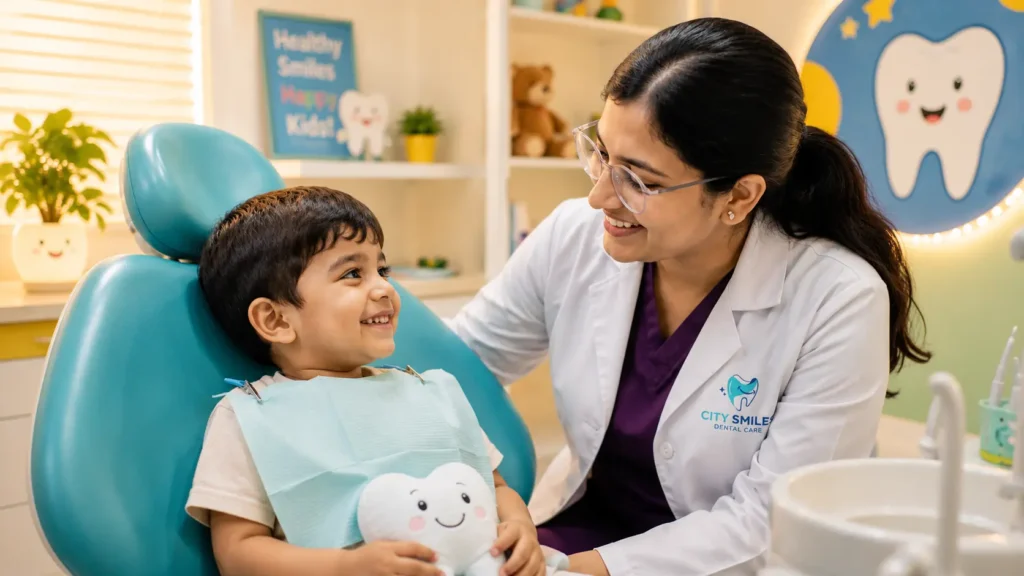
Most parents assume the first dental visit can wait until their child is old enough to “cooperate.” The reality is different.
The Indian Academy of Pediatrics recommends scheduling a child’s first dental visit by their first birthday, or within six months of the first baby tooth erupting — whichever comes first.
Early visits are not just about checking teeth. They help your child build comfort with the dental environment before any actual treatment is needed. They also allow the dentist to spot early signs of decay, assess jaw development, and give parents guidance on feeding habits, thumb-sucking, and fluoride needs.
Waiting too long — often until a problem arises — means the first visit becomes associated with discomfort rather than routine care. That association can persist for years.
Why the First Dental Visit Sets the Tone for Life
Research in pediatric dentistry is consistent on one point: a child’s earliest dental experiences shape their attitude toward oral healthcare as an adult.
Children who have calm, positive first visits are significantly more likely to attend regular dental checkups throughout their life. Children who experience a frightening or painful first visit are far more likely to avoid the dentist for years — sometimes decades — as adults.
This is why pediatric dentists approach a first visit differently. The goal is not to do as much as possible. It is to do as little as needed while building trust, familiarity, and a positive association with the dental chair.
At City Smiles Dental Care in South Kolkata, first visits for young children are handled with exactly this principle in mind — unhurried, gentle, and designed around the child’s comfort rather than clinical efficiency.
How to Prepare Your Child for the Dentist: Step-by-Step
Preparation begins at home, days before the appointment — not in the waiting room. These steps work for children between ages one and seven.
Start the Conversation Early
Mention the upcoming dentist visit casually and positively, at least three to five days before the appointment. Do not build it up dramatically in either direction — neither “it’s going to be so much fun!” nor “don’t worry, it won’t hurt.”
Keep it matter-of-fact: “We’re going to visit a dentist on Friday. She’s going to look at your teeth and make sure they’re healthy.”
Casual framing reduces the sense that the visit is a big deal — which is exactly the impression you want.
Choose the Right Words — and Avoid the Wrong Ones
The language you use around the dental visit matters more than most parents realise.
Words to avoid:
- Pain / hurt / needle / injection / drill
- “Don’t be scared” (implies there is something to be scared of)
- “It’ll be over quickly” (implies something unpleasant is coming)
- “Be brave” (same problem)
Phrases that work better:
- “The dentist will count your teeth.”
- “She’ll use a small mirror to look inside your mouth.”
- “They have a special chair that goes up and down.”
- “You might feel a little tickle.”
If your child asks directly whether it will hurt, be honest and calm: “It probably won’t. And if anything feels a bit odd, you can always tell me or the dentist.”
Play Dentist at Home
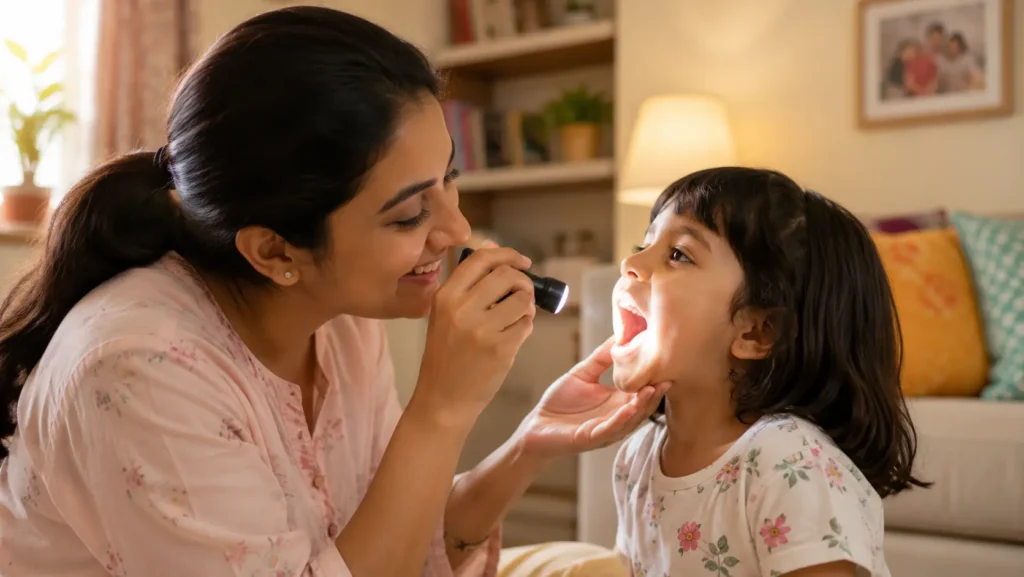
Role play is one of the most effective ways to reduce dental anxiety in young children. In the days before the appointment, take turns being “the dentist” and “the patient.”
Use a small flashlight to look inside each other’s mouths. Count teeth. Have your child recline on a bed and pretend you are checking their teeth. Let them do the same to you.
This normalises the physical experience of opening their mouth for someone else and removes the novelty — and fear — from the appointment.
Read Books or Watch Videos About the Dentist
Several children’s books explain dental visits in warm, age-appropriate ways. Look for titles that show the dentist as a friendly helper rather than a figure of authority.
Short, child-friendly videos on reputable sources can also help children know what to expect — the equipment, the chair, the lights. Familiarity reduces fear.
Avoid sharing dramatic or comedic “dentist fail” videos, even as humour. Children take these literally.
Plan the Visit for the Right Time of Day
Book morning appointments when possible. Most young children are better regulated, more cooperative, and less likely to be overtired or hungry in the morning.
Avoid scheduling right before nap time or after a missed meal. A hungry or exhausted child will find any situation harder to manage — including a dental visit.
What Happens at a Child’s First Dental Appointment?
Knowing what to expect removes the fear of the unknown for both parent and child.
A typical first dental visit for a young child includes:
- Welcome and familiarisation — The dental team introduces themselves and shows the child around the operatory. Equipment is named in child-friendly language.
- Seat and recline — The child sits in the dental chair, which may be raised or lowered. Many children find this genuinely enjoyable.
- Visual examination — The dentist gently looks inside the child’s mouth using a small mirror and light. No instruments cause discomfort at this stage.
- Tooth count — The dentist counts teeth and checks for early signs of decay, spacing issues, or developmental concerns.
- Gentle cleaning (if appropriate) — Depending on age and cooperation, a gentle polish may be done.
- Parent discussion — The dentist reviews findings with you and provides guidance on brushing technique, diet, fluoride, and what to watch for next.
- Positive send-off — The visit ends on a high note. Many child-friendly clinics offer a small sticker or certificate.
The entire visit typically takes 20 to 30 minutes for a cooperative child.
How to Handle Child Dental Anxiety on the Day
Even well-prepared children can become anxious at the last moment. Here is how to handle it.
Stay calm yourself. Children are highly attuned to parental anxiety. If you are tense, they will sense it. Take a breath before you enter the clinic.
Arrive a few minutes early. Rushing creates stress. Arriving early allows your child to observe the environment, settle in, and feel safe before anything happens.
Let them bring a comfort item. A favourite toy or a small stuffed animal can provide enormous reassurance.
Avoid over-reassuring. Saying “don’t worry” repeatedly signals that there is something to worry about. Stay neutral and cheerful instead.
Follow the dentist’s lead. Pediatric dentists are trained in behaviour management. Trust their approach, even if it involves asking you to sit slightly further back. Sometimes children cooperate better when they feel they are managing the situation independently.
Celebrate after — not before. Plan something small and enjoyable after the appointment — a favourite snack, a walk in a park. Do not promise it as a bribe beforehand, which implies the visit itself is an ordeal.
Common Mistakes Parents Make Before a First Dental Visit
| What Parents Often Do | Why It Backfires |
| Sharing their own dental fears with the child | Transfers anxiety directly |
| Saying “it won’t hurt” before anything is planned | Plants the idea of pain |
| Waiting for a dental problem before the first visit | Creates a fear-pain association |
| Bribing the child before the appointment | Signals the visit is unpleasant |
| Choosing a general dentist unfamiliar with children | Environment and approach matter |
| Booking a late afternoon slot when the child is tired | Fatigue lowers a child’s threshold |
Myths vs. Facts: Child Dental Visits
| Myth | Fact |
| Baby teeth don’t matter — they’ll fall out anyway | Baby teeth hold space for permanent teeth and affect speech, nutrition, and jaw development |
| Children only need a dentist when something is wrong | Prevention is far more effective (and less traumatic) than treatment |
| My child is too young for a dental visit | The first visit should happen by age one |
| A child screaming at the dentist will be traumatised | Pediatric dentists are trained for this; most children settle quickly |
| My child’s teeth look fine, so they’re fine | Decay between teeth or early enamel changes are not visible without examination |
What to Tell Your Child About the Dentist (and What Not To)
This section is worth printing and keeping on the fridge before the appointment.
Say this:
- “The dentist helps keep your teeth strong and clean.”
- “We’re just going to say hello and let her look at your teeth.”
- “You can sit on my lap if you want.” (Check with the clinic first.)
- “The dentist has seen lots and lots of children’s teeth — she’s very good at it.”
Don’t say this:
- “You have to go whether you like it or not.” (Creates opposition)
- “The dentist will take your teeth out if you don’t brush.” (Fear-based, inaccurate)
- “I hate the dentist too, but we have to go.” (Transfers anxiety)
- “Be good or the dentist will give you a needle.” (Please never say this.)
The dentist is not a consequence. The dentist is a healthcare professional your child will rely on for life.
FAQs
What is the right age for a child’s first dental visit? Most pediatric dentists recommend the first visit by the child’s first birthday, or within six months of the first baby tooth appearing. Early visits focus on familiarisation and guidance rather than treatment.
What if my child cries or refuses to cooperate during the dental visit? This is very common, especially at younger ages. Pediatric dentists are trained in behaviour management and child communication. A brief moment of upset rarely affects the quality of the examination and does not constitute a traumatic experience. The dental team will guide you on how to help.
How do I explain the dentist to a two-year-old? Keep it very simple: “The dentist is a doctor who looks after your teeth.” Show them a picture of a dental chair if possible. Role-play opening wide at home. Do not over-explain.
Should I stay with my child during the appointment? In most pediatric dental settings, parents are encouraged to be present, particularly for a first visit. The dentist may ask you to sit in a specific position so the child focuses on them. Follow the dentist’s guidance — they know what creates the most cooperative environment.
Can I book a first dental visit for my toddler even if there is nothing wrong? Absolutely, and this is strongly recommended. Preventive visits are far less stressful than treatment visits and help your child build a positive relationship with dental care from the start.
My child has seen me be scared of the dentist. Is it too late to fix that? Not at all. Children are resilient. Frame the upcoming visit positively, avoid reinforcing your own fear, and let the pediatric dentist do the work. A skilled, child-friendly dentist can overcome a lot of prior negative framing.
How often should a child visit the dentist? Once a healthy dental baseline is established, most children need dental checkups every six months. Your dentist will recommend a schedule based on your child’s individual risk factors.
What if my child has tooth pain before the first appointment? Contact the clinic immediately and mention it is urgent. Do not wait for a scheduled appointment if your child is in discomfort. Most dental clinics in South Kolkata, including City Smiles Dental Care, can accommodate dental emergencies.
Is fluoride safe for young children? Yes, in appropriate amounts. Your dentist will advise on fluoride toothpaste quantity and whether topical fluoride treatments are appropriate for your child’s age and decay risk.
What should I bring to my child’s first dental appointment? Bring any previous dental records if available, a list of medications your child takes, your child’s comfort item if they have one, and a parent or guardian who can provide full medical history.
Conclusion

The way a child experiences their first dental visit can influence their relationship with oral health for the rest of their life. The preparation you do at home — the words you choose, the role play, the calm you project — matters as much as anything that happens in the clinic.
To prepare your child for the dentist, start early, stay positive, and choose a clinic where the team genuinely understands how to work with young patients. In South Kolkata, families from Garia, Jadavpur, Tollygunge, Baghajatin, Santoshpur, and nearby areas trust City Smiles Dental Care for exactly this kind of experience.
A first dental visit done right is not just an appointment. It is the foundation of a lifetime of confident, healthy smiles.
Book Your Child’s First Dental Appointment
City Smiles Dental Care welcomes children of all ages for their first dental visits. Our team in South Kolkata creates a calm, unhurried environment designed to help young patients feel safe — and often even excited — about coming back.
You can also find us on Google Maps and read what South Kolkata families say about us: City Smiles Dental Care on Google