


Medically reviewed by [Dr. RajsheKhar Banerjee, BDS, MDS (Orthodontics)] · City Smiles Dental Care, South Kolkata · Updated October 2026
If your front teeth overlap, twist, or seem to be fighting for space, you are far from alone. Dental crowding is one of the most common reasons people visit an orthodontist, and it affects children, teenagers, and adults alike.
The encouraging part is that crowded teeth treatment now offers more choices than ever, from traditional braces to near-invisible clear aligners. This guide explains how crowding is assessed, which treatments suit which cases, how long correction takes, what it typically costs in Kolkata, and how to keep your results stable.
Quick answer: Crowded teeth are treated by first creating space in the jaw and then guiding the teeth into line, usually with braces or clear aligners. Space comes from gentle arch expansion, polishing tiny amounts of enamel between teeth (IPR), or, in severe cases, removing a tooth. Mild cases may take 6–12 months; severe cases 18–30 months. A clinical examination decides the right plan.
What Are Crowded Teeth?
Crowded teeth occur when there is not enough room in the jaw for all the teeth to sit in a straight line. The teeth then overlap, rotate, or get pushed forward or backward. Dentists call this dental crowding and grade it as mild, moderate, or severe, based on how many millimetres of space are missing.
Crowding is a type of malocclusion, meaning the teeth and bite do not line up as they should. It is the opposite of gaps between teeth, where the jaw has more room than the teeth need.
Patients often use “crowded teeth” and “crooked teeth” interchangeably. Strictly, a single tilted tooth is crooked, while crowding describes a space shortage across the arch.
How Severe Is Your Crowding?
| Severity | Space shortage (per arch) | What it usually looks like | Typical approach |
| Mild | Up to about 3 mm | Slight overlap of one or two front teeth | Clear aligners or braces; enamel polishing (IPR) often enough |
| Moderate | About 4–6 mm | Clearly overlapping teeth, some rotations | Braces or aligners, with IPR and/or arch expansion |
| Severe | More than 6 mm | Teeth blocked out of the arch, heavy overlap, a canine erupting high in the gum | Usually braces; extraction may be needed |
These ranges are a guide only. Your orthodontist measures the exact shortage from your X-rays and models or digital scans.
Why Do Teeth Become Crowded?
Teeth usually become crowded because of a mismatch between tooth size and jaw size, which is largely inherited. Early loss of baby teeth, prolonged thumb sucking, extra or impacted teeth, and natural age-related changes can also cause or worsen crowding. In adults, the lower front teeth often shift slowly over the decades.
- Genetics: relatively large teeth in a smaller jaw is the most common pattern.
- Early loss of baby teeth: neighbouring teeth drift into the gap and block the permanent tooth. This is why dentists use space maintainers for children.
- Childhood habits: thumb sucking, tongue thrusting, and mouth breathing can narrow the upper jaw.
- Extra or impacted teeth: a supernumerary tooth or a tooth that fails to erupt can disrupt the arch.
- Age-related drift: lower front teeth tend to crowd gradually with age, even in people who had braces but stopped wearing retainers.
- Gum disease: loss of bone support lets teeth splay and overlap.
Do Crowded Teeth Need Treatment?
Not every case of crowding needs treatment, but many do, because overlapping teeth trap plaque in places a toothbrush cannot reach, raising the risk of cavities and gum disease. Crowding can also cause uneven tooth wear, bite problems, and self-consciousness. Whether to treat is a personal decision, best made after an orthodontic examination.
Treatment is usually worth considering when:
- you cannot floss or clean properly between certain teeth
- gums bleed repeatedly around overlapped teeth
- a permanent tooth is blocked from coming in
- teeth are chipping or wearing unevenly, or your bite feels off
- the crowding is getting worse over time
- it affects your confidence when you smile, speak, or are photographed
Many adults say they stopped smiling in photos years ago. Others worry they are “too old”, or that braces will be painful and obvious at work. These concerns are real, and most of them have practical answers, which we cover below.
Crowded Teeth Treatment Options
The main crowded teeth treatment options are metal braces, ceramic braces, clear aligners, and lingual braces. All of them move teeth gradually using gentle, controlled pressure. The right choice depends on how severe the crowding is, your bite, your age, how visible you want the appliance to be, and your budget.
Metal Braces
Stainless steel brackets and wires remain the most versatile tooth crowding braces. They manage everything from mild overlap to severe crowding with rotated or blocked-out teeth, and they are usually the most affordable option.
The trade-offs are visibility, avoiding hard or sticky foods, and spending a few extra minutes on brushing.
Ceramic Braces
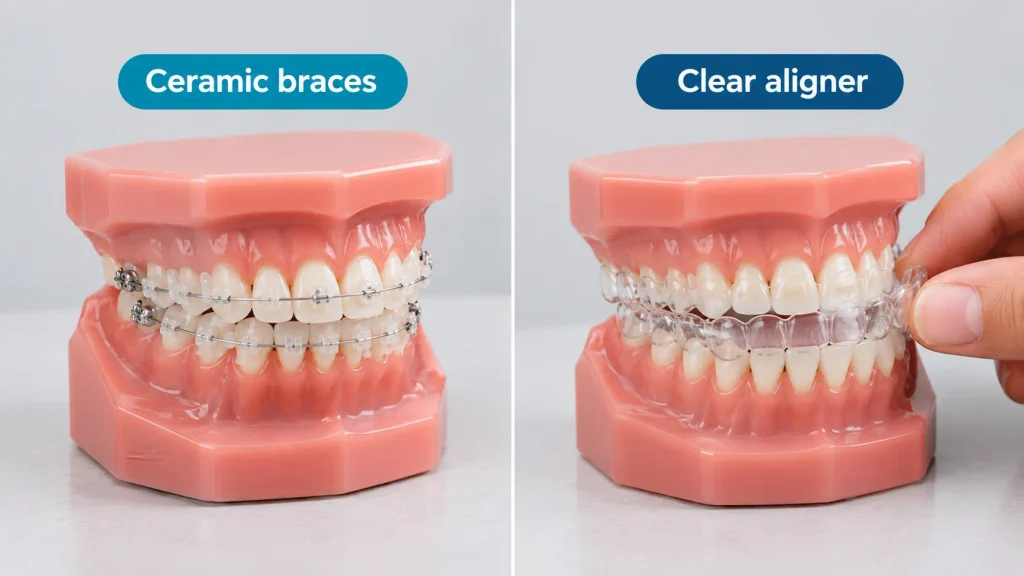
Tooth-coloured ceramic brackets work like metal braces but blend in with your teeth. They suit teenagers and adults who want a less noticeable fixed option.
The brackets are slightly bulkier and the elastic ties can stain with frequent tea or coffee. Our guide to ceramic vs metal braces compares them in detail.
Clear Aligners
Clear aligners are a series of removable, transparent trays, each moving the teeth a fraction of a millimetre. They work very well for mild to moderate crowding and are popular with college students and working professionals.
They must be worn 20–22 hours a day to work. Small tooth-coloured “attachments” are usually bonded to some teeth so the trays can grip, and complex crowding may still need braces or a combined approach.
Lingual Braces
Lingual braces are bonded to the back of the teeth, so they are hidden from view. They cost more, take longer to get used to (the tongue and speech need a few weeks to adapt), and are suitable only for certain cases.
Can Veneers Fix Crooked Teeth?
Veneers can disguise very mild crowding, but they do not move teeth and usually require removing some healthy enamel. For most patients, aligning the teeth first is the more conservative choice. Veneers or bonding can then be considered if shape or colour still needs refining.
How Orthodontists Create Space for Crowded Teeth
To straighten crowded teeth, an orthodontist must first create room for them. The main methods are arch expansion, interproximal reduction (IPR), moving back teeth slightly backward, and, in some cases, tooth extraction, and many plans combine them. The choice depends on how much space is needed, your facial profile, gum health, and whether your jaw is still growing.
- Arch expansion: In growing children, a palatal expander can widen the upper jaw itself. In adults, braces and aligners can achieve modest widening of the tooth arch, within the limits of the surrounding bone and gums.
- Interproximal reduction (IPR): A fraction of a millimetre of enamel is polished from between selected teeth. It is usually painless, needs no injection, and, done within safe limits, does not weaken the teeth.
- Distalisation: Back teeth are moved slightly backward to free up space in front, sometimes helped by small temporary anchorage screws.
- Extraction: In severe crowding, removing one tooth on each side (often a premolar) can be the healthiest way to fit the remaining teeth in line without pushing them too far forward.
Will I Need a Tooth Removed?
Most mild and moderate cases today are treated without extraction. It is usually considered only when the space shortage is large, the front teeth already stick out, or expansion would push teeth outside healthy bone.
A good orthodontist will always explain why before recommending it. If extraction is suggested, ask to see the space analysis and the alternatives that were considered.
Braces vs Clear Aligners for Crowded Teeth
Braces are generally the stronger choice for severe or complex crowding because the orthodontist controls every tooth continuously. Clear aligners suit mild to moderate crowding and are nearly invisible and removable, but they only work if worn 20–22 hours a day. Both can produce excellent results in the right case.
| Factor | Braces (metal or ceramic) | Clear aligners |
| Best for | All severities, including severe crowding and badly rotated teeth | Mild to moderate crowding; some complex cases with careful planning |
| Visibility | Metal visible; ceramic less noticeable | Nearly invisible |
| Removable | No | Yes, for eating and brushing |
| Discipline needed | Low (fixed in place) | High (20–22 hours daily wear) |
| Food restrictions | Avoid hard, sticky, chewy foods | None, as trays are removed to eat |
| Cleaning | More effort around brackets | Easier; trays cleaned separately |
| Review visits | About every 4–8 weeks | About every 6–10 weeks |
| Relative cost | Lower to moderate | Higher |
For a deeper look at this choice, read our comparison of clear aligners vs metal braces.
How Long Does Crowded Teeth Treatment Take?
Crowded teeth treatment usually takes between 6 and 30 months. Mild crowding may be corrected in 6–12 months, moderate crowding in 12–24 months, and severe crowding in 18–30 months or longer. Age, bone response, the need for extractions, and how consistently you follow instructions all affect the timeline.
| Severity | Typical active treatment | What can extend it |
| Mild | 6–12 months | Irregular aligner wear |
| Moderate | 12–24 months | Rotated teeth, IPR in stages |
| Severe | 18–30+ months | Extraction space closure, impacted canines, bite correction |
Missed appointments, broken brackets, and under-worn aligners are the most common reasons treatment overruns. Retention follows active treatment and continues long-term.
Crowded Teeth Treatment Cost in Kolkata
In Kolkata, crowded teeth treatment generally costs about ₹25,000–₹60,000 with metal braces, ₹40,000–₹90,000 with ceramic braces, and ₹70,000–₹2,50,000 or more with clear aligners. The final fee depends on the severity of crowding, treatment length, the appliance chosen, and whether extractions or retainers are included.
| Option | Approximate range in Kolkata | Notes |
| Metal braces | ₹25,000 – ₹60,000 | Most economical; suits all severities |
| Ceramic braces | ₹40,000 – ₹90,000 | Less visible fixed option |
| Clear aligners | ₹70,000 – ₹2,50,000+ | Varies with number of trays and system |
| Lingual braces | ₹1,50,000 – ₹3,00,000+ | Hidden; limited availability |
These are general market ranges across Kolkata, not City Smiles Dental Care’s fixed fees.
What usually affects the final cost:
- severity of crowding and expected duration
- appliance type and aligner system
- X-rays, scans, and records
- extractions, IPR, or expanders
- retainers after treatment
You will receive a clear, itemised estimate after your consultation and records. For aligner-specific pricing, see our guide to clear aligners cost in Kolkata.
Crowded Teeth in Children vs Adults
Children can often have crowding managed while their jaws are still growing, which may reduce the complexity of later treatment. Adults cannot change jaw growth, but they can straighten crowded teeth at almost any age as long as their gums and supporting bone are healthy. Adult treatment may take slightly longer.
Children (Around Ages 7–12)
An orthodontic check-up around age 7 helps spot crowding early. Interceptive steps such as palatal expansion, space maintainers, or guiding erupting teeth can create room before permanent teeth settle into crowded positions.
Not every child needs early treatment. Sometimes the right advice is simply to monitor growth, which is something a responsible orthodontist will tell you honestly. Read more about braces for children.
Teens and Adults
Full braces or aligner treatment usually starts once most permanent teeth have erupted, typically around ages 11–14. Adults now make up a large share of orthodontic patients.
Before treatment begins, any cavities or gum problems must be treated. Moving teeth through inflamed gums can accelerate bone loss, so a healthy foundation comes first.
Your Treatment Journey at City Smiles Dental Care
Treatment at City Smiles Dental Care begins with a detailed examination and ends with a retention plan that keeps your teeth straight. In between, your orthodontist designs a personalised plan, fits your braces or aligners, and reviews your progress at regular visits. Here is what each stage typically involves.
- Consultation: We discuss what bothers you and examine your teeth, gums, bite, and jaw joints.
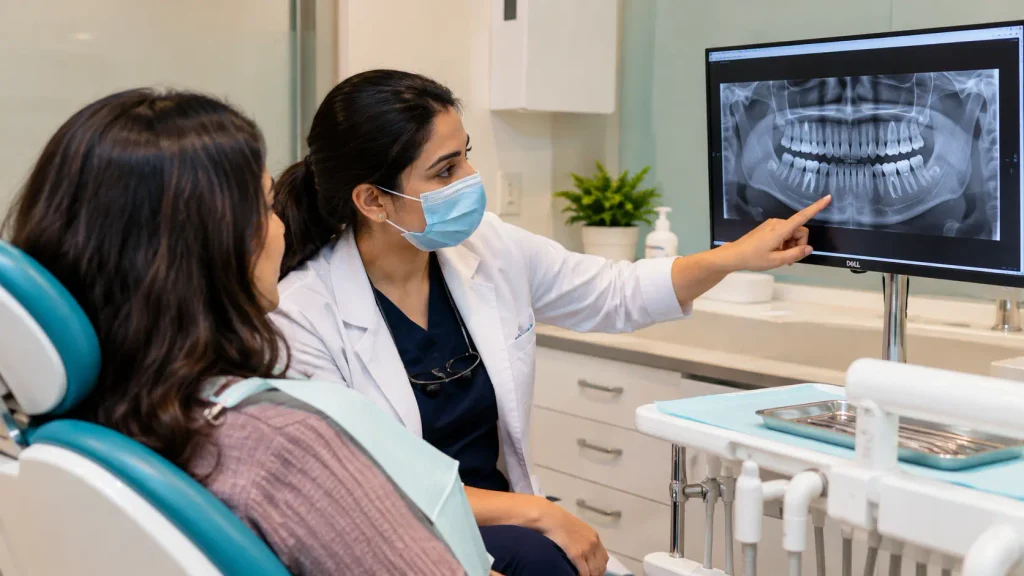
- Records: X-rays (usually an OPG, plus a side-view X-ray when the bite needs analysis), photographs, and impressions or a digital scan.
- Treatment plan: We explain the space analysis, your options with pros and cons, the expected timeline, and an itemised cost estimate. You choose what suits you.
- Preparation: Cleaning, fillings, gum care, or planned extractions are completed first.
- Active treatment: Braces are fitted or your first aligners delivered. Mild soreness for 2–4 days is normal and eased with soft foods and pain relief your dentist recommends.
- Progress visits: Adjustments or new aligner sets every few weeks.
- Retention: Retainers are fitted the day treatment ends.
Two illustrative examples show why plans differ. A 26-year-old who commutes to work from Garia worries about visible braces in client meetings, and struggles to floss her overlapping lower front teeth. With mild-to-moderate crowding and healthy gums, she may be a good candidate for clear aligners with minor IPR.
A 13-year-old from Baghajatin, by contrast, has an upper canine erupting high in the gum because there is no room for it. Fixed braces are usually the more predictable way to create space and guide that tooth into the arch.
Keeping Teeth Straight After Treatment
Teeth tend to drift back toward their old positions after braces or aligners, a process called relapse. Wearing your retainer as instructed is the single most important step in protecting your result. Many orthodontists now advise long-term, often lifelong, night-time retainer wear, especially for previously crowded lower front teeth.
| Fixed retainer | Removable retainer | |
| What it is | Thin wire bonded behind the front teeth | Clear tray or wire-and-acrylic plate |
| Advantages | Works all day without effort | Easy to clean around; simple to replace |
| Limitations | Needs careful flossing; wire can come loose | Works only when worn; can be lost or damaged |
Many patients receive both. If crowding has already returned because a retainer was stopped years ago, retreatment is usually simpler and shorter, often with aligners.
Myths vs Facts About Crowded Teeth
Many patients put off crowded teeth treatment because of something they heard from friends, family, or online. Here are the misconceptions we hear most often from patients across South Kolkata, alongside what current dental evidence and everyday clinical experience actually show.
| Myth | Fact |
| “I’m too old for braces.” | Age is not the barrier; gum and bone health is. Many patients start treatment in their 30s, 40s, or later. |
| “My wisdom teeth caused the crowding, so removing them will fix it.” | Research does not support wisdom teeth as the main cause of front-teeth crowding. They may need removal for other reasons, but that alone will not straighten teeth. |
| “Crowded teeth are only a cosmetic issue.” | Overlapping teeth are harder to clean, which raises the risk of decay and gum disease. |
| “Clear aligners can’t treat real crowding.” | They correct most mild-to-moderate crowding well. Severe cases may still be better suited to braces. |
| “Braces damage teeth.” | Well-managed treatment does not weaken teeth. Poor cleaning during treatment is what causes white spots and decay. |
| “Once teeth are straight, they stay straight.” | Without retainers, teeth commonly drift and crowding can return. |
| “My child’s teeth will straighten on their own.” | Slight crowding in young children sometimes improves with growth, but true crowding of permanent teeth rarely corrects itself. |
Frequently Asked Questions
Can crowded teeth be fixed without braces?
Mild crowding can often be corrected with clear aligners, a removable alternative to braces. Veneers or bonding can disguise very minor irregularities but do not move the teeth. Moderate to severe crowding usually needs braces or aligners to correct the underlying alignment properly.
Is crowded teeth treatment painful?
Most patients feel mild pressure or soreness for two to four days after braces are fitted, adjusted, or a new aligner set begins. Soft foods and pain relief recommended by your dentist usually help. Enamel polishing (IPR) is generally painless and does not need an injection.
Can adults get crowded teeth fixed?
Yes, adults can straighten crowded or crooked teeth at almost any age, provided the gums and supporting bone are healthy. Any gum disease or cavities are treated first. Adult treatment can take slightly longer because the jaw is no longer growing, but results can be just as good.
Do overlapping teeth always need extraction?
No. Most mild and moderate cases of overlapping teeth are treated without extraction, using arch expansion or enamel polishing to create space. Extraction is usually considered only for severe crowding, protruding front teeth, or when expansion would move teeth outside healthy bone.
How long do I need to wear a retainer after treatment?
Many orthodontists recommend long-term, often lifelong, retainer wear, usually at night after an initial period of full-time wear. Teeth keep shifting slightly throughout life, so stopping retainers commonly allows crowding to return, especially in the lower front teeth.
Can crowding come back after braces?
Yes, crowding can return if retainers are not worn as advised, and lower front teeth naturally tend to crowd slightly with age. Consistent retainer wear greatly reduces this risk. If relapse does happen, retreatment is usually shorter and simpler than the original treatment.
At what age should my child be checked for crowded teeth?
An orthodontic check-up around age 7 is widely recommended. By then, the first permanent molars and incisors have usually erupted, so early signs of crowding or jaw narrowing are visible. Early assessment does not always mean early treatment; often the advice is simply to monitor growth.
Are clear aligners better than braces for crooked teeth?
Neither is better for everyone: clear aligners are nearly invisible and removable, making them ideal for mild to moderate cases in disciplined patients. Braces give more control for severe crowding, rotated teeth, and complex bite problems. Your orthodontist will recommend what suits your specific case.
How should I clean crowded teeth before treatment?
Brush twice daily with fluoride toothpaste and clean between teeth every day using floss, interdental brushes, or a water flosser for tight overlaps. Professional cleanings every six months help remove hardened deposits in hard-to-reach areas. Good hygiene before treatment also makes orthodontics safer.
Conclusion
Crowded teeth are common, treatable, and correctable at almost any age. The best crowded teeth treatment for you depends on how much space is missing, your bite, your gum health, and your lifestyle. Braces, clear aligners, and careful space creation each have a place.
What matters most is an honest assessment. No responsible clinic can promise a specific result before examining you, and every good outcome starts with a careful clinical exam and a plan you fully understand.
Book Your Crowding Assessment in South Kolkata
If overlapping or crooked teeth are bothering you, the first step is simply finding out where you stand. At City Smiles Dental Care, we assess your crowding, explain every suitable option in plain language, and give you an itemised estimate, so you can decide with confidence and in your own time.
We welcome patients from Garia, Baghajatin, Jadavpur, Tollygunge, Santoshpur, Dhakuria, and across South Kolkata.
- Book online: Schedule your orthodontic consultation
- Call us: 062890 04840
- Find us: Get directions and read patient reviews on Google
This article is for general information and does not replace a personal dental examination. Treatment recommendations depend on clinical assessment.