


Few dental topics carry as much misinformation as gum health, and believing the wrong thing can quietly cost you your teeth. Many of the most common gum disease myths sound reasonable, which is exactly why they are dangerous. They convince people to wait, to brush harder, or to avoid the dentist until the damage is advanced.
At City Smiles Dental Care in South Kolkata, we regularly meet patients who delayed treatment because of a belief they picked up somewhere along the way. This guide separates the myths from the gum disease truths, so you can make calm, informed decisions about your own mouth.
Gum Disease, in Plain Terms
Gum disease is an infection and inflammation of the tissues that hold your teeth in place. It begins as gingivitis, a reversible irritation of the gums, and can progress to periodontitis, where the supporting bone starts to break down. It is one of the leading reasons adults lose teeth, yet it is largely preventable.
Quick answer: Gum disease is a bacterial infection of the gums and supporting bone. Caught early as gingivitis, it is reversible. Left untreated, it can advance to periodontitis and cause permanent bone loss and tooth loss. Early signs include bleeding, swelling and persistent bad breath.
10 Gum Disease Myths vs The Facts
Below are the ten beliefs we hear most often, each paired with the fact that matters.
Myth 1: Bleeding gums are normal
Fact: Healthy gums do not bleed when you brush or floss properly. Bleeding is usually the earliest sign of gingivitis, caused by plaque building up along the gumline. It is your body flagging inflammation, not a harmless quirk. The good news is that early bleeding often settles within one to two weeks of improved cleaning and a professional check.
Myth 2: Gum disease only affects older people
Fact: Gum disease can begin at almost any age. Gingivitis is common in teenagers and young adults, and hormonal changes during puberty or pregnancy can make gums more reactive. While advanced periodontitis is more common with age, the early stages often start decades earlier. Age is a risk factor, not an entry requirement.
Myth 3: If nothing hurts, my gums are healthy
Fact: Gum disease is often called a “silent” condition because it is usually painless until it is advanced. Bone can be lost without any ache at all. By the time teeth feel loose or sore, significant damage may already be done. This is exactly why routine check-ups matter more than waiting for pain.
Myth 4: Gum disease only harms your mouth
Fact: Research has linked gum disease with several whole-body health conditions, including diabetes, heart disease and complications in pregnancy. The relationship with diabetes is especially well documented and works in both directions: poorly controlled blood sugar worsens gum health, and gum infection can make blood sugar harder to manage. These are associations that researchers continue to study, but they are a strong reason to take gum infection facts seriously.
Myth 5: Scaling loosens teeth and creates gaps
Fact: This is one of the most damaging periodontitis myths. Professional scaling removes hardened tartar that brushing cannot shift. When heavy tartar is cleared, teeth can briefly feel different and small gaps may appear, but those gaps were already there, hidden under deposits and caused by prior gum recession. Scaling does not loosen healthy teeth; it helps save them.
Myth 6: Brushing harder cleans gums better
Fact: Pressure is not the same as cleanliness. Aggressive brushing with a hard brush can wear down enamel and push the gums back, causing sensitivity and recession. Gentle, thorough brushing twice a day with a soft brush, combined with daily cleaning between the teeth, protects gums far better than force.
Myth 7: Mouthwash can cure gum disease
Fact: Mouthwash can freshen breath and reduce surface bacteria, but it cannot remove plaque and tartar from below the gumline, and it cannot reverse an established infection. It is a helpful add-on, never a substitute for brushing, interdental cleaning and professional care. Relying on it alone often masks a problem that keeps progressing.
Myth 8: Gum disease cannot be reversed, so why bother
Fact: It depends on the stage. Gingivitis, the early stage, is reversible with proper cleaning and a professional scaling. Periodontitis cannot be fully reversed because lost bone does not regrow on its own, but it can be stopped and controlled so you keep your teeth for life. Doing nothing is the only option that guarantees it gets worse.
Myth 9: Only smokers and careless people get it
Fact: Smoking is a major risk factor, and smokers often have more severe disease, partly because smoking can hide the bleeding that would otherwise warn them. But plenty of non-smokers with good habits develop gum disease too. Genetics, diabetes, certain medications, hormonal changes and stress all influence your risk. Gum disease is not simply a sign of neglect.
Myth 10: Losing teeth is a normal part of ageing
Fact: Tooth loss is not an inevitable milestone of getting older. With healthy gums and regular care, your natural teeth can last a lifetime. When older adults lose teeth, untreated gum disease is one of the most common reasons, not age itself. Protecting your gums is one of the most effective ways to keep your own teeth.
Quick Myths vs Facts Table
| The Myth | The Fact |
| Bleeding gums are normal | Bleeding is an early warning sign of gingivitis |
| Only older people get it | It can start in the teens and twenties |
| No pain means healthy gums | Gum disease is usually painless until advanced |
| It only affects the mouth | It is linked with diabetes and other conditions |
| Scaling damages teeth | Scaling removes tartar and helps save teeth |
| Harder brushing is better | Gentle, thorough cleaning protects gums |
| Mouthwash cures it | Mouthwash supports care but cannot cure it |
| It can never be reversed | Early gingivitis is reversible |
| Only smokers get it | Many factors raise risk, smoking is one |
| Tooth loss is just ageing | Healthy gums can keep teeth for life |
Warning Signs You Should Never Ignore
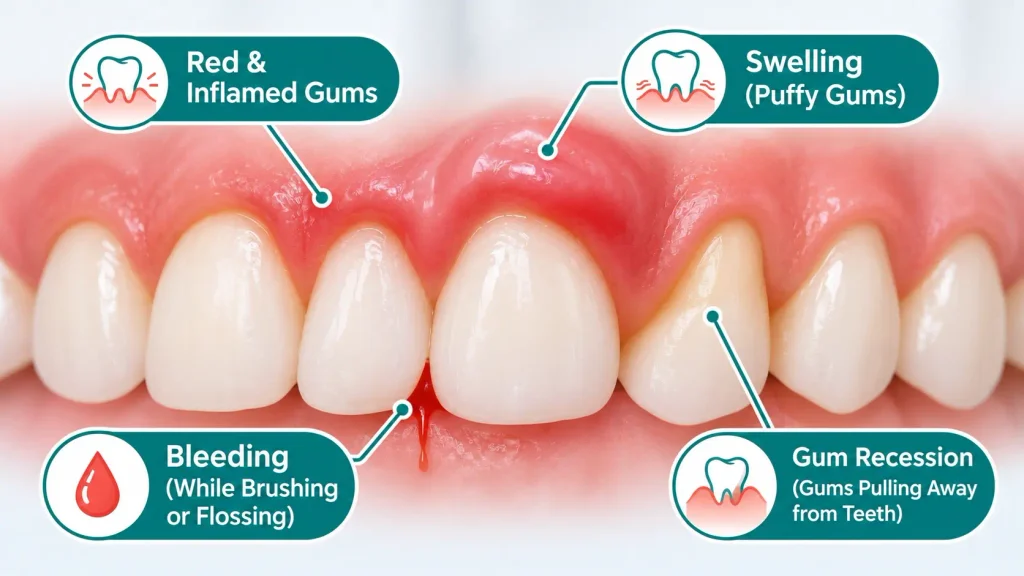
Knowing the gum disease truths is only useful if you also recognise the signals. See a dentist if you notice any of the following.
- Gums that bleed when brushing or flossing
- Red, swollen or tender gums
- Persistent bad breath or a bad taste
- Gums that are pulling away from the teeth
- Teeth that feel loose or have shifted
- Pus between the teeth and gums
- A change in how your teeth fit together when you bite
One symptom on its own is not a diagnosis, but it is a reason to get checked.
How Gum Disease Is Diagnosed and Managed
A reliable assessment is clinical, not guesswork. During an examination, a dentist checks the depth of the small spaces between your gums and teeth, looks for bleeding and recession, and may take X-rays to see the level of supporting bone. This is the only dependable way to confirm the stage of gum disease.
Management depends on what is found. Early cases are usually handled with a professional cleaning (scaling) and improved home care. More advanced cases may need deeper cleaning below the gumline and a structured review plan, and in some situations a referral for specialised periodontal care. At City Smiles Dental Care, treatment recommendations are always based on a proper clinical examination and a personalised plan, never a one-size-fits-all script.
Gum Care for Patients in South Kolkata
If you live in South Kolkata, including Garia, Baghajatin, Jadavpur, Tollygunge, Santoshpur or Dhakuria, you do not have to guess whether your gums are healthy. A short check-up can tell you exactly where you stand and save you from acting on a myth.
Our team focuses on clear communication and gentle, patient-friendly care, so you leave understanding your own mouth rather than more confused than when you arrived.
Ready to get the facts about your own gums?
- Book an appointment online through our appointment page.
- Find us and read patient reviews on our Google Business Profile.
- Call the clinic at +91 6289 004 840 to ask a question or schedule a visit.
A single check-up is far cheaper, and far less stressful, than treating gum disease once it is advanced.
Frequently Asked Questions
Are bleeding gums a sign of gum disease? Often, yes. Bleeding during brushing or flossing is the most common early sign of gingivitis. It is not normal for healthy gums, so it is worth a dental check rather than ignoring it.
Is gum disease reversible? The early stage, gingivitis, is reversible with good cleaning and a professional scaling. The advanced stage, periodontitis, can be controlled and stopped from worsening, but lost bone does not regrow on its own.
Can young people get gum disease? Yes. Gingivitis is common in teenagers and young adults, and hormonal changes can make gums more prone to inflammation. Early habits strongly influence long-term gum health.
Does scaling damage or loosen teeth? No. Scaling removes hardened tartar that drives infection. Any gaps or sensitivity that appear afterwards were usually masked by that tartar, not caused by the cleaning.
Can gum disease affect the rest of my body? Research links gum disease with conditions such as diabetes, heart disease and pregnancy complications. The connection with diabetes is particularly strong and runs both ways, which is a good reason to treat gum health seriously.
Can mouthwash cure gum disease? No. Mouthwash can help control surface bacteria and freshen breath, but it cannot remove tartar below the gumline or reverse an active infection. It supports care but does not replace it.
How often should I get my gums checked? Many people benefit from a check-up and professional cleaning around every six months, though your dentist may suggest a different interval based on your individual risk.
Is bad breath always caused by gum problems? Not always, but persistent bad breath is frequently linked to bacteria associated with gum disease. If it does not improve with good oral hygiene, it is worth a dental assessment.
Final Word
Most gum disease myths share one thing in common: they give you permission to wait. Bleeding gums get dismissed, pain-free mouths get assumed to be healthy, and scaling gets avoided out of fear. The gum disease truths point the other way. Early action is simple, it works, and it protects both your teeth and your wider health.
If anything in this article sounded familiar, treat it as a nudge. A quick, honest assessment at City Smiles Dental Care in South Kolkata will tell you what is really happening with your gums, so you can stop believing the myths and start protecting your smile.