


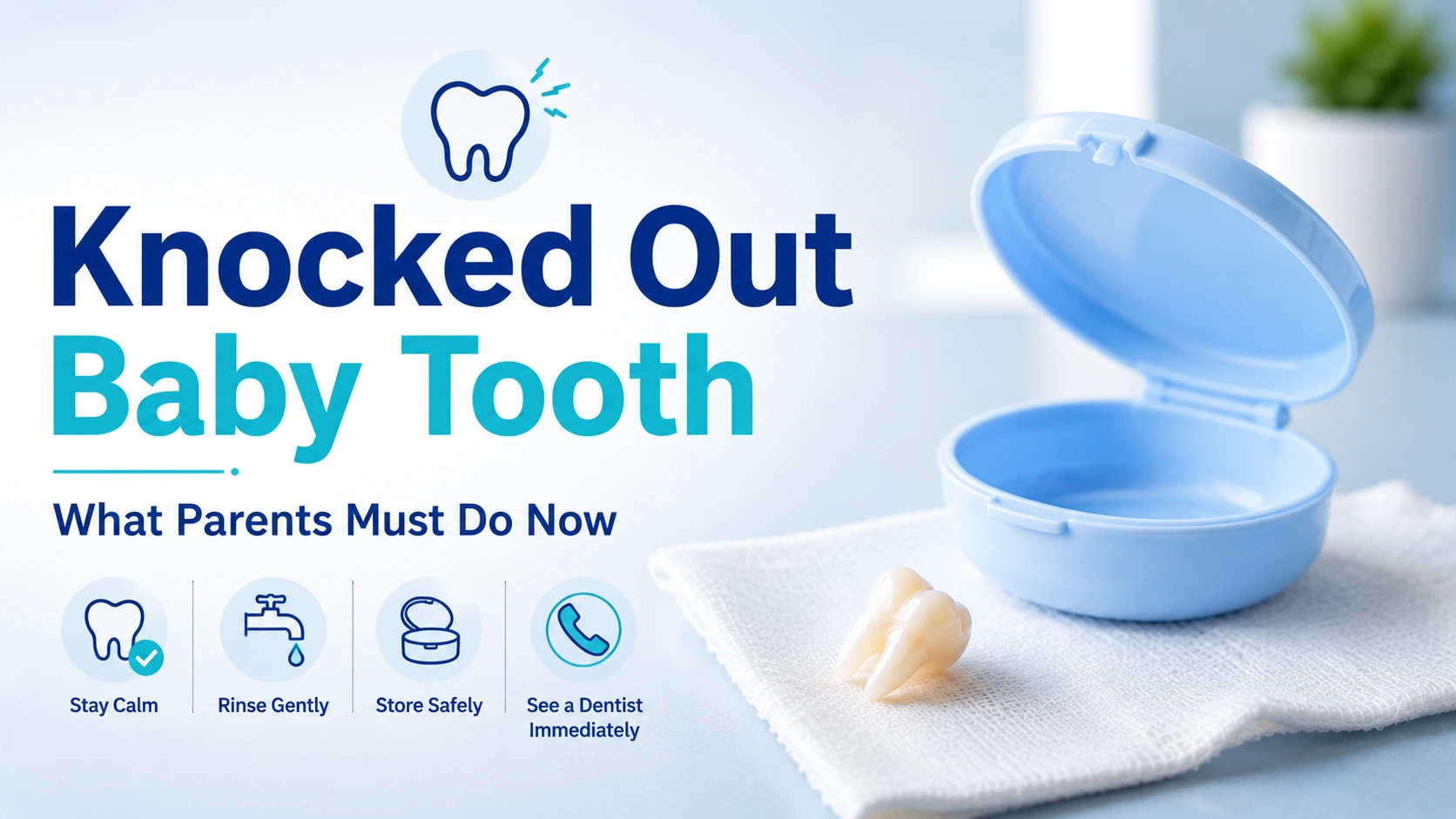
It happens in a split second. Your child trips on the playground, tumbles off a bicycle, or collides with another child — and suddenly there is a tooth in your hand and a very distressed child in front of you.
A knocked-out baby tooth is one of the most common dental emergencies in children. It is frightening for parents, but with the right information, you can handle it calmly and protect your child’s long-term dental health.
This guide tells you exactly what to do — and what not to do — when a knocked out baby tooth emergency strikes.
What Actually Happens When a Baby Tooth Gets Knocked Out
When a tooth is knocked out completely, dentists refer to it as an avulsed tooth. In adults and older children with permanent teeth, avulsion is treated as an urgent emergency requiring immediate replantation.
Baby teeth are different. The treatment approach is almost the opposite.
A baby tooth sits above a developing permanent tooth bud. Interfering with the socket — particularly attempting to push the tooth back in — can damage that developing bud and cause serious problems with the adult tooth that will eventually emerge. This is why child dental trauma guidelines are very specific: for primary (baby) teeth, do not replant.
The Most Important Rule — Do NOT Replant a Baby Tooth
If there is one thing to remember from this entire guide, it is this: never attempt to put a knocked-out baby tooth back into the socket.
This is the single most common mistake panicked parents make, especially those who have read general advice about adult tooth avulsion.
Why Replanting Is Dangerous for Baby Teeth
The permanent tooth bud sits directly below the baby tooth’s root. Forcing a knocked-out primary tooth back into the socket risks:
- Damaging the permanent tooth bud — potentially causing discolouration, malformation, or delayed eruption of the adult tooth
- Introducing bacteria — increasing the risk of socket infection
- Causing additional trauma — to already injured gum tissue
Leave replantation decisions entirely to a dentist.
What to Do in the First 5 Minutes (Step-by-Step)
Child dental trauma is distressing for everyone involved. A calm, methodical response makes all the difference.
Step 1: Stay calm. Your child will mirror your emotional response. A composed parent immediately reduces the child’s fear.
Step 2: Stop the bleeding. Apply gentle pressure to the socket using a clean piece of gauze or a soft cloth. Have your child bite down gently on it for 10 to 15 minutes.
Step 3: Check for other injuries. Look carefully at your child’s mouth, lips, and gums. Check for other displaced or chipped teeth. If your child lost consciousness, vomited, or is confused, go to the nearest emergency hospital first — these are signs of a possible concussion or head injury.
Step 4: Find the tooth. Pick it up carefully. Hold it by the crown (the white, flat top surface), not the root. Do not scrub or wipe the root.
Step 5: Store the tooth correctly. Place it in a small container of cold milk or saline solution. If neither is available, keep it moist inside the child’s cheek (only if the child is old enough not to swallow it) or in a small cup of water. Bring it to the dentist — your dentist needs to examine it to confirm the entire tooth came out cleanly and no root fragment remains in the socket.
Step 6: Contact your dentist immediately. Even though baby teeth are not replanted, you still need a professional assessment. Call City Smiles Dental Care or head to the clinic as soon as possible.
What to Do With the Knocked-Out Tooth
Many parents instinctively rinse the tooth vigorously under a tap or scrub it clean. Resist this urge.
| What to Do | What NOT to Do |
| Hold the tooth by the crown | Touch or scrub the root |
| Store in cold milk or saline | Rinse aggressively under running water |
| Bring it to the dentist | Attempt to push it back in the socket |
| Keep it moist | Let it dry out or wrap it in tissue |
The dentist needs the tooth to examine whether it came out whole. A broken root tip left behind in the socket requires careful management to protect the permanent tooth below.
Signs Your Child Needs Immediate Emergency Dental Care
For a straightforward knocked-out baby tooth in an otherwise well child, you should see a dentist within 24 hours. However, certain situations require you to seek care immediately — including a visit to hospital emergency services if necessary.
Seek urgent care right away if your child:
- Is bleeding heavily and the bleeding does not slow after 15 minutes of pressure
- Has lost consciousness, even briefly
- Appears confused, drowsy, or is vomiting
- Has obvious fractures to the jaw, face, or other teeth
- Shows swelling spreading to the eye or neck area
- Is in severe or uncontrolled pain
These can indicate a head injury, jaw fracture, or serious infection — all of which need immediate medical attention before the dental visit.
Will a Knocked-Out Baby Tooth Affect Permanent Teeth?
This is the question parents ask most, and understandably so.
In most cases, the answer is reassuring: a knocked-out baby tooth does not permanently affect the adult tooth, provided the socket heals cleanly and there is no deep infection or damage to the underlying bud.
However, if the trauma was severe — particularly if the root fragment was left behind or if infection developed — the permanent tooth may sometimes show:
- Minor discolouration
- Small white or yellowish markings (Turner’s hypoplasia)
- Slightly delayed eruption
Your dentist will monitor the area with follow-up X-rays as the permanent tooth develops. Early observation significantly reduces the risk of complications.
Myths vs. Facts About Baby Tooth Trauma
| Myth | Fact |
| “Just push the baby tooth back in — it’ll be fine.” | Never replant a knocked-out baby tooth. It can damage the permanent tooth developing below. |
| “It’s only a baby tooth — we don’t need to see a dentist.” | A dentist must examine the socket to check for retained root fragments and assess the permanent tooth bud. |
| “The adult tooth will come out wrong now.” | In most cases, the permanent tooth erupts normally, especially with prompt and proper care. |
| “Rinsing the tooth under the tap will clean and save it.” | Aggressive rinsing strips vital cells from the root surface — but for baby teeth, the goal is simply to preserve it for examination, not replantation. |
| “Milk is too ordinary to store a tooth in — they’re just saying that.” | Cold milk is genuinely one of the best short-term storage media for teeth because its pH and protein content help preserve cellular viability. |
What Happens at the Dentist After Child Dental Trauma
Knowing what to expect at the clinic helps reduce anxiety for both parent and child.
A paediatric-trained dentist will typically:
- Examine the socket to confirm the entire tooth and root came out. If any fragment remains, it may need to be carefully removed.
- Take an X-ray to assess the permanent tooth bud below and check for any bone injury.
- Clean and dress the area if there is significant gum injury.
- Assess neighbouring teeth for signs of trauma, loosening, or damage — a knocked-out tooth is rarely the only one affected.
- Advise on follow-up monitoring, which typically involves periodic X-rays as the permanent tooth develops.
The visit is usually calm and straightforward. Most children tolerate it well once the initial shock passes.
Emergency Pediatric Dental Care in South Kolkata
If your child has experienced a knocked-out baby tooth or any form of child dental trauma, City Smiles Dental Care is here to help.
We provide emergency pediatric dental assessments for families across South Kolkata — including Garia, Jadavpur, Baghajatin, Tollygunge, Santoshpur, Dhakuria, and surrounding neighbourhoods.
Our approach is built around making young patients feel safe and comfortable, even in stressful situations. We understand that a child who has just been through dental trauma needs gentleness, patience, and expertise — not a clinical environment that adds to the anxiety.
If your child has had an avulsed tooth or any dental injury, do not wait. Book an appointment or find us on Google Maps for directions and contact details.
Frequently Asked Questions
1. My child’s baby tooth was knocked out. Should I put it back in the socket? No. Unlike adult teeth, knocked-out baby teeth should never be replanted. The permanent tooth bud sits directly beneath the socket, and forcing a tooth back in can damage it. Contact a dentist promptly, but do not attempt replantation.
2. Do I need to go to a dentist if it is just a baby tooth? Yes. A dental visit is necessary to confirm the entire tooth came out cleanly, to examine the socket, and to take an X-ray of the developing permanent tooth below. Do not skip the appointment because it is “only a baby tooth.”
3. What is the best way to store a knocked-out baby tooth? Place it in a clean container of cold milk or saline. If those are unavailable, a small cup of water will do. The goal is to keep it moist and bring it to the dentist for examination — not for replantation.
4. How quickly do we need to see a dentist after a knocked-out baby tooth? Within 24 hours is ideal for a straightforward case. Sooner if there is heavy bleeding that will not stop, signs of head injury, severe pain, or visible damage to other teeth or the jaw.
5. Will a knocked-out baby tooth affect my child’s adult teeth? In most cases, no. Permanent teeth usually erupt normally. In rare cases of significant socket damage or infection, there may be minor discolouration or slight delays in eruption. Your dentist will monitor the area with X-rays.
6. My child is in pain after the tooth fell out. What can I give them? A child-appropriate dose of paracetamol (as directed on the packaging for their age and weight) can help manage discomfort. Avoid ibuprofen if there is active bleeding. Do not give aspirin to children. Contact your dentist to discuss the situation.
7. There is still something in the socket — is that part of the tooth? It could be a root fragment, which is a real possibility if the tooth did not come out cleanly. Do not attempt to remove it yourself. See a dentist immediately so it can be properly examined and managed.
8. My child swallowed the tooth. Is that dangerous? In most cases, swallowing a tooth is not dangerous — it will pass through the digestive system. However, you should confirm with a doctor if there is any possibility the tooth was inhaled (aspirated) rather than swallowed, as this is a medical emergency.
9. What if there is a lot of bleeding from the socket? Apply gentle but firm pressure using a clean piece of gauze or cloth. Have your child bite down on it and hold for 10 to 15 minutes without peeking. If bleeding continues after 20 to 30 minutes of consistent pressure, go to an emergency department.
10. Is there anything I can do to prevent tooth injuries in my child? Mouthguards are highly effective protection during contact sports, cycling, and activities with fall risk. Ask your dentist about a custom-fitted mouthguard — they are more comfortable and offer better protection than over-the-counter options.
Conclusion
A knocked out baby tooth is a frightening moment for any parent — but it does not have to become a dental crisis. The single most important thing to remember is to stay calm, stop the bleeding, and do not attempt to replant the tooth. Bring your child and the tooth to a dentist as soon as possible.
Child dental trauma is best managed promptly. A professional assessment not only addresses the immediate injury but also protects the permanent teeth developing beneath the surface.
At City Smiles Dental Care, we treat children’s dental emergencies with the care, calm, and clinical expertise that every young patient deserves. Families across South Kolkata — from Garia and Jadavpur to Tollygunge, Baghajatin, and Santoshpur — trust us with their children’s dental health.
If your child has had a baby tooth knocked out or experienced any dental trauma, book an appointment online today. We are here to help.