


If you’ve noticed your child’s teeth coming in crooked, or your dentist has mentioned an overbite, you’re probably asking the same question every parent asks first: Do my child’s teeth really need braces — and if so, when?
It’s a fair question. Braces for children are a significant commitment — of time, money, and your child’s comfort. Before you make any decision, you deserve a clear, honest answer, not a sales pitch.
This guide covers everything parents need to know about kids’ braces — the right age to start, the types available, what treatment actually involves, and how to find the right orthodontic care in South Kolkata.
Why Orthodontic Timing Matters for Children
Orthodontic treatment for children isn’t simply about aesthetics. Misaligned teeth and bite problems — left untreated — can lead to uneven wear on tooth enamel, difficulty chewing, speech issues, and even jaw discomfort over time.
The good news: children’s jaws are still growing. This makes it significantly easier to guide teeth into proper alignment during childhood than during adulthood. The right intervention at the right time can reduce the complexity and duration of future treatment considerably.
Signs Your Child May Need Braces
No parent can diagnose this at home — only a clinical evaluation can confirm it. But there are signs worth watching for:
- Crowded or overlapping teeth — when permanent teeth come in without enough space
- Teeth that don’t meet properly — an overbite, underbite, or crossbite
- Gaps between teeth that appear wider than expected
- Thumb-sucking or tongue-thrusting habits that have continued beyond toddler years
- Early or late loss of baby teeth
- Difficulty biting or chewing certain foods
- Mouth breathing or frequent speech difficulties
If you’ve noticed any of these in your child, an orthodontic assessment is a sensible next step — even if treatment doesn’t begin immediately.
The Right Age for Braces — What the Research Says
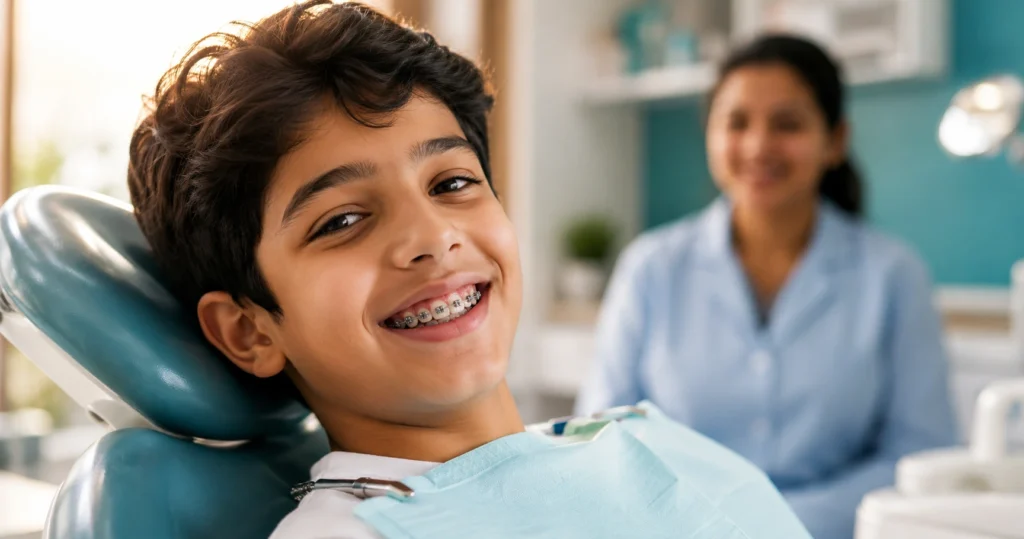
The Indian Orthodontic Society, aligned with international guidelines, recommends that children receive their first orthodontic evaluation by age 7. This may seem early, but the purpose isn’t to rush treatment — it’s to assess jaw development while the child still has a mix of baby and permanent teeth.
At this stage, a trained orthodontist can identify problems that are easier to correct early. Many children will simply be monitored and reviewed as they grow. Others may benefit from early, limited intervention.
Active orthodontic treatment with braces — the full process — most commonly begins between ages 10 and 14, once most of the permanent teeth have emerged.
The Two-Phase Treatment Approach
Some children benefit from what is called two-phase orthodontic treatment:
Phase 1 (Early Treatment): Typically between ages 6–10. Focuses on jaw development and making space for permanent teeth. May involve removable appliances or a palate expander — not full braces.
Phase 2 (Full Treatment): Typically between ages 11–14. Involves full braces or aligners to bring all permanent teeth into their final positions.
Not every child needs Phase 1. A proper clinical evaluation will determine whether early intervention adds real value for your child’s case.
Types of Braces for Children
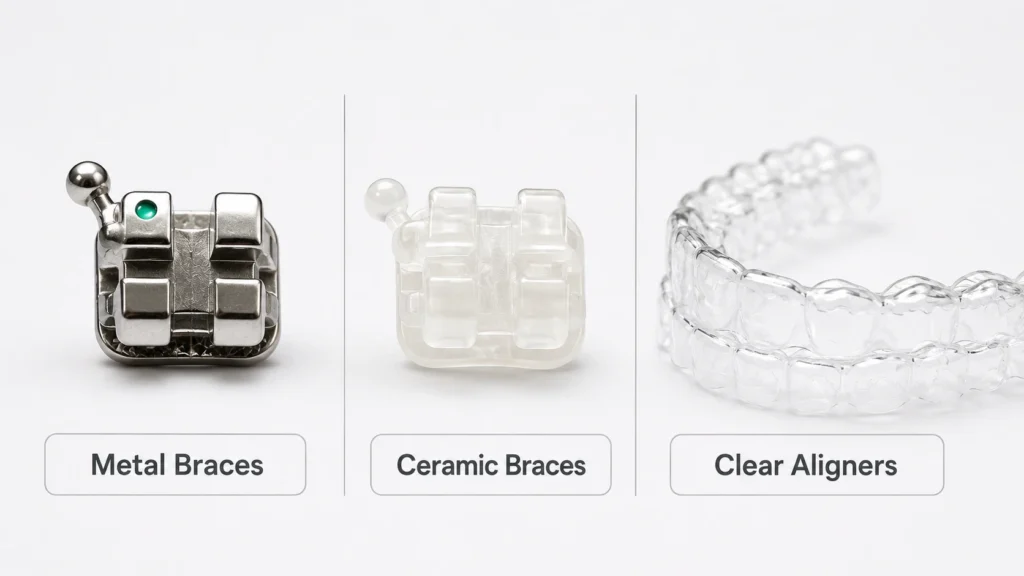
Traditional Metal Braces
Metal braces remain the most widely used orthodontic option for children — for good reason. They are reliable, durable, and effective across a wide range of cases, including complex bite corrections that other options may not handle as well.
Modern metal braces are significantly smaller and more comfortable than older versions. For children and adolescents, they are often the most cost-effective and clinically versatile choice.
Ceramic Braces
Ceramic braces work the same way as metal braces but use tooth-coloured or clear brackets, making them less visible. They are a common choice for older children and teenagers who are self-conscious about appearance.
They are generally slightly more expensive than metal braces and require a bit more care to avoid staining.
Clear Aligners for Older Children
Clear aligners (such as Invisalign Teen) are an option for some older children and teenagers — typically 13 and above — whose permanent teeth have mostly come in. They are nearly invisible and removable, which appeals to many families.
However, they require strict compliance. The aligners must be worn 20–22 hours per day to be effective. For younger children or those who may not maintain this discipline, traditional braces tend to deliver more predictable results.
Comparison Table: Braces Options for Children
| Feature | Metal Braces | Ceramic Braces | Clear Aligners |
| Visibility | Most visible | Less visible | Nearly invisible |
| Suitable age | 7+ (as needed) | 10+ | 13+ (typically) |
| Complexity handled | All cases | Mild to moderate | Mild to moderate |
| Compliance required | No (fixed) | No (fixed) | Yes (20–22 hrs/day) |
| Maintenance | Standard | Slight stain risk | Aligners must be cleaned |
| Relative cost | Most affordable | Moderate | Higher |
| Durability | Excellent | Good | Good if worn correctly |
What to Expect During Child Orthodontic Treatment
Understanding the process helps parents prepare their children — and themselves.
Initial Consultation: The orthodontist examines your child’s teeth, jaw, and bite. X-rays and photographs are usually taken to assess bone structure and tooth positioning. A treatment plan is discussed, including timelines and options.
Fitting the Braces: For metal or ceramic braces, brackets are bonded to the teeth and a wire is threaded through. This appointment takes approximately 1–2 hours. There is no pain during the fitting itself.
Adjustment Appointments: Every 4–6 weeks, the orthodontist adjusts the wire to continue guiding teeth. Each adjustment may cause mild soreness for 2–3 days, which typically responds well to soft foods and over-the-counter pain relief if needed.
Duration: Child orthodontic treatment typically takes 12 to 24 months, depending on the severity of misalignment and the child’s growth rate.
Retainers: Once braces are removed, retainers are essential. They hold the teeth in their new positions while the surrounding bone stabilizes. This phase is as important as the treatment itself.
Common Parent Concerns — Answered Honestly
Will Braces Hurt My Child?
There is some discomfort, but braces should not be painful in an ongoing way. The most common discomfort occurs in the first few days after fitting and after each adjustment — a dull achiness that usually passes within 48–72 hours. Most children adapt quickly.
If your child experiences sharp or persistent pain, or if a bracket or wire breaks, contact the clinic promptly.
How Will Braces Affect My Child’s Daily Life?
Some foods need to be avoided: hard, sticky, or very chewy foods that can damage brackets or wires. Brushing and flossing require more attention and time. Your child’s orthodontist will provide detailed guidance.
Most children adapt to their braces within a few weeks. School, sports, and social activities continue as normal. For contact sports, a mouthguard is recommended.
Myths vs Facts: Kids Braces Edition
| Myth | Fact |
| “My child should wait until all adult teeth are in.” | An evaluation at age 7 is recommended even with baby teeth present. Early assessment, not necessarily early treatment. |
| “Braces are only cosmetic.” | Orthodontic treatment corrects bites, reduces uneven tooth wear, and can prevent jaw problems — it’s functional, not just aesthetic. |
| “Clear aligners are always better than metal braces.” | For children with complex cases or compliance concerns, metal braces often deliver better outcomes. |
| “Braces are a one-time thing — once they’re off, it’s done.” | Retainers are essential after treatment. Without them, teeth can shift back over time. |
| “My child’s teeth will straighten out on their own.” | While some mild crowding resolves as jaws grow, significant bite and alignment issues do not self-correct. |
Braces for Children in South Kolkata — What Parents Here Ask Us
At City Smiles Dental Care, we see children from across South Kolkata — from Baghajatin and Santoshpur to Jadavpur, Dhakuria, and Tollygunge. A few questions come up repeatedly from parents in our area:
“Is there a good time of year to start braces?” Not clinically — but many families in South Kolkata prefer starting treatment at the beginning of a school year or during the summer holidays, so the child has time to adjust before routines intensify.
“How much do braces cost for children in Kolkata?” Costs vary depending on the type of braces, the complexity of the case, and the duration of treatment. A proper cost estimate is only possible after a clinical examination. We always explain treatment costs clearly before starting, with no hidden charges.
“Will my child need to miss school for appointments?” Adjustment appointments are typically short (30–45 minutes) and can usually be scheduled around school hours. Emergency visits for broken brackets or wires may be needed occasionally.
To discuss your child’s specific situation, book a consultation at City Smiles Dental Care.
Frequently Asked Questions
1. At what age should my child first see an orthodontist? The recommended age for a first orthodontic evaluation is 7. At this age, the jaw is still developing and the orthodontist can identify potential issues early — even if treatment doesn’t begin for several years.
2. Does my child definitely need braces if I bring them in at age 7? Not necessarily. Many children who come in for an early evaluation simply need monitoring as they grow. An evaluation is about informed awareness, not a commitment to treatment.
3. How long does child orthodontic treatment usually take? Most children complete orthodontic treatment in 12 to 24 months. Simpler cases may resolve in under a year; more complex bite corrections can take longer.
4. Are metal braces the only option for children? No. Ceramic braces and, for older children and teenagers, clear aligners are also available. However, metal braces remain the most versatile and reliable option for growing children, especially in complex cases.
5. Will my child feel pain with braces? Some soreness is normal after fitting and after each adjustment — typically lasting 2–3 days. This is usually manageable with soft foods and, if needed, mild pain relief. The discomfort decreases as the child adjusts over time.
6. Can my child still play sports with braces? Yes, with appropriate protection. A custom mouthguard is recommended for contact sports. We advise parents to discuss this with the orthodontist at the time of fitting.
7. What foods should my child avoid with braces? Hard foods (nuts, raw carrots), sticky foods (toffee, chewing gum), and very chewy foods should be avoided. A full dietary guide is provided at the start of treatment.
8. What happens after the braces come off? Retainers are fitted immediately after braces are removed. These hold the teeth in their corrected positions. Retainer wear is essential — typically full-time initially, then at night — to prevent teeth from shifting back.
9. How often does my child need to visit the clinic during treatment? Adjustment appointments are typically every 4–6 weeks. Emergency visits for broken brackets or wires may occasionally be needed between scheduled appointments.
10. How do I book an orthodontic assessment for my child at City Smiles Dental Care? You can book an appointment directly through our appointment page or find us on Google Maps. We serve patients from across South Kolkata, including Garia, Baghajatin, Jadavpur, Tollygunge, Santoshpur, and Dhakuria.
Conclusion
Braces for children are one of the most impactful dental decisions a parent can make — and one of the most misunderstood. The right time, the right type, and the right clinical guidance all matter. Starting with an evaluation early doesn’t mean rushing into treatment; it means you have the information to act when the time is right.
If you’ve been wondering whether your child’s teeth need attention, the clearest next step is a proper assessment. At City Smiles Dental Care in South Kolkata, we take time to understand your child’s individual development and give you an honest picture — no pressure, no guesswork.
Book a children’s orthodontic consultation today. Families from Baghajatin, Garia, Jadavpur, Tollygunge, and surrounding South Kolkata areas are welcome.
Book an Appointment
City Smiles Dental Care — South Kolkata
Your child’s smile is worth getting right — and early assessment costs nothing but a little time.
1 Comment