


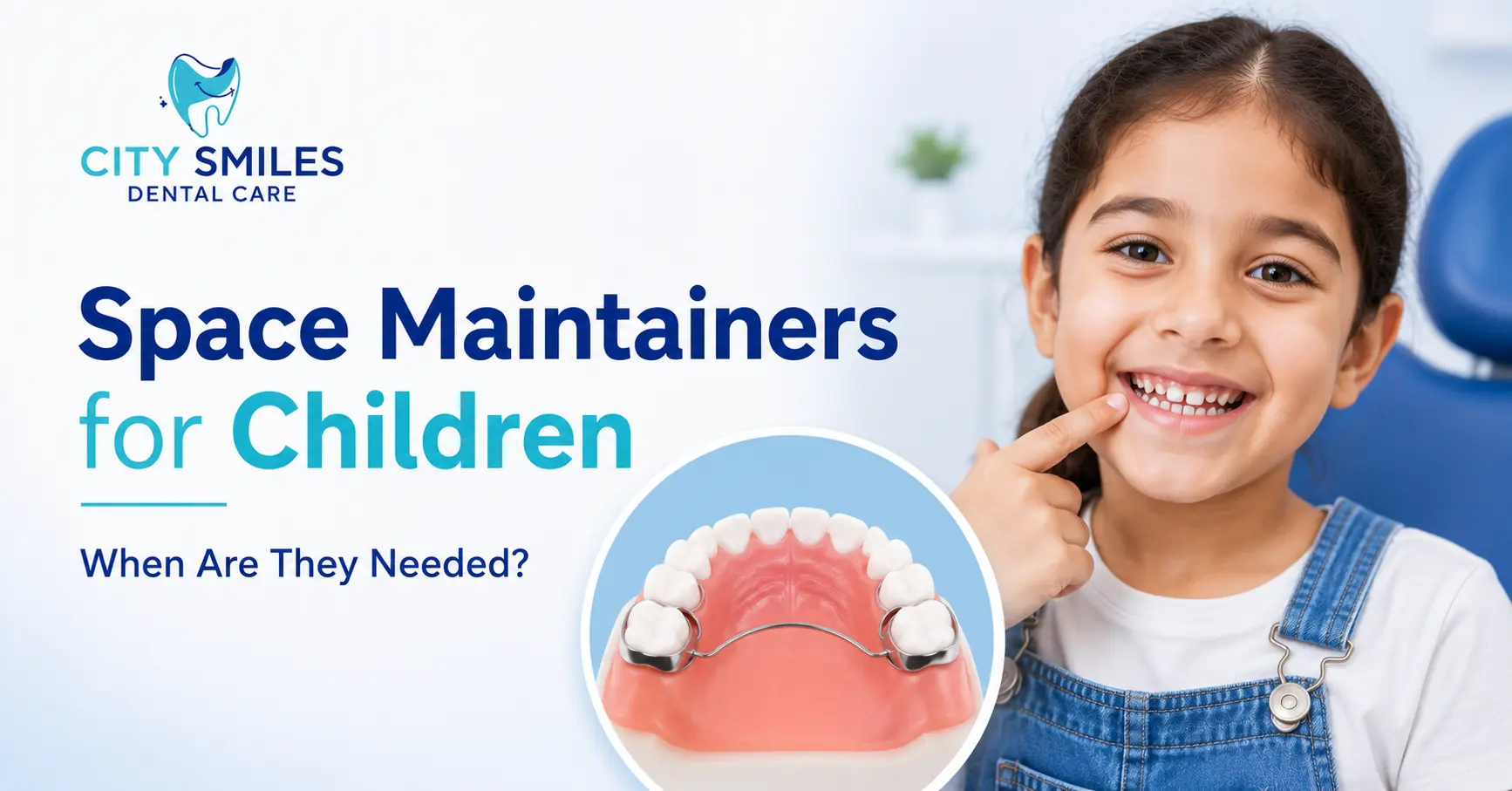
Losing a baby tooth is one of childhood’s little milestones. Most of the time, it is perfectly natural — the permanent tooth is ready to come through, and the gap closes on its own within months. But sometimes a baby tooth is lost far too early, long before the permanent replacement is ready to arrive. When that happens, the teeth on either side begin to drift into the empty space, and the permanent tooth below no longer has a clear path to erupt correctly.
This is where space maintainers come in.
At City Smiles Dental Care in South Kolkata, this is one of the most common situations we assess in young patients. Parents arrive worried, unsure whether the missing tooth is a problem or simply part of growing up. This guide answers that question clearly.
What Is a Space Maintainer?
A space maintainer is a small dental appliance — usually made of stainless steel or acrylic — designed to hold open the gap left by a prematurely lost baby tooth. It prevents neighbouring teeth from drifting into that space and reserves the correct position for the permanent tooth that will eventually erupt.
Think of it as a placeholder. Without it, adjacent teeth migrate silently over weeks and months, narrowing the space until the incoming permanent tooth has nowhere to go. The result is often crowding, crooked teeth, or the need for more extensive orthodontic treatment later.
Why Baby Teeth Matter More Than Most Parents Realise
A common misconception is that baby teeth are temporary and therefore unimportant. In reality, they serve several critical functions:
- They guide the eruption of permanent teeth below them.
- They maintain the arch length of the jaw.
- They support normal speech development.
- They enable proper chewing during the critical years of childhood growth.
When a baby tooth is lost prematurely — through decay, trauma, or extraction — this guidance system is disrupted. The degree of disruption depends on which tooth was lost and how early it was lost.
What Happens When a Baby Tooth Is Lost Too Early
When a baby tooth disappears before the permanent tooth underneath is ready, the surrounding teeth begin to shift. This is not a slow, dramatic movement — it can happen in a matter of months, quietly and without pain. The bone and soft tissue in the area can also change shape.
By the time the permanent tooth is ready to erupt, the space may have narrowed significantly. The tooth then erupts out of alignment, crowding others, or becomes impacted altogether. Children who experience premature tooth loss — particularly of back baby teeth — are at noticeably higher risk of requiring orthodontic treatment if the situation is left unmanaged.
When Is a Space Maintainer Needed?
A pediatric space maintainer is typically recommended when:
- A baby molar or canine is lost before the child is approximately nine to ten years old (before the permanent successor is close to erupting).
- The tooth was lost due to severe decay requiring extraction.
- The tooth was knocked out due to trauma.
- X-rays show the permanent tooth is still two or more years from erupting.
- Multiple baby teeth have been lost in the same quadrant.
The single most important factor is the timing. If the permanent tooth is already close to breaking through the gum, a space maintainer may not be necessary. But if that permanent tooth is still years away, the risk of space loss is real and a child space maintainer can prevent a much larger problem.
When Is a Space Maintainer NOT Needed?
Not every missing baby tooth requires a maintainer. One is generally not needed when:
- The permanent tooth is already visible or expected to erupt within a few months.
- The lost tooth is a front baby tooth (incisors) in most cases — the permanent front teeth typically erupt quickly.
- The child is old enough that the natural eruption sequence is nearly complete.
- The child has a malocclusion that will require orthodontic treatment regardless — in some cases, extraction of baby teeth is part of a planned orthodontic strategy.
This is why a clinical examination and a dental X-ray are essential. There is no reliable way to determine this at home by looking at the gap. A dentist needs to assess the bone and the developing tooth below.
Types of Space Maintainers
Fixed vs. Removable
| Type | Description | Best For |
| Fixed | Cemented to adjacent teeth; cannot be removed by the child | Younger children (under 10); cases requiring reliability |
| Removable | Similar to a retainer; taken out for cleaning | Older children; teens; cases where hygiene cooperation is assured |
Fixed maintainers are far more common for young children precisely because compliance is not required. They stay in place and do their job without depending on the child to remember to wear them.
Unilateral vs. Bilateral
- Unilateral: Maintains space on one side of the mouth (e.g., a single missing molar on the upper left).
- Bilateral: Spans both sides, typically used when multiple back teeth are missing on both sides of an arch. A common type is the lower lingual holding arch, used when multiple lower baby molars are lost.
The type recommended will depend on which teeth are missing and the specific pattern of your child’s dental development.
The Fitting Process: What to Expect
Fitting a space maintainer is a straightforward, comfortable procedure. Here is what typically happens:
- Examination and X-ray — The dentist assesses which teeth are present, which are developing below the gumline, and how much space remains.
- Impression or scan — A mould or digital scan of the area is taken so the appliance fits precisely.
- Fitting visit — At the next appointment (sometimes the same visit), the maintainer is cemented or fitted into place. Most children find this entirely painless.
- Brief adjustment period — Your child may feel the appliance for a day or two. This settles quickly.
There are no injections involved in fitting most space maintainers. For anxious children, the team at City Smiles Dental Care takes time to explain each step in child-friendly language before proceeding.
Caring for a Space Maintainer at Home
A few simple habits keep the appliance functioning correctly:
- Avoid sticky sweets, chewing gum, and hard candies — these can dislodge a fixed maintainer.
- Brush thoroughly around and under the appliance twice daily.
- Continue regular dental check-ups every six months so the dentist can check the fit and monitor eruption progress.
- If the appliance feels loose, schedule a check sooner rather than later — a dislodged maintainer that goes unnoticed stops doing its job.
How Long Does a Child Need a Space Maintainer?
The maintainer stays in place until the permanent tooth is ready to erupt into the space — and the dentist can see on an X-ray that the eruption is imminent. This could be anywhere from a few months to two or three years, depending on the child’s age at the time of tooth loss and which tooth was involved.
Once the permanent tooth begins to break through the gum, the appliance is removed at a routine appointment. The tooth then erupts naturally into the reserved space.
Myths vs. Facts About Space Maintainers
| Myth | Fact |
| “Baby teeth don’t matter — they’ll fall out anyway.” | Baby teeth guide permanent teeth and maintain jaw arch length. Early loss without management causes real alignment problems. |
| “Space maintainers are painful.” | Fitting is painless. There may be mild awareness for a day or two while the child adjusts. |
| “My child will need braces anyway, so why bother?” | Space maintainers can reduce the complexity and cost of future orthodontic treatment significantly. |
| “The gap will close naturally and the tooth will push through.” | Sometimes. But in many cases, adjacent teeth migrate before the permanent tooth can erupt, leaving insufficient room. |
| “Only permanent teeth need to be protected.” | The health and position of baby teeth directly determines how permanent teeth erupt. |
Frequently Asked Questions
Q1: What is a space maintainer for a child? A space maintainer is a dental appliance that holds open the gap left by a prematurely lost baby tooth. It prevents surrounding teeth from shifting into that space and reserves the correct position for the incoming permanent tooth.
Q2: Does my child need a space maintainer if a baby tooth fell out naturally? If the permanent tooth is expected to erupt within a few months, a maintainer is usually not necessary. If the tooth fell out years before the permanent successor is ready, your dentist will assess whether one is needed based on an X-ray.
Q3: At what age are space maintainers most commonly used? Space maintainers are most often placed in children between ages four and ten. The need depends less on age and more on which tooth was lost and how far away the permanent tooth is from erupting.
Q4: Is the procedure painful? No. Fitting a space maintainer is a comfortable, straightforward procedure. No injections are required in most cases. Children typically adjust within a day or two.
Q5: How long does a space maintainer stay in? It stays in until the permanent tooth is ready to erupt into the space — which can range from a few months to two or three years. Your dentist monitors progress at regular check-ups and removes it when appropriate.
Q6: What happens if we don’t use a space maintainer? Without a maintainer, adjacent teeth can drift into the gap over months. This narrows the space for the permanent tooth, often leading to crowding, impaction, or misalignment that requires more extensive orthodontic treatment later.
Q7: Can my child eat normally with a space maintainer? Yes, for the most part. Sticky and very hard foods should be avoided as they can dislodge or damage the appliance. Your dentist will provide a clear list of foods to be cautious with.
Q8: How do I know if my child’s space maintainer needs adjustment? If your child mentions that it feels loose, that food is getting trapped beneath it, or if it looks misaligned when you look inside, schedule a check. Otherwise, routine six-monthly appointments will include an assessment.
Q9: Are space maintainers available at City Smiles Dental Care in South Kolkata? Yes. Our clinic provides pediatric dental evaluations including assessment for premature tooth loss. Families from Garia, Baghajatin, Jadavpur, Tollygunge, Santoshpur, and surrounding South Kolkata areas regularly visit us for paediatric dental care.
Q10: Will my child need braces after using a space maintainer? Not necessarily. Space maintainers reduce the risk of misalignment, but whether braces are needed later depends on the child’s overall dental development. An orthodontic assessment at the appropriate age (usually around seven to eight years) gives you a clearer picture.
Conclusion
Space maintainers are one of the simplest, most effective interventions in paediatric dentistry — and one of the most overlooked. When a baby tooth is lost too early, the consequences are rarely visible right away. They emerge gradually: a tooth that erupts crooked, a smile that needs extensive correction, an orthodontic treatment that could have been much simpler.
The earlier a premature tooth loss is assessed, the better the outcome. A single appointment, an X-ray, and a professional evaluation are all it takes to determine whether your child needs a space maintainer or whether watchful monitoring is sufficient.
If your child has recently lost a baby tooth early — whether through decay, an accident, or extraction — the right time to act is now, not later.
Book Your Child’s Dental Assessment at City Smiles Dental Care
At City Smiles Dental Care in South Kolkata, we assess each child individually. We look at their X-rays, their eruption timeline, and their specific dental development before making any recommendation.
There is no guesswork. There is no pressure. Just an honest clinical evaluation and a clear explanation of what your child needs — and what they don’t.
We see families from Garia, Baghajatin, Jadavpur, Tollygunge, Santoshpur, Dhakuria, and across South Kolkata.
You can also find us and read patient reviews on our Google Business Profile.
Your child’s permanent smile is already forming beneath the surface. Let’s make sure it has the space it needs.