


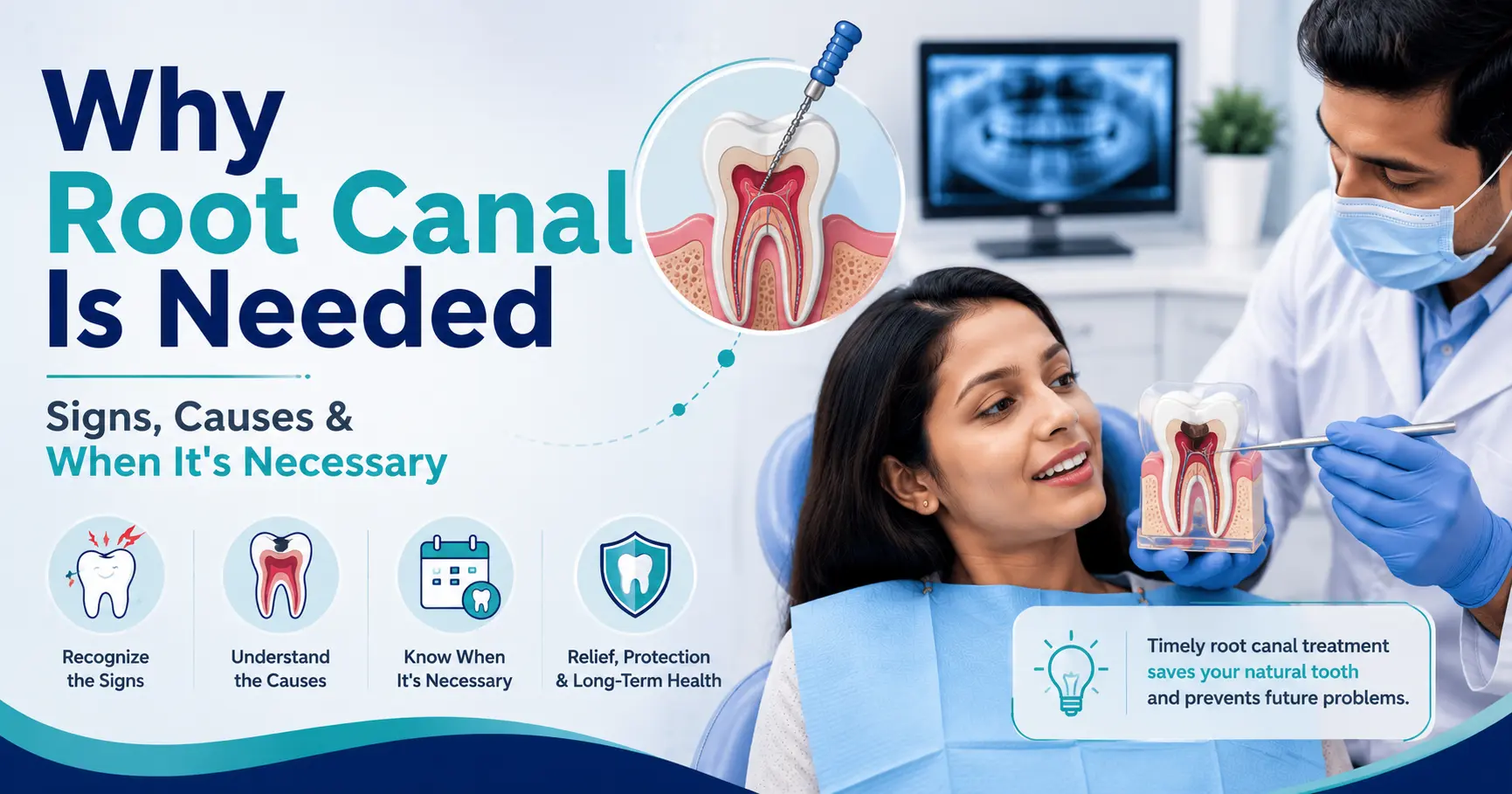
Few dental recommendations cause as much worry as “you need a root canal.” If you’ve recently heard those words — or you’re dealing with a throbbing tooth and wondering what’s next — you deserve a clear, honest explanation. Understanding why root canal is needed helps you make a calm, informed decision instead of a fearful one.
The short version: a root canal saves a tooth that would otherwise be lost to infection. Below, we explain exactly what goes wrong inside the tooth, the warning signs to watch for, and why delaying treatment is riskier than the procedure itself.
Why Is a Root Canal Needed? (Quick Answer)
A root canal is needed when the dental pulp — the nerve and blood supply inside your tooth — becomes infected, inflamed, or damaged beyond healing. Because this tissue cannot repair itself, the infection is removed, the canals are cleaned and sealed, and the tooth is saved instead of extracted.
In other words, the goal isn’t to cause discomfort — it’s to end it, while keeping your natural tooth in place.
What Happens Inside an Infected Tooth
Every tooth has three layers: the hard outer enamel, the softer dentin beneath it, and a hollow inner chamber that holds the pulp. That inner chamber is where the trouble begins.
The role of the dental pulp
The pulp contains nerves, blood vessels, and connective tissue. During childhood it helps the tooth grow. Once the tooth is fully formed, the pulp mainly provides sensation — which is why an infected pulp can hurt so intensely, or why a tooth may feel sensitive to heat and cold.
How a tooth infection develops
A tooth infection usually starts when bacteria reach the pulp. This can happen through:
- Deep tooth decay that eats through the enamel and dentin.
- A crack or chip that exposes the inner tooth.
- Repeated dental procedures on the same tooth.
- Trauma or injury, even without a visible break.
Once bacteria invade the pulp, the body cannot flush them out. Inflammation builds, pressure increases, and the tissue eventually begins to die — creating a dental pulp infection that will keep spreading until it is treated.
The Main Reasons a Root Canal Becomes Necessary
A root canal becomes necessary when the pulp is infected or irreversibly inflamed. The most common triggers are deep decay reaching the nerve, a cracked or fractured tooth, an existing infection or abscess, or trauma that damages the pulp. In each case, the natural tooth can still be saved by removing the diseased tissue.
Here are the situations that most often lead to a root canal recommendation:
- Deep, untreated cavities that reach the pulp chamber.
- Cracked or fractured teeth that let bacteria seep inside.
- A pulp that has already died (necrotic pulp), even without current pain.
- A dental abscess — a pocket of pus at the root tip.
- Repeated trauma to a tooth over the years.
- A large filling or crown where decay has crept underneath.
Your dentist won’t recommend the procedure based on a single symptom. The decision follows a clinical examination and, usually, an X-ray that reveals what’s happening below the gum line.
Warning Signs Your Tooth May Need a Root Canal
Common warning signs include lingering tooth pain, sensitivity to hot or cold that doesn’t settle, pain while chewing, swelling near the gums, a darkening tooth, or a small pimple-like bump on the gum. Any of these symptoms lasting more than a day or two deserves a dental evaluation.
Watch for these signals:
- Lingering pain that continues after eating or drinking.
- Sensitivity to hot and cold that stays even after the source is removed.
- Pain when biting or chewing on a specific tooth.
- Swelling or tenderness in the nearby gums or face.
- A darkening or discoloured tooth.
- A recurring pimple-like bump on the gum (a sign of drainage from an abscess).
- A bad taste or persistent bad breath from one area.
Importantly, symptoms can come and go. A tooth that suddenly stops hurting is not necessarily healed — the nerve may simply have died, which is exactly why an evaluation matters.
Why You Can’t Ignore a Dental Pulp Infection
Ignoring a dental pulp infection allows bacteria to spread from the tooth into the surrounding bone. This can cause a painful abscess, bone loss, facial swelling, and — in uncommon but serious cases — an infection that spreads to other parts of the head and neck. Early treatment prevents these complications.
Think of the tooth as a sealed container. Once infection fills it, there are only two ways out: through treatment, or by forcing its way into the jaw. Left alone, the infection tends to:
- Form an abscess at the root tip.
- Erode the bone that anchors the tooth.
- Cause swelling that can spread to the face or neck.
- Weaken the tooth until it can no longer be saved.
What starts as a manageable problem can become a dental emergency. That’s the real reason dentists urge patients not to “wait and see” once a pulp infection is confirmed.
Root Canal vs. Tooth Extraction: Why Saving the Tooth Usually Wins
Many patients ask, “Why not just pull the tooth?” It’s a fair question. But losing a natural tooth creates its own long-term problems. Here’s how the two options compare.
| Consideration | Root Canal (Save the Tooth) | Extraction (Remove the Tooth) |
| Natural tooth | Preserved | Lost |
| Chewing function | Maintained | Reduced until replaced |
| Neighbouring teeth | Stay in position | May drift or tilt over time |
| Jawbone health | Supported by the tooth root | Can shrink where the tooth is missing |
| Follow-up treatment | Usually a crown | Often an implant or bridge later |
| Long-term cost | Typically lower overall | Replacement can cost more over time |
A root canal keeps your own tooth doing its job. Extraction may seem simpler, but it often leads to further treatment — and additional expense — down the road. Your dentist will always weigh which option genuinely serves your long-term health.
Why Antibiotics Alone Cannot Cure an Infected Tooth
Antibiotics cannot cure an infected tooth on their own because the infection lives inside the sealed pulp chamber, where blood flow is limited or gone. Medication may ease swelling and pain temporarily, but it cannot reach and eliminate the bacteria trapped inside. The infected tissue must be physically removed.
This surprises many patients. Antibiotics work well when the bloodstream can carry them to the infection. Inside a dead or dying pulp, there’s little to no blood supply left — so the drug simply can’t get where it needs to go. That’s why infected tooth treatment almost always requires a procedure, not just a prescription.
Myths vs. Facts About Root Canal Treatment
| Myth | Fact |
| “Root canals are extremely painful.” | With modern anaesthesia, the procedure feels similar to getting a filling. It relieves pain rather than causing it. |
| “If the pain stops, I don’t need treatment.” | A pain-free tooth can still be infected. When the nerve dies, pain fades but infection continues. |
| “It’s better to just pull the tooth.” | Saving the natural tooth protects your bite, alignment, and jawbone. Extraction often needs costly replacement later. |
| “Antibiotics can fix it.” | Antibiotics may calm symptoms but cannot remove the infection sealed inside the tooth. |
| “Root canals cause illness elsewhere in the body.” | This claim is based on discredited, century-old research. Modern evidence does not support it. |
| “Root canal treatment takes many long visits.” | Most cases are completed in one or two appointments, depending on the tooth. |
What to Expect During Infected Tooth Treatment
Understanding the process removes a lot of the fear. While every case differs, infected tooth treatment generally follows these steps:
- Examination and X-ray to confirm the diagnosis and map the tooth’s canals.
- Local anaesthesia so the area is fully numb and comfortable.
- Removing the infected pulp from inside the tooth.
- Cleaning and shaping the canals to clear out bacteria.
- Sealing the canals with a biocompatible filling material.
- Restoring the tooth, usually with a crown, to protect it long-term.
Most patients are surprised by how routine it feels. The discomfort they feared beforehand is usually the infection itself — and that’s precisely what the treatment resolves.
When to See a Dentist in South Kolkata
If you’re experiencing lingering tooth pain, swelling, or sensitivity that won’t settle, don’t wait for it to worsen. A timely check-up can often mean simpler treatment and a better outcome. At City Smiles Dental Care, we serve families across South Kolkata — including Garia, Baghajatin, Jadavpur, Tollygunge, Santoshpur, and Dhakuria — with careful diagnosis and gentle, personalised care.
We never recommend treatment you don’t need. Whether a root canal is truly necessary is confirmed through a proper clinical examination and X-ray, and we take the time to explain your options clearly before anything is decided.
You can book an appointment online or find directions and reviews on our Google Business Profile.
Frequently Asked Questions
1. Why is a root canal needed if my tooth doesn’t hurt anymore? When an infected nerve dies, the pain often disappears — but the infection remains and keeps spreading. A root canal removes that hidden infection to protect the tooth and surrounding bone.
2. Can a tooth infection go away on its own? No. Once bacteria reach the pulp, the body cannot clear the infection because the pulp has little or no blood supply. Without treatment, it typically worsens.
3. Is a root canal really necessary, or can I just get the tooth pulled? Extraction is an option, but saving the natural tooth usually protects your bite, jawbone, and neighbouring teeth. Your dentist will help you weigh both choices.
4. Why can’t antibiotics cure my infected tooth? Antibiotics can ease swelling and pain temporarily, but they cannot reach the bacteria sealed inside the tooth. The infected tissue must be physically removed.
5. What happens if I delay root canal treatment? Delaying can lead to an abscess, bone loss, facial swelling, and a higher chance of losing the tooth entirely. Early treatment is simpler and safer.
6. Does a root canal hurt? With modern local anaesthesia, the procedure is comparable to a routine filling. Most patients feel relief afterward because the source of pain is removed.
7. How do I know if my tooth needs a root canal? Common signs include lingering pain, sensitivity to hot and cold, pain when chewing, gum swelling, or a darkening tooth. A dental examination and X-ray confirm the diagnosis.
8. Can a cracked tooth cause a pulp infection? Yes. A crack can let bacteria travel into the pulp, leading to a dental pulp infection even if the tooth looks mostly intact.
9. How many visits does a root canal take? Most root canals are completed in one or two appointments, depending on the tooth and the extent of infection.
10. Will I need a crown after a root canal? Often, yes. A treated tooth can become more brittle, so a crown is usually placed to protect and strengthen it for the long term.
Conclusion: Why Root Canal Is Needed to Protect Your Smile
Understanding why root canal is needed turns a frightening recommendation into a clear, sensible decision. When the dental pulp is infected, it cannot heal on its own — and removing that infection is the only reliable way to save your natural tooth. Left untreated, the problem doesn’t just stay put; it spreads, threatening the bone and your overall health.
A root canal isn’t a punishment. It’s a rescue. It relieves pain, stops infection, and preserves a tooth you’d otherwise lose. If you’re unsure whether you truly need one, the answer lies in a proper examination — not in worry or guesswork.
Book Your Consultation at City Smiles Dental Care
If a nagging toothache, sensitivity, or swelling has you worried, don’t wait for it to escalate. The friendly team at City Smiles Dental Care in South Kolkata will examine your tooth, explain exactly what’s happening, and recommend only the treatment you genuinely need.
📅 Book your appointment online 📍 Find us on Google — serving Garia, Baghajatin, Jadavpur, Tollygunge, Santoshpur, Dhakuria, and nearby South Kolkata areas.
Your natural smile is worth saving — and we’re here to help you keep it.