


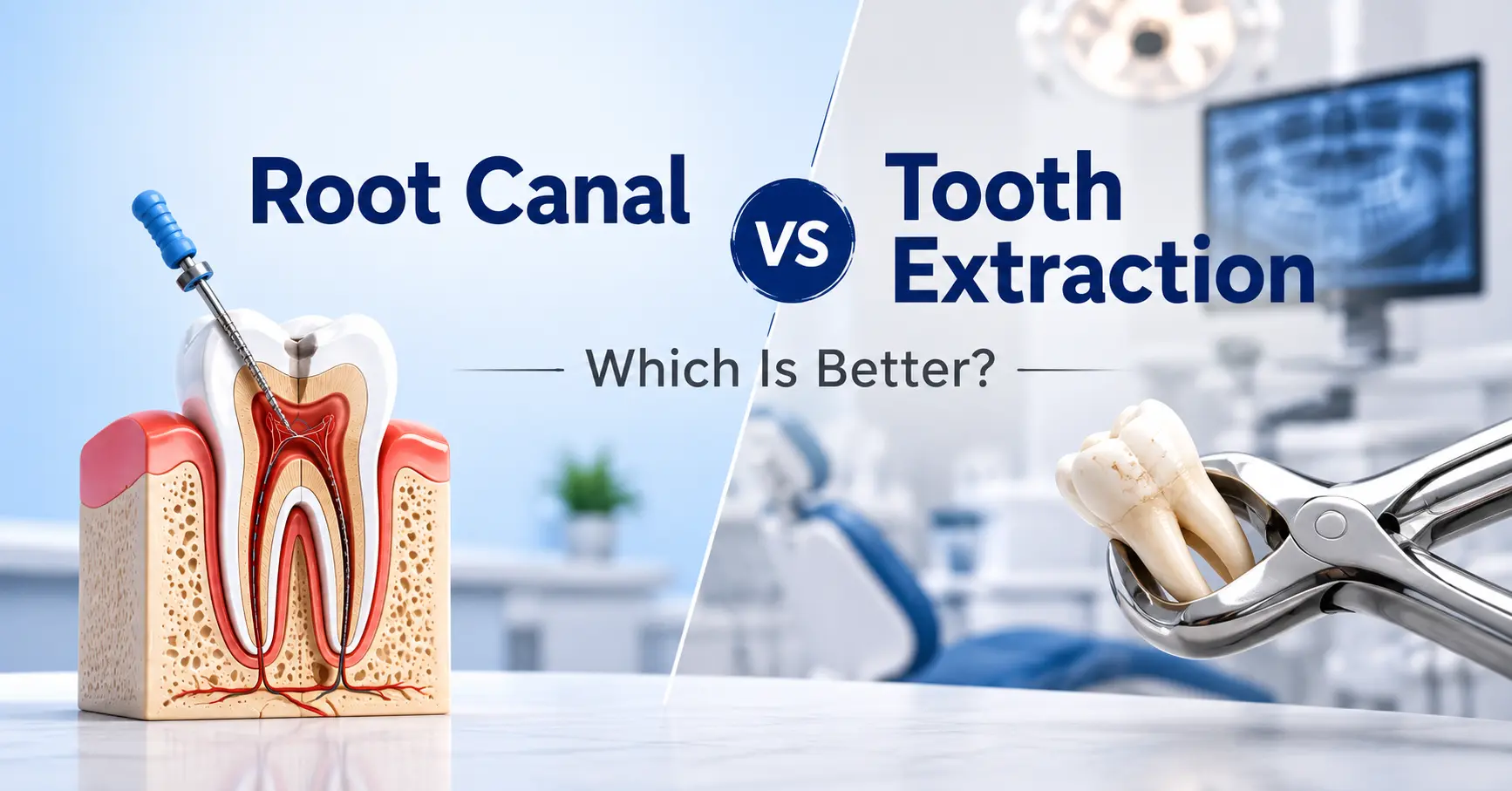
Hearing that a tooth needs either a root canal or an extraction is one of the more unsettling moments in a dental visit. Both options solve the same underlying problem — a tooth that is infected, badly decayed, or damaged — but they lead to very different long-term outcomes.
This guide compares root canal vs tooth extraction across pain, cost, recovery, and long-term oral health, so you can walk into your next appointment at City Smiles Dental Care with clear, informed questions rather than guesswork.
Root Canal vs Tooth Extraction at a Glance
Quick answer: In most cases, a root canal is the better choice because it saves your natural tooth and avoids the cost and complexity of tooth replacement. Extraction is reserved for teeth that are too damaged, infected, or loose to be saved. The final decision always depends on what a dental X-ray and clinical exam reveal about the specific tooth.
| Factor | Root Canal Treatment | Tooth Extraction |
| What it does | Removes infected pulp, seals and restores the tooth | Removes the entire tooth from the socket |
| Natural tooth | Preserved | Lost permanently |
| Pain during procedure | Minimal, under local anaesthesia | Minimal, under local anaesthesia |
| Recovery time | 1–2 days of mild sensitivity | 3–7 days, longer for surgical extraction |
| Number of visits | Usually 1–2 visits | Usually 1 visit |
| Upfront cost (India) | Moderate (varies by tooth and crown type) | Lower upfront |
| Long-term cost | One-time investment in most cases | Often needs a bridge/implant/denture later, adding cost |
| Effect on nearby teeth | None — surrounding teeth stay in place | Neighbouring teeth may shift over time |
| Chewing function | Restored close to natural | Reduced until tooth is replaced |
| Best suited for | Teeth with restorable structure and healthy supporting bone | Teeth with severe fracture, advanced bone loss, or non-restorable decay |
What Is a Root Canal Treatment?
Root canal treatment (RCT) is a procedure that removes infected or inflamed pulp tissue from inside a tooth, cleans and disinfects the canal, and seals it to prevent further infection. The tooth is then restored, usually with a filling or a crown, so it continues to function normally.
The procedure specifically targets the inside of the tooth while leaving the outer structure — the part that lets you bite and chew — fully intact. This is why root canal treatment is often described as “tooth-saving” treatment: the natural tooth remains in your mouth, doing its job, instead of leaving a gap that needs to be filled with an artificial replacement.
Patients frequently associate root canal with pain, largely due to outdated stories or the pain of the infection itself before treatment. In reality, the procedure is performed under local anaesthesia and is designed to relieve pain caused by the infection, not create it.
What Is a Tooth Extraction?
Tooth extraction is the removal of a tooth from its socket in the jawbone. It may be a simple extraction (for a visible, accessible tooth) or a surgical extraction (for teeth that are broken at the gumline, impacted, or require minor incision).
Extraction is a faster, one-visit solution, which is part of why it can feel like the more “straightforward” choice. But because it removes the tooth entirely, it also removes the tooth’s role in chewing, jawbone stimulation, and keeping neighbouring teeth aligned — all of which need to be addressed afterward through a replacement option such as a dental implant, bridge, or denture.
Root Canal vs Tooth Extraction — Detailed Comparison
Pain and Comfort
Both procedures are performed under local anaesthesia, so neither root canal nor extraction is significantly more painful than the other during treatment. The real difference shows up afterward: root canal patients typically report mild sensitivity for a day or two, while extraction sites — especially surgical ones — can feel sore for several days as the socket heals.
Ironically, the pain that brings most patients in for a root canal in the first place — a throbbing, infected tooth — is what the treatment is designed to relieve.
Cost Comparison
Extraction usually has a lower upfront cost than root canal treatment. However, this comparison is incomplete if it stops there.
A tooth removed by extraction almost always needs to be replaced to prevent shifting teeth, bite problems, and bone loss in the jaw. Once you factor in the cost of a dental implant, bridge, or partial denture, extraction plus replacement frequently costs more than a root canal plus crown — sometimes significantly more, depending on the replacement chosen.
Root canal treatment, by contrast, is typically a one-time investment: once the tooth is treated and restored, no separate replacement procedure is usually needed.
For an exact quote based on your specific tooth and X-ray findings, a consultation at City Smiles Dental Care in South Kolkata will give you a precise cost breakdown rather than a general estimate.
Treatment Time and Number of Visits
A straightforward extraction can often be completed in a single visit. Root canal treatment may take one or two visits depending on the number of canals, the extent of infection, and whether a crown is placed in the same sitting or a follow-up appointment.
While extraction may seem faster, this timeline doesn’t include the additional visits needed later for a replacement tooth — which can add weeks or months to the overall treatment journey.
Recovery Period
- Root canal: Mild tenderness for 24–48 hours; most patients return to normal eating and activity the next day.
- Simple extraction: Soft-tissue healing over 3–5 days, with full socket healing over several weeks.
- Surgical extraction: Recovery of 5–7 days with more noticeable swelling, followed by longer bone healing.
Long-Term Impact on Oral Health
This is where the two paths diverge the most. A successfully root canal-treated tooth continues to function as part of your natural bite for years — often for life, when properly restored and maintained.
An extracted tooth, if left unreplaced, allows neighbouring teeth to drift into the gap, can alter your bite alignment, and leads to gradual bone loss in the jaw at that site. This is why dentists generally recommend preserving the natural tooth whenever it’s clinically possible, reserving extraction for cases where the tooth genuinely cannot be saved.
When Is a Root Canal the Better Choice?
Root canal treatment is generally recommended when:
- The tooth’s outer structure is strong enough to support a filling or crown after treatment
- Infection is confined to the pulp, without severe damage to the supporting bone
- The patient wants to avoid the cost and time of a tooth replacement procedure
- Maintaining natural bite alignment and chewing efficiency is a priority
- The tooth is a molar or premolar playing an important role in chewing function
When Is Extraction the Better (or Only) Choice?
Extraction becomes the recommended — or sometimes the only viable — option when:
- The tooth is fractured below the gumline or has insufficient structure to restore
- There is advanced bone loss around the tooth due to severe gum disease
- The tooth is severely mobile and cannot support long-term function even after treatment
- Root canal treatment has failed previously and retreatment is not viable
- The tooth is impacted or causing crowding issues (in specific orthodontic cases)
What Happens If You Extract a Tooth Instead of Saving It?
If extraction is chosen — or is unavoidable — the empty space doesn’t stay “neutral.” Over time:
- Neighbouring teeth begin to tilt or drift toward the empty space, affecting your bite.
- The opposing tooth (in the other jaw) may over-erupt into the gap.
- Jawbone at the extraction site gradually resorbs, since it no longer receives stimulation from a tooth root.
- Chewing efficiency on that side decreases, sometimes leading patients to unconsciously favour the opposite side.
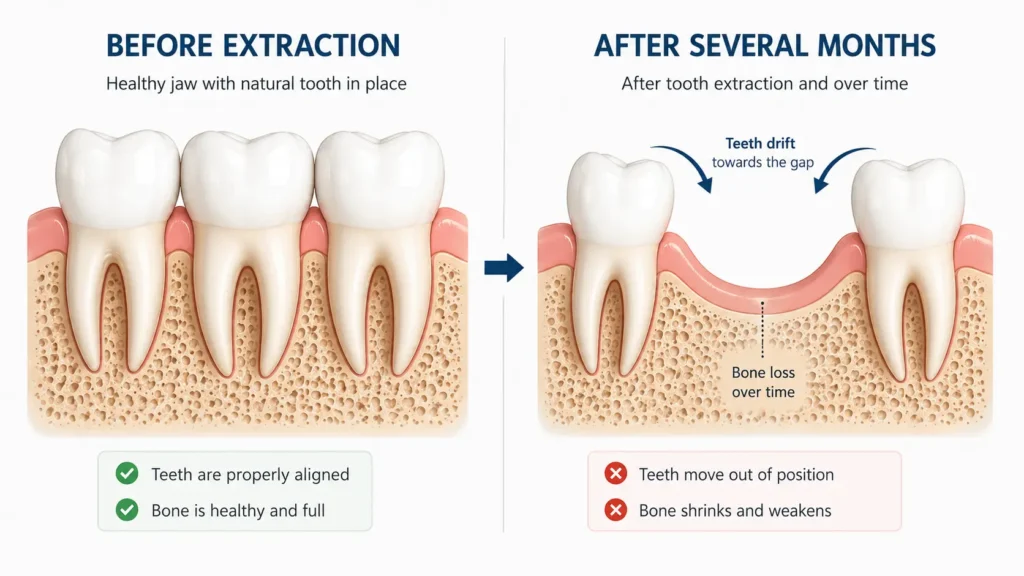
This is why dentists at City Smiles Dental Care always discuss a replacement plan — implant, bridge, or denture — at the same time as an extraction, rather than treating extraction as a final, standalone step.
Myths vs Facts: Root Canal and Extraction
| Myth | Fact |
| “Root canal is more painful than extraction.” | Both are done under local anaesthesia; post-procedure discomfort is usually milder and shorter after a root canal than after extraction. |
| “It’s cheaper to just extract the tooth.” | Extraction is cheaper upfront, but replacing the tooth afterward (implant/bridge/denture) often makes the total cost higher than a root canal. |
| “A root-canal-treated tooth will fail eventually anyway.” | With a proper crown and regular checkups, root canal-treated teeth commonly last a lifetime. |
| “Extraction is a permanent fix, so there’s nothing more to do.” | An extracted tooth almost always needs replacement to prevent bone loss and shifting teeth. |
| “If a tooth hurts a lot, it must be extracted.” | Pain level doesn’t determine treatment — X-ray findings and structural integrity do. Many painful teeth are successfully saved with root canal treatment. |
How City Smiles Dental Care Helps You Decide
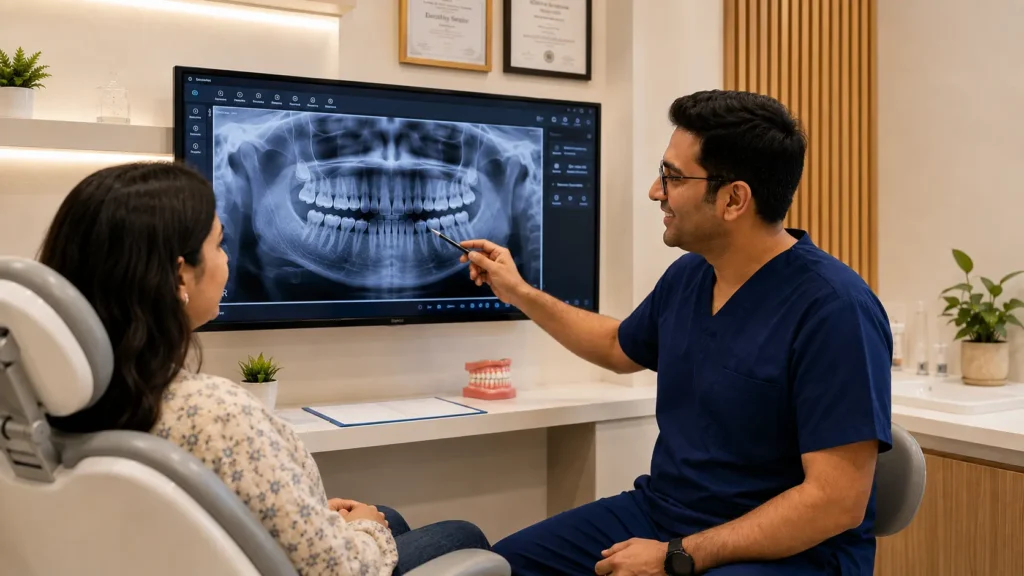
At City Smiles Dental Care, the decision between root canal and extraction is never made from a single symptom or a phone conversation. It starts with a clinical examination and dental X-ray to assess the extent of infection, the remaining tooth structure, and the condition of the supporting bone.
Where the tooth can be reasonably preserved, our clinicians will generally recommend root canal treatment as the first option — in line with standard dental practice — while being transparent if extraction is genuinely the safer or more practical route for your specific case. Every treatment plan is personalised, and no outcome is guaranteed without that in-person evaluation.
Patients from Garia, Baghajatin, Jadavpur, Tollygunge, Santoshpur, Dhakuria, and other parts of South Kolkata can get a same-week evaluation to understand exactly where their tooth stands before deciding.
Frequently Asked Questions
1. Is a root canal always better than extraction? Not always — it depends on how much healthy tooth structure remains and the condition of the supporting bone. When a tooth is restorable, root canal treatment is generally preferred because it preserves your natural tooth.
2. Does root canal treatment hurt more than tooth extraction? No. Both procedures use local anaesthesia during treatment. Post-procedure discomfort is usually mild after a root canal and can be somewhat more noticeable after an extraction, especially a surgical one.
3. Which option is cheaper — root canal or extraction? Extraction has a lower upfront cost, but it typically requires a replacement tooth (implant, bridge, or denture) afterward, which often makes the total long-term cost higher than a root canal with a crown.
4. Can every damaged tooth be saved with a root canal? No. Teeth with severe fractures below the gumline, advanced bone loss, or extensive structural damage may not be candidates for root canal treatment and may need extraction instead.
5. What happens if I don’t replace an extracted tooth? Neighbouring teeth can drift into the gap, your bite alignment may shift, and the jawbone at that site can gradually shrink from lack of stimulation.
6. How long does a root canal-treated tooth typically last? With a proper crown restoration and regular dental checkups, a root canal-treated tooth can last for many years, often a lifetime.
7. Is one visit enough for a root canal, or does it always take multiple sittings? It depends on the tooth and the extent of infection. Some cases are completed in a single visit; others require two visits for thorough disinfection before final restoration.
8. Will my dentist decide for me, or do I get a choice? You are always part of the decision. Your dentist will explain the clinical findings and recommend the option most likely to succeed, but the final choice is discussed together with you.
Conclusion — Making the Right Choice for Your Tooth
When comparing root canal vs tooth extraction, the healthier long-term choice — in cases where the tooth can genuinely be saved — is almost always root canal treatment, since it preserves your natural tooth, avoids replacement costs, and maintains normal chewing function. Extraction remains an important and sometimes necessary option when a tooth is too damaged to restore, but it should always come with a clear plan for replacing the missing tooth.
The only way to know which path is right for your tooth is a proper clinical examination and X-ray. If you’re weighing this decision, book a consultation with City Smiles Dental Care to get a clear, personalised answer rather than guessing between two treatment names.
Ready to find out if your tooth can be saved? Book an appointment with City Smiles Dental Care for an evaluation, or check patient reviews on our Google Business Profile before your visit.