


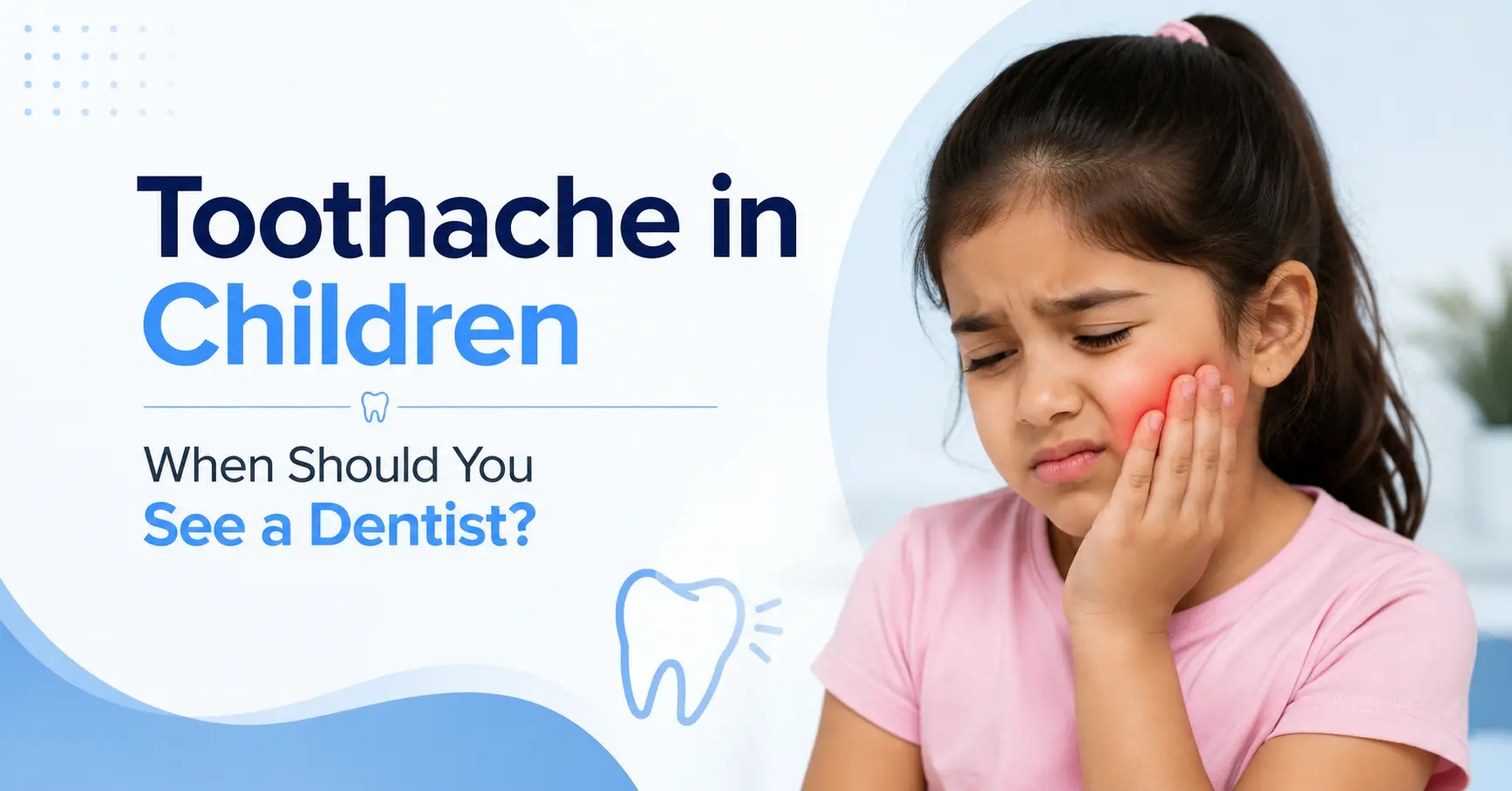
It’s 9 p.m. Your child suddenly starts crying and pointing at a back tooth. The nearby pharmacy is about to close, tomorrow is a school day, and you’re left wondering: is this something that needs a dentist right now, or can it wait until morning?
A toothache in children is one of the most common reasons parents in South Kolkata search for urgent dental guidance — and the right decision at this stage genuinely affects the outcome. This guide walks you through the real warning signs, what you can safely do at home, and exactly when to bring your child in.
Quick Answer: When a Child’s Toothache Needs a Dentist
See a dentist the same day if your child has facial swelling, fever, pain that wakes them at night, or pain following a fall or injury. See a dentist within 1–2 days for persistent pain without swelling. Mild, occasional sensitivity that resolves quickly can typically wait for the next routine visit — but should still be mentioned to your dentist.
Why Is My Child’s Tooth Hurting? (Common Causes)
Tooth pain in children rarely appears without a reason, even when that reason isn’t visible to a parent. The most frequent causes include:
- Tooth decay (cavities): Baby teeth have thinner enamel than adult teeth, so decay can reach the nerve faster than parents expect.
- A cracked or chipped tooth: Often from a fall, a hard food, or biting on a toy.
- Food or debris trapped between teeth: This can cause sharp, localized pain that mimics a cavity.
- An erupting tooth: New teeth pushing through the gum line, especially first molars, commonly cause dull, aching discomfort.
- Gum infection or early gum disease: Redness, swelling, or bleeding around a specific tooth.
- A developing dental abscess: A pocket of infection at the root of the tooth, usually from untreated decay.
Because several of these causes look identical from a parent’s side of the exam chair, a dental evaluation is the only way to know which one you’re dealing with.
The Toothache That “Just Stopped” — Why That Can Be a Red Flag
Here’s something most parents don’t expect: when a severe toothache suddenly goes away on its own, that is not always a sign of recovery.
In many cases, this happens because the nerve inside the tooth has died from infection. The pain signal stops — but the infection often continues spreading into the surrounding bone and gum tissue. A child can look and feel completely fine for days or weeks before swelling or fever suddenly appears.
The safest rule: if your child had significant tooth pain that has now disappeared without any dental visit in between, it still needs to be checked, not crossed off the list.
Is This a Dental Emergency? A Simple Triage Guide
Not every toothache carries the same urgency. Use this guide to decide your next step.
See a Dentist Today (Same Day)
- Facial or gum swelling, especially if it’s spreading
- Fever along with tooth pain
- Pain severe enough to disrupt sleep or eating
- Pain following a fall, sports injury, or blow to the face
- A visibly broken, chipped, or knocked-loose tooth
- A pimple-like bump on the gum near the painful tooth (this can indicate an active abscess)
See a Dentist Within 1–2 Days
- Ongoing pain that comes and goes but doesn’t fully resolve
- Sensitivity to hot, cold, or sweet foods that lingers after the food is gone
- Mild gum bleeding or tenderness around one specific tooth
- Pain that responds to paracetamol/ibuprofen but keeps returning
Can Wait for a Routine Appointment
- Brief, occasional sensitivity with no swelling, fever, or sleep disruption
- Discomfort clearly linked to a new tooth erupting, with no other red flags
- Mild irritation from a temporary cause (e.g., a popcorn husk) that resolves after gentle cleaning
When in doubt, treat it as the more urgent category. It costs little to have a dentist confirm a tooth is fine; it costs a great deal more to miss an early infection.
Safe Ways to Ease Your Child’s Pain Before the Dental Visit
While you arrange the appointment, these steps can make your child more comfortable:
- Rinse with warm salt water (for children old enough not to swallow it) to reduce irritation around the gum.
- Gently floss around the painful tooth in case trapped food is contributing to the pain.
- Use a cold compress on the outside of the cheek for 10–15 minutes to ease swelling and discomfort.
- Give an age-appropriate dose of paracetamol or ibuprofen, following the dosing guidance on the packaging or from your pediatrician.
- Keep your child upright rather than lying flat, since lying down can increase blood flow to the area and intensify throbbing pain.
These measures manage discomfort — they do not treat the underlying cause, and pain relief should never be used as a reason to delay a visit.
What NOT to Do When Your Child Has a Toothache
- Do not place aspirin directly on the tooth or gum. This is a common home remedy myth, and it can chemically burn the gum tissue.
- Do not apply heat to the outside of the face — heat can worsen swelling from an infection.
- Do not give adult-strength medication or exceed the recommended pediatric dose.
- Do not ignore swelling that is spreading toward the eye or neck. This needs same-day medical and dental attention.
- Do not wait for the pain to become “bad enough.” As covered above, reduced pain does not reliably mean reduced risk.
“But Baby Teeth Fall Out Anyway — Does It Really Matter?”
This is one of the most common reasons parents delay treatment — and it’s a reasonable question, not a careless one. Here’s the honest answer: yes, it matters, even though the tooth is temporary.
Baby teeth:
- Hold the correct spacing for permanent teeth growing underneath
- Support normal chewing and nutrition during a critical growth period
- Play a direct role in clear speech development
- Can pass infection to the permanent tooth bud beneath them if left untreated
An infection in a baby tooth doesn’t stay contained just because the tooth will eventually fall out on its own. Left untreated, it can affect the permanent tooth developing below it — which is the opposite of what most parents intend when they choose to “wait it out.”
What Happens at a Pediatric Dental Visit for Tooth Pain
A first visit for a toothache is usually more reassuring than parents expect. A typical visit includes:
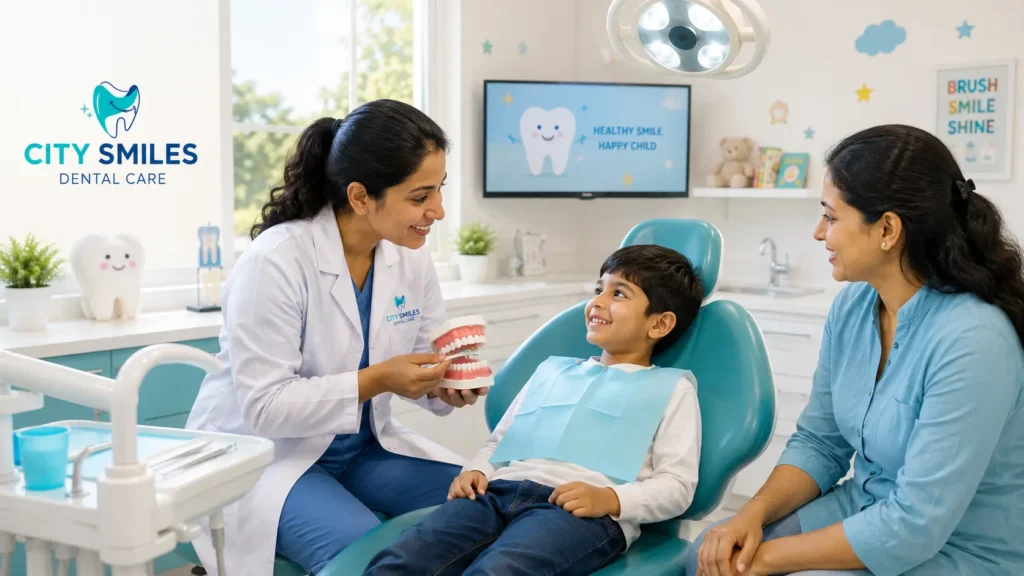
- A conversation with your child at their level, to build comfort before any exam begins.
- A visual and gentle physical examination of the painful tooth and surrounding gum.
- An X-ray, if needed, to check below the gumline for decay, infection, or bone involvement that isn’t visible to the eye.
- A clear explanation to you of what’s causing the pain and the realistic treatment options.
- A personalized treatment plan — the right next step depends entirely on what the exam and X-ray show, so no treatment is recommended before that evaluation is complete.
Every child’s case is different, and the exact treatment path can only be confirmed after a clinical examination — this page is educational and isn’t a substitute for that assessment.
Myths vs. Facts About Toothache in Children
| Myth | Fact |
| “If the pain goes away, the problem is gone.” | Pain can stop because the nerve has died while infection continues silently. |
| “Baby teeth don’t need serious treatment.” | Untreated infection in a baby tooth can affect the permanent tooth developing beneath it. |
| “Aspirin on the gum numbs the pain safely.” | Direct aspirin contact can burn and damage gum tissue. |
| “Toothache always means a cavity.” | It can also be an erupting tooth, trapped food, a crack, or gum inflammation. |
| “A same-day dentist visit is only for emergencies with visible damage.” | Swelling, fever, or night-waking pain are same-day signs even without visible damage. |
Frequently Asked Questions
1. Can a toothache in a child go away on its own? Mild discomfort from something like trapped food can resolve on its own once the debris is removed. However, pain from decay or infection does not resolve on its own — it may temporarily stop while the underlying problem continues, which is why persistent or recurring pain should always be evaluated.
2. What is safe for kids’ toothache relief at home? Warm salt water rinses, a cold compress on the cheek, gentle flossing to remove trapped food, and an age-appropriate dose of paracetamol or ibuprofen are generally safe short-term measures while you arrange a dental visit.
3. Is a toothache always a sign of a cavity in children? No. It can also result from an erupting tooth, a cracked tooth, trapped food, gum inflammation, or, less commonly, referred pain from a sinus issue. A dental exam is needed to identify the actual cause.
4. Why did my child’s toothache suddenly stop hurting? This can happen when the nerve inside the tooth has died from ongoing infection. The absence of pain does not mean the infection has resolved, so a dental check is still recommended.
5. When should I take my child to the dentist for tooth pain? Same day for swelling, fever, injury, or pain that disrupts sleep. Within 1–2 days for persistent pain without those signs. Mild, occasional sensitivity can generally wait for a routine visit but should still be mentioned to your dentist.
6. Can a toothache in a child indicate an infection or abscess? Yes. Warning signs of a possible abscess include facial or gum swelling, a bump on the gum resembling a pimple, fever, and pain that intensifies over a short period. These require prompt dental evaluation.
7. Is it normal for teething to cause tooth pain in older children? Yes, discomfort from erupting molars (often around ages 6 and 12) is common and usually mild and dull rather than sharp or throbbing. If the discomfort is severe, sharp, or accompanied by swelling, it’s worth ruling out other causes.
8. What can I give my child for dental pain relief? Age-appropriate paracetamol or ibuprofen, dosed according to packaging instructions or your pediatrician’s guidance, is generally suitable for short-term relief. Avoid adult medications and never apply aspirin directly to the gum.
9. Should I take my child to a general dentist or a pediatric dentist? A pediatric dentist has additional training in child behavior management, child-specific dental development, and treating children comfortably, which often makes the experience smoother for both child and parent — particularly for a first anxious visit.
Toothache in Children Near South Kolkata: When to Visit City Smiles Dental Care
Parents across Garia, Baghajatin, Jadavpur, Tollygunge, Santoshpur, and Dhakuria regularly reach out when a child’s toothache appears suddenly, often outside regular clinic hours elsewhere. At City Smiles Dental Care, children are examined in a calm, patient-led environment designed to reduce fear before any treatment decision is made — because an anxious, uncooperative child makes accurate diagnosis harder for everyone involved.
If your child is showing any of the same-day warning signs covered above, don’t wait for the discomfort to “prove itself.” A short exam can rule out — or catch early — a problem that’s far easier to treat before it progresses.
Conclusion
A toothache in children is easy to underestimate, especially when the pain is inconsistent or seems to resolve on its own. But as covered above, reduced pain isn’t the same as reduced risk, and baby teeth carry more long-term importance than their temporary status suggests. The safest approach is simple: manage discomfort safely at home, watch for the red-flag signs, and get a proper dental evaluation rather than waiting to see how things develop.
If your child is dealing with tooth pain, don’t leave it to guesswork. Book an appointment with City Smiles Dental Care for a prompt, child-friendly evaluation, or find our clinic details and patient reviews on our Google Business Profile.