



Tooth pain rarely announces exactly what’s wrong with it. It can start as a dull ache after your morning tea and turn into a throb that keeps you up at night, or it can vanish just as mysteriously as it appeared. For many patients in South Kolkata, this uncertainty is exactly what brings them to search for signs you need a root canal — because knowing which symptoms are urgent can save both the tooth and a great deal of unnecessary pain.
A root canal becomes necessary when the soft tissue inside a tooth, called the pulp, gets infected or inflamed — usually from deep decay, a crack, or repeated dental work on the same tooth. This guide walks through the ten most reliable signs, explains what’s happening beneath the surface, and helps you understand when a symptom needs attention this week versus today.
This article is for general patient education. A confirmed diagnosis always requires a clinical examination and dental X-ray by a qualified dentist.
What Is a Root Canal, and Why Do These Signs Appear?
A root canal treatment removes infected or inflamed pulp tissue from inside a tooth, cleans the internal canals, and seals them to stop the infection from spreading. Most of the warning signs described below — pain, sensitivity, swelling — happen because the nerve and blood supply inside the tooth are reacting to bacteria that have reached the pulp chamber.
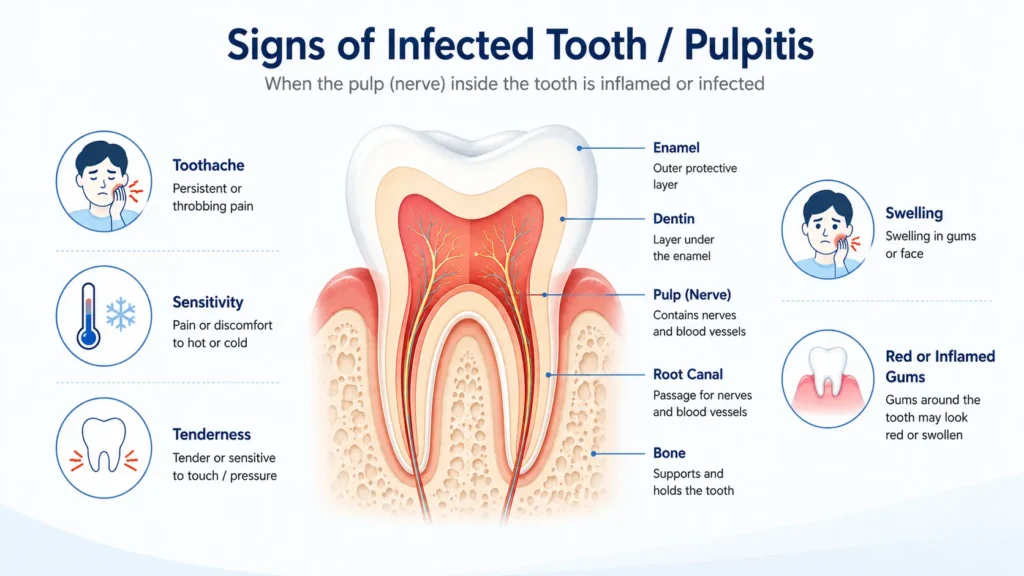
Every tooth has a hard outer layer (enamel), a middle layer (dentin), and a hollow inner chamber that houses nerves and blood vessels. When decay, a crack, or trauma allows bacteria to reach that inner chamber, the pulp becomes inflamed and then infected. Left untreated, the infection can travel down through the root and into the surrounding jawbone, forming an abscess.
This is why root canal symptoms often feel disproportionate to how the tooth looks from the outside — the real damage is happening where you can’t see it.

10 Signs You Need a Root Canal Treatment
Not every symptom on this list means you definitely need a root canal, and not every root canal case shows every symptom. Some infections are almost silent until a routine check-up X-ray reveals them. Still, if you notice two or more of the following, it’s worth getting the tooth examined soon rather than waiting.
1. Persistent or Throbbing Tooth Pain
Pain that lingers for more than a day or two, worsens at night, or throbs in rhythm with your pulse is one of the clearest signs of nerve involvement. Unlike the short, sharp twinge of simple sensitivity, this kind of pain tends to build gradually and doesn’t fully go away with an over-the-counter painkiller.
Patients often describe it as a deep ache that seems to radiate toward the ear, jaw, or even other teeth, making it hard to pinpoint exactly which tooth is the problem — something only a dental exam and X-ray can confirm.
2. Lingering Sensitivity to Hot or Cold
Brief sensitivity that fades within a few seconds is usually normal, but sensitivity that lingers for 30 seconds or longer after the hot or cold stimulus is removed often signals pulp inflammation. This is one of the most useful self-checks patients can do at home.
Try sipping something cold or warm and note how long the discomfort lasts. If it fades almost immediately, it may simply be enamel wear or a small area of exposed dentin. If it lingers, it points toward the nerve itself being affected.
3. Pain When Chewing or Biting Down
Sharp pain specifically when chewing, or when biting on a particular spot, often means the infection has spread beyond the tooth into the ligament that anchors it to the bone. This is sometimes described as the tooth feeling “high” or “different” compared to the others, even though nothing has physically changed about its height.
This sign is particularly common with cracked teeth, where the crack only opens under the pressure of biting, letting bacteria reach the nerve intermittently.
4. Swollen or Tender Gums Near One Tooth
Localised gum swelling around a single tooth — rather than general gum irritation across the mouth — is a common indicator of an underlying tooth infection rather than routine gum disease. The gum may look puffy, feel tender to touch, or appear slightly darker than the surrounding tissue.
This is different from generalised gum inflammation linked to plaque buildup, which usually affects a wider area and responds to improved oral hygiene.
5. A Pimple or Boil on the Gums (Gum Abscess)
A small, pimple-like bump on the gum — sometimes called a gum boil or dental sinus tract — is a classic dental abscess sign that indicates the body is trying to drain an infection from the root tip. It may come and go, and can even leak a small amount of fluid with a bad taste.
This is one sign that should never be ignored, even if the associated pain is mild or absent, because the infection is often already established by the time this appears.
6. Tooth Discoloration or Darkening
A tooth that gradually turns grey, yellow-brown, or noticeably darker than its neighbours can indicate that the internal nerve tissue has died, often following an old injury or long-standing untreated decay. This discoloration happens because breakdown products from the dying pulp tissue seep into the surrounding dentin.
Patients sometimes notice this months or even years after a childhood injury to the tooth, long after any original pain has faded.
7. A Cracked, Chipped, or Broken Tooth
Any crack or fracture that’s deep enough to expose the inner layers of the tooth creates a direct pathway for bacteria to reach the pulp. Cracks aren’t always visible to the naked eye — some only show up under magnification or on an X-ray, which is why unexplained pain after a fall, a bite on something hard, or a sports injury warrants a check-up even if the tooth looks intact.
8. Deep Decay or a Large, Ageing Filling
A cavity that has been left untreated for a long time, or a large filling that has been repeatedly redone on the same tooth over the years, significantly raises the chance of the nerve eventually becoming involved. Each time a filling is replaced, a small amount of additional tooth structure is removed, bringing the restoration closer to the pulp chamber.
This is a common and often underappreciated route to needing a root canal — patients are frequently surprised that a tooth “already treated” for a cavity can still end up needing further treatment.
9. Swelling That Spreads to the Face or Jaw
Swelling that extends beyond the gum line into the cheek, jaw, or around the eye is a sign of a spreading dental infection and should be treated as a dental emergency. This can be accompanied by fever, a general feeling of being unwell, or difficulty fully opening the mouth.
This level of swelling means the infection has moved from the tooth into the surrounding soft tissue, and it needs same-day evaluation rather than a routine appointment.
10. A Tooth That Suddenly Stops Hurting
This is the sign most patients misread as good news. When severe tooth pain suddenly disappears without any treatment, it often means the nerve inside the tooth has died — not that the problem has resolved. The infection can still be present and active in the surrounding bone, simply without the pain signal it once produced.
This is precisely why a dentist’s evaluation matters more than how a tooth currently feels; a “quiet” infected tooth can still be causing damage.
Normal Tooth Sensitivity vs Root Canal Symptoms: How to Tell the Difference
Not every twinge means trouble. This table outlines how ordinary sensitivity typically differs from symptoms that point toward the nerve being involved.
| Feature | Normal Sensitivity | Possible Root Canal Symptom |
| Duration of pain | Fades within seconds | Lingers 30+ seconds or longer |
| Trigger | Only with hot/cold/sweet | Can occur without any trigger, including at rest |
| Timing | Random, situational | Often worse at night or when lying down |
| Swelling | Absent | Present, sometimes localised to one tooth |
| Response to painkillers | Usually resolves fully | Partial relief or pain returns quickly |
| Bite pressure | No change | Pain or discomfort when biting or chewing |
| Gum appearance | Normal | Puffy, tender, or a small bump nearby |
If your symptoms consistently fall in the right-hand column, it’s a reasonable indication to schedule an exam rather than wait it out.
What Happens If You Ignore These Signs?
Ignoring root canal symptoms doesn’t make the infection go away — it typically allows it to spread from the tooth’s root into the surrounding jawbone, sometimes forming a larger abscess or affecting neighbouring teeth. In some cases, the tooth may eventually need to be extracted rather than saved, simply because treatment was delayed too long.
Beyond the tooth itself, untreated dental infections have been linked by dental and medical literature to broader health concerns in some patients, particularly those with existing conditions such as diabetes. This is one of the reasons dentists consistently recommend prompt evaluation over a “wait and see” approach once two or more warning signs are present.
Root Canal or Extraction? How Dentists Decide
Many patients arrive at a consultation assuming the choice is automatically extraction, when in most cases a root canal is the option that preserves the natural tooth. Dentists generally weigh a few factors before recommending either path:
- How much healthy tooth structure remains above the gum line to support a filling or crown afterward
- Whether the crack, if present, extends below the gum line or into the root itself
- The extent of bone loss around the root, visible on an X-ray
- The patient’s overall oral health and ability to maintain the restored tooth
As a general principle, preserving a natural tooth through root canal treatment is usually preferable to extraction when the tooth’s structure allows it, since an extracted tooth eventually needs replacement to maintain proper chewing function and prevent shifting of neighbouring teeth. That said, every case is different, and the right decision depends entirely on what a clinical exam and X-ray reveal about your specific tooth.
Learn more – Root Canal vs Tooth Extraction: Which Is Better?
Myths vs Facts About Root Canal Symptoms
Myth: If a tooth doesn’t hurt, it doesn’t need a root canal. Fact: A dead or dying nerve can stop producing pain signals entirely, even while infection is still present in the surrounding bone.
Myth: Swelling always means the infection is new. Fact: Swelling, including a gum boil, can appear and disappear over months as a long-standing infection periodically drains.
Myth: Root canal treatment itself is more painful than the symptoms leading up to it. Fact: Modern root canal treatment, performed under local anaesthesia, is designed to relieve the pain caused by the infection rather than add to it; most patients report the pre-treatment symptoms were more uncomfortable than the procedure itself.
Myth: A crown or filling means the tooth can never need a root canal. Fact: A previously filled or crowned tooth can still develop a nerve infection years later, especially if the restoration is old or the tooth has since cracked.
When These Signs Mean You Need Emergency Dental Care
Facial or jaw swelling, fever, difficulty swallowing or breathing, or pain that is rapidly worsening alongside swelling are emergency signs and should not wait for a routine appointment. These symptoms can indicate a spreading infection that needs same-day attention.
If you’re experiencing this combination of symptoms, contact a dental clinic directly rather than waiting for the next available routine slot, and seek emergency medical care immediately if swelling is affecting your ability to breathe or swallow.
What Happens at Your Root Canal Consultation at City Smiles Dental Care
A consultation typically starts with a discussion of your symptoms and their timeline, followed by a clinical examination and a dental X-ray to assess the extent of the problem. At City Smiles Dental Care, treatment planning is personalised to each patient — the same set of symptoms can point to different treatment needs depending on the tooth’s structural condition, root anatomy, and overall oral health.
Patients from Garia, Baghajatin, Jadavpur, Tollygunge, Santoshpur, Dhakuria, and other parts of South Kolkata are welcome to book a consultation to have any of the signs above properly evaluated before symptoms progress further.
Frequently Asked Questions
1. How do I know for sure if I need a root canal? Only a dental exam combined with an X-ray can confirm whether a tooth needs a root canal. Persistent pain, lingering sensitivity, swelling, or a gum boil are strong indicators that warrant getting checked.
2. Can a tooth that needs a root canal heal on its own? No. Once the pulp tissue is infected, it cannot heal itself, and the infection will typically continue to spread rather than resolve without treatment.
3. Is it normal for a badly aching tooth to suddenly stop hurting? This is common when the nerve has died, but it does not mean the infection has resolved — it usually means the tooth needs prompt evaluation despite feeling better.
4. What does root canal pain actually feel like? It’s often described as a deep, throbbing ache that may worsen at night, react intensely to hot or cold, or intensify when biting down on the affected tooth.
5. Can sinus problems cause symptoms that mimic a root canal issue? Yes, upper back teeth sit close to the sinuses, and sinus pressure can sometimes cause tooth pain that mimics a root canal problem, which is why a dental exam is useful to rule this in or out.
6. Does a gum boil near a tooth always mean infection? A bump on the gum near a specific tooth is a common dental abscess sign and should be evaluated, even if it isn’t painful, since it usually indicates an underlying infection.
7. How long can I safely wait if I notice these signs? There’s no universally safe waiting period, since infections progress at different rates; symptoms involving facial swelling, fever, or rapidly worsening pain need same-day attention, while milder signs still warrant an appointment within a few days.
8. Will a root canal save a badly infected tooth? In many cases, yes — root canal treatment can save a tooth even with significant infection, provided enough healthy structure remains, though a clinical exam is needed to confirm this for your specific tooth.
9. Can children show these same signs? Children can show similar signs, including sensitivity and swelling, though evaluation and treatment approaches for baby and permanent teeth differ from those for adults.
10. What happens if I keep ignoring the symptoms? Ignoring these signs generally allows the infection to spread further into the bone and surrounding tissue, which can eventually put the tooth at higher risk of needing extraction instead of a root canal.
Conclusion
Recognising the signs you need a root canal early — whether it’s lingering sensitivity, a throbbing ache, swelling, or a tooth that’s gone unexpectedly quiet — puts you in a far better position to save the natural tooth and avoid a more complicated treatment down the line. None of these signs are something to self-diagnose with certainty, but they’re a reliable cue that it’s time for a professional exam.
If you’re noticing any of these symptoms, book a consultation with City Smiles Dental Care to have the tooth properly examined. Patients across South Kolkata — including Garia, Baghajatin, Jadavpur, Tollygunge, Santoshpur, and Dhakuria — can also check recent patient experiences on our Google Business Profile before their visit.