


If you have a toddler who still reaches for their thumb at nap time, you are not alone — and you don’t need to panic. Thumb sucking is one of the most common childhood habits, and for most children it is completely normal. But parents often ask us the same question at City Smiles Dental Care: at what point does thumb sucking teeth problems become something to actually worry about?
The honest answer is that it depends on your child’s age, how intensely they suck, and how long the habit continues. This guide walks you through exactly when thumb sucking is harmless, when it starts to affect the teeth and jaw, and what you can do about it — as a parent, and with help from a dentist if needed.
What Is Considered Normal Thumb Sucking?
Thumb sucking is a natural reflex present from before birth, and most children use it to self-soothe, especially when tired, hungry, or anxious. It is considered developmentally normal in infants and toddlers up to roughly age 2 to 4. The habit typically fades on its own as children find other ways to comfort themselves.
A few points worth keeping in mind:
- Nearly all infants suck their thumb or fingers at some stage.
- Most children stop between ages 2 and 4 without any intervention.
- Occasional, light thumb sucking rarely causes lasting dental changes at this age.
- The primary (baby) teeth are more forgiving of pressure than permanent teeth.
There is usually no reason to actively discourage the habit in a two-year-old. The concern grows only if it continues well past this window.
At What Age Does Thumb Sucking Become a Dental Concern?
Thumb sucking becomes a genuine dental concern once it continues past age 4 to 5, particularly as permanent teeth begin erupting around age 6. Before this age, forces from sucking rarely cause permanent structural change. After it, the same habit can start shifting how the adult teeth and jaw develop.
Three factors determine whether a habit is likely to cause dental effects:
- Duration — how many years the child has been sucking their thumb.
- Frequency and intensity — passive resting of the thumb versus vigorous, active sucking.
- Timing relative to tooth eruption — habits that persist as permanent front teeth come in cause more noticeable changes.
A child who occasionally sucks their thumb at age 3 is very different, dentally speaking, from a child who is still doing it aggressively at age 7.
How Thumb Sucking Affects Teeth and Jaw Development
Prolonged, intense thumb sucking applies repeated pressure on the front teeth, upper jaw, and roof of the mouth, which can gradually reshape how they grow. The most common thumb sucking dental effects include an open bite, flared upper front teeth, a narrowed palate, and altered speech patterns. These changes develop slowly and are directly related to how hard and how often the child sucks.
Open Bite and Overjet
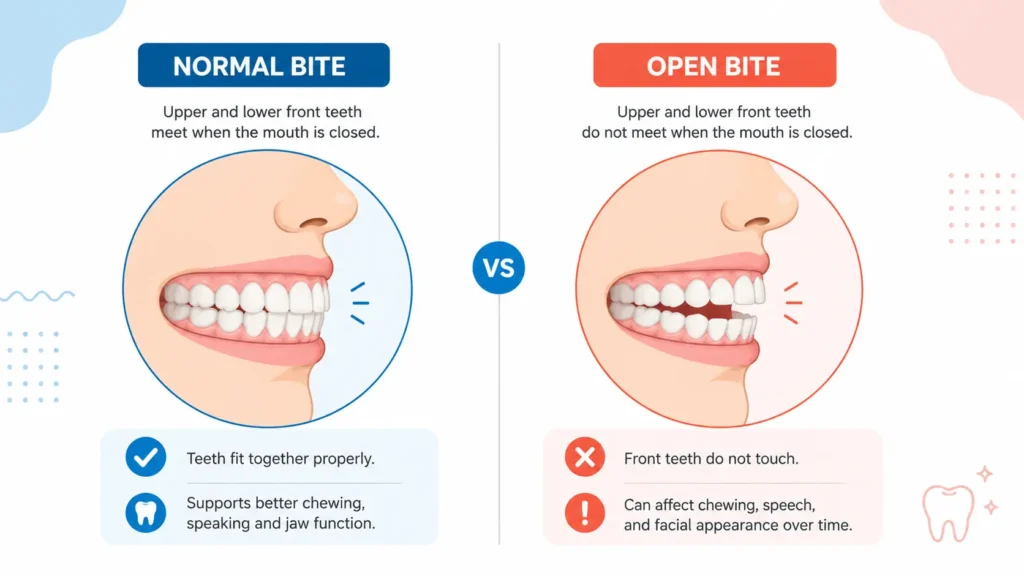
The upper and lower front teeth are pushed apart by the thumb, creating a gap between them even when the back teeth are closed together — this is called an anterior open bite. The upper front teeth can also tip forward, creating an increased overjet, sometimes described by parents as “buck teeth.”
Narrowing of the Palate
Constant pressure from the cheek muscles, combined with the tongue sitting lower than normal to make room for the thumb, can narrow the upper jaw over time. A narrowed palate can lead to a posterior crossbite, where the upper back teeth sit inside the lower back teeth instead of outside them.
Speech and Swallowing Changes
Because the tongue’s resting position is disrupted, some children develop a tongue thrust or mild lisp, particularly with sounds like “s,” “t,” and “d.” Swallowing patterns can also be affected, though this typically improves once the oral habit stops and normal tongue posture returns.
Signs Thumb Sucking May Already Be Affecting Your Child’s Teeth
Not every child who sucks their thumb develops dental problems, but a few warning signs suggest it is time to pay closer attention:
- A visible gap remains between the upper and lower front teeth when the mouth is closed.
- The upper front teeth appear to be tilting or flaring outward.
- The child has developed a lisp or altered “s” sound.
- There is a callus or reddened patch on the thumb from frequent sucking.
- The child is still sucking their thumb daily past age 5.
- The bite looks uneven when the back teeth are pressed together.
If you notice two or more of these signs, it is a reasonable point to bring it up at your child’s next dental visit rather than waiting for the next routine check-up.
Thumb Sucking vs Pacifier Use: Which Is Easier on Teeth?
Parents often ask whether switching from thumb to pacifier — or the reverse — makes a dental difference. Both habits can affect the bite in similar ways when continued too long, but pacifiers are generally easier to wean a child off than a thumb, since a parent can control access to it.
| Factor | Thumb Sucking | Pacifier Use |
| Parental control over the habit | Low — thumb is always available | Higher — pacifier can be phased out or removed |
| Typical pressure on palate | Variable, often more intense | Often more even, depending on design |
| Ease of weaning | Harder, since it’s part of the child’s own body | Easier, since the object itself can be withdrawn |
| Hygiene | No external object to sterilize | Requires regular cleaning |
| Dental impact if prolonged | Similar risk of open bite and narrowed palate | Similar risk, slightly lower with orthodontic-shaped pacifiers |
Neither option is inherently “safe” for unlimited use. The real determining factor is how long the habit — thumb or pacifier — continues past the toddler years.
Mild vs Prolonged Thumb Sucking: Comparing the Dental Impact
The dental impact of thumb sucking exists on a spectrum. A child who sucks their thumb lightly and stops by age 3 faces a very different outlook than one who sucks vigorously into the early school years.
| Aspect | Mild / Early Habit (stops by age 3–4) | Prolonged / Intense Habit (continues past age 5–6) |
| Typical dental effect | Little to no lasting change | Open bite, flared teeth, narrowed palate |
| Effect on permanent teeth | Minimal, since permanent teeth haven’t erupted | Higher risk, as habit overlaps with adult tooth eruption |
| Self-correction after stopping | Usually corrects on its own | May need active monitoring or orthodontic input |
| Speech impact | Rare | More likely, especially with tongue thrust |
| Recommended action | Monitor and encourage gentle weaning | Pediatric dental evaluation recommended |
How to Help Your Child Stop Thumb Sucking
Most children respond better to gentle encouragement than to punishment or shaming, which can increase anxiety and, ironically, reinforce the habit. Here are approaches that tend to work well:
- Identify the triggers. Notice whether your child sucks their thumb mainly at bedtime, during stress, or out of boredom, and address that specific trigger.
- Praise progress, not perfection. A simple reward chart for thumb-free hours or days can motivate young children more effectively than criticism.
- Offer a substitute comfort. A soft toy or blanket at bedtime can replace the self-soothing role the thumb was playing.
- Keep the thumb “busy.” Older toddlers often respond to wearing a sock or glove on the hand at night as a gentle physical reminder.
- Involve your child in the goal. Children aged 4 and up often do better when they choose their own motivation, such as picking a small reward for milestones.
- Avoid harsh reprimands. Scolding tends to increase stress-driven sucking rather than reduce it.
If these home strategies aren’t working by age 5, it’s a good time to loop in a pediatric dentist rather than continuing to manage it alone.
When to See a Pediatric Dentist About This Oral Habit
A pediatric dental evaluation is recommended once a child is still actively thumb sucking at age 5 or older, or if you notice any of the warning signs mentioned earlier — regardless of age. At City Smiles Dental Care, we assess the child’s bite, palate width, and speech pattern to determine whether the habit has caused any structural change, and we work with parents on realistic, non-stressful weaning strategies.
We regularly see families from Garia, Baghajatin, Jadavpur, Tollygunge, Santoshpur, Dhakuria, and other neighbourhoods across South Kolkata for exactly this concern. An early, low-pressure visit is often all that’s needed — many children never require any device or procedure at all, and the conversation itself can help parents feel more confident about their next steps.
Learn more – How to Prepare Your Child for Their First Dental Appointment

Dental Treatment Options If Damage Has Already Started
If a child’s bite has already been affected, treatment is planned around the child’s age, the severity of the change, and whether permanent teeth have erupted — there is no single fixed approach, and any recommendation follows a hands-on clinical examination.
Options a pediatric dentist may discuss include:
- Behavioural counselling and positive reinforcement, continued and reinforced professionally.
- Habit-breaking appliances, such as a removable or fixed device that gently discourages thumb placement, used only when home strategies have not worked.
- Monitoring through childhood growth, since some open bites correct naturally once the habit stops before all permanent teeth arrive.
- Referral for orthodontic evaluation, only if the bite change persists into the mixed or permanent dentition stage.
We never recommend an appliance or orthodontic referral without first observing the child’s bite directly, since the right approach varies significantly from case to case.
Myths vs Facts About Thumb Sucking and Teeth
| Myth | Fact |
| “Thumb sucking always causes crooked teeth.” | Only prolonged, intense sucking past the toddler years typically causes lasting change. |
| “A pacifier is completely safe for the teeth.” | Prolonged pacifier use carries similar risks to thumb sucking if continued too long. |
| “Damage from thumb sucking is permanent.” | Many changes self-correct once the habit stops before permanent teeth erupt. |
| “Only a dentist can stop the habit.” | Most children stop with parental support; a dentist’s role is usually guidance, not force. |
| “Thumb sucking has no effect on speech.” | It can contribute to a lisp or tongue thrust in some children who suck intensely. |
Frequently Asked Questions
At what age should a child stop thumb sucking? Most children stop naturally between ages 2 and 4. If the habit continues past age 5, especially as permanent teeth begin erupting, it is a good time to seek guidance from a pediatric dentist.
Does thumb sucking always cause crooked teeth? No. Mild or occasional thumb sucking that stops before age 4 rarely causes lasting damage. Dental changes are more likely with intense, prolonged sucking that continues into the school years.
Is a pacifier better than thumb sucking for a child’s teeth? Both carry similar dental risks if used long-term, though a pacifier is generally easier for parents to phase out since it can be physically removed, unlike a thumb.
Can thumb sucking affect my child’s speech? Yes, in some children. Prolonged sucking can alter tongue posture and contribute to a lisp or tongue thrust, though this often improves once the habit and tongue position normalize.
Will my child’s teeth go back to normal after they stop thumb sucking? Often, yes — particularly if the habit stops before permanent teeth erupt. Changes that persist after permanent teeth arrive may need dental monitoring or orthodontic input.
What is a habit-breaking appliance, and does my child need one? It is a removable or fixed dental device that gently discourages thumb placement in the mouth. It is only recommended after home strategies have been tried and a dentist has examined the child’s bite.
How can I gently help my child quit thumb sucking without stress? Identify what triggers the habit, offer a comforting substitute, use encouragement and reward-based motivation, and avoid scolding, which tends to increase anxiety-driven sucking.
Should I take my child to a pediatric dentist just for thumb sucking, even if their teeth look fine? Yes, if the habit continues past age 5. An early check-up helps catch subtle bite changes before they progress, even when nothing looks obviously wrong yet.
Conclusion
Thumb sucking is a normal part of early childhood, and in most cases it resolves on its own without any dental consequences. The concern around thumb sucking teeth effects grows only when the habit continues past the toddler years, particularly once permanent teeth begin to erupt. Gentle, consistent encouragement at home resolves the habit for most children — and for those who need extra support, a pediatric dental evaluation can catch changes early and guide the right next step.
If your child in Garia, Baghajatin, Jadavpur, Tollygunge, Santoshpur, Dhakuria, or anywhere else in South Kolkata is still sucking their thumb past age 5, or you’ve noticed any of the warning signs above, City Smiles Dental Care is here to help. Book a pediatric dental check-up with our team, or read reviews from other South Kolkata parents on our Google Business Profile. A brief, low-pressure visit today can save your child years of orthodontic correction later.