


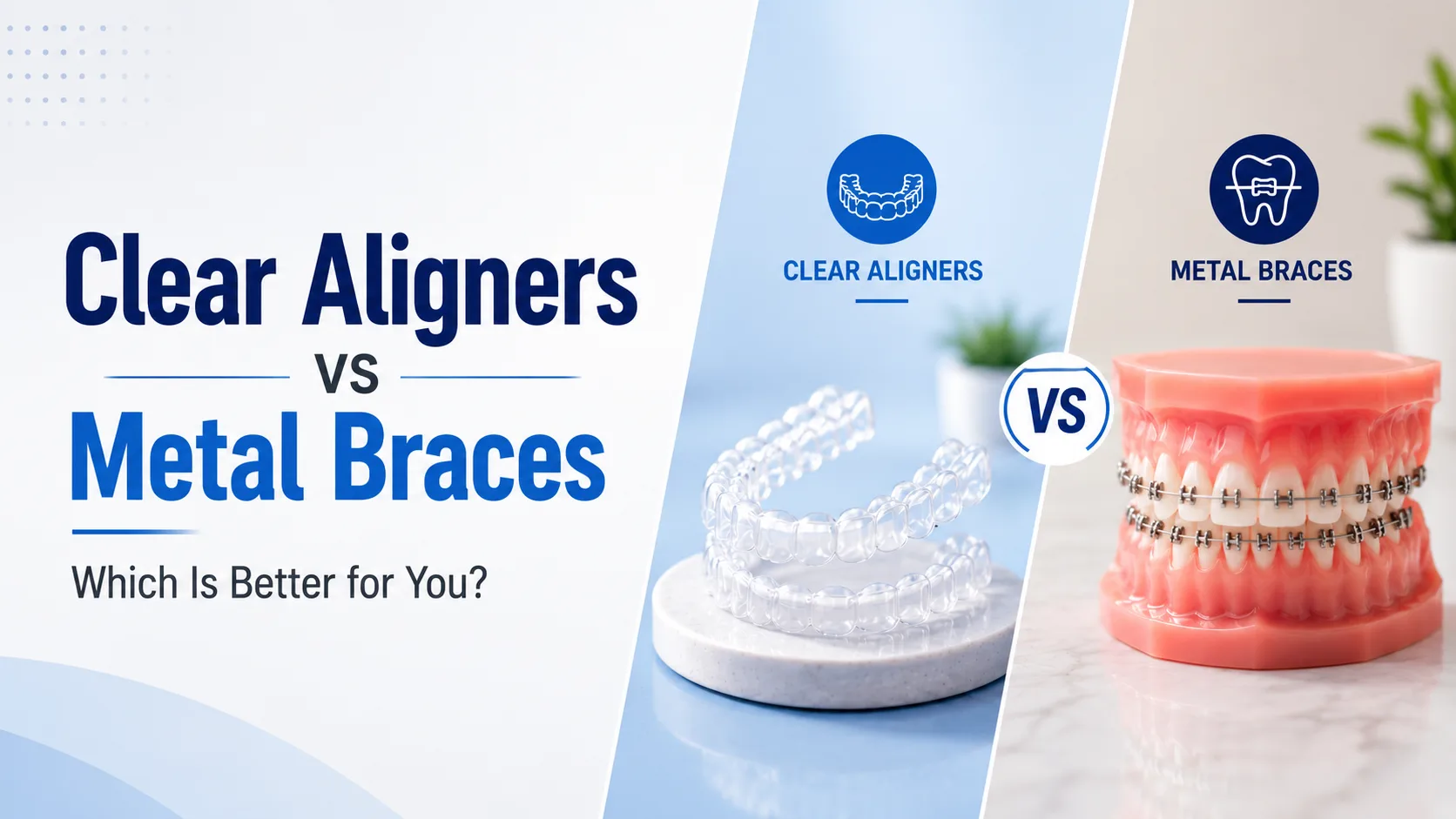
If you’ve been putting off orthodontic treatment because you can’t decide between clear aligners vs braces, you’re not alone. It’s one of the most common questions patients ask when they visit a dentist in South Kolkata for a smile consultation.
Both treatments straighten teeth effectively. But they work differently, suit different situations, and come with different trade-offs in cost, comfort, and daily life. This guide breaks down the real differences — not marketing claims — so you can walk into your consultation already informed.
Quick Answer
Clear aligners suit mild-to-moderate misalignment, working adults, and patients who prioritize appearance and removability. Metal braces suit complex bite corrections, growing children and teenagers, and patients who want a fixed, lower-maintenance option. Neither is universally “better” — the right choice depends on your specific bite and goals, which is why a clinical evaluation matters more than any generic comparison.
What Are Clear Aligners?
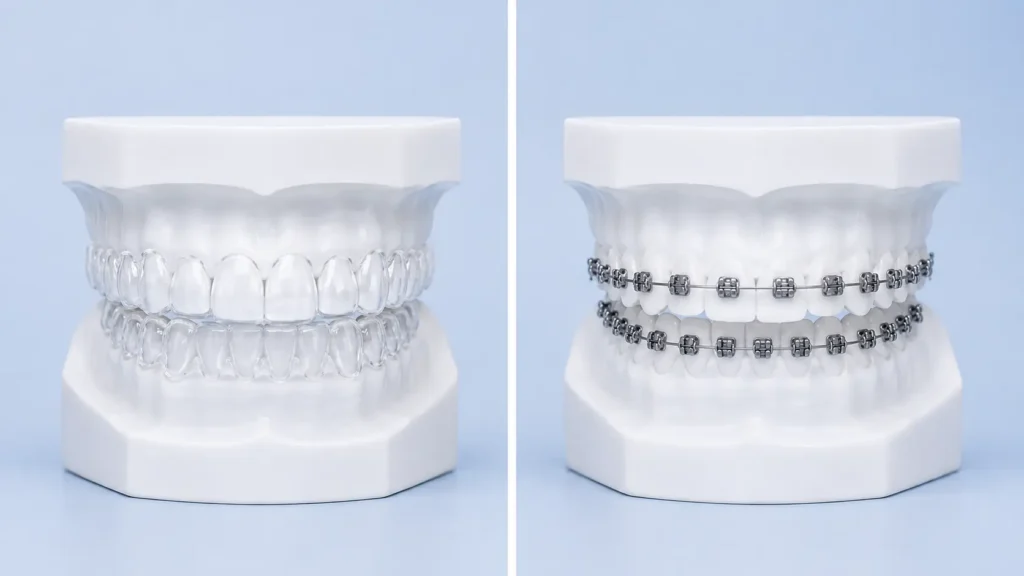
Clear aligners are a series of custom-made, transparent plastic trays that gradually shift teeth into position. Each set is worn for one to two weeks before moving to the next in the series, with the treatment plan mapped out in advance using digital scans or impressions.
They’re removable, which means patients can take them out to eat, brush, and floss normally. This is one of the biggest lifestyle advantages over fixed appliances, but it also means results depend heavily on how consistently they’re worn.
Most dentists recommend wearing aligners for 20 to 22 hours a day. Wearing them less than that can slow progress or affect the final result.
What Are Metal Braces?
Metal braces are the traditional, fixed orthodontic appliance made of stainless-steel brackets bonded to each tooth and connected by an archwire. The wire is tightened periodically during in-clinic visits, gradually guiding teeth into their correct position.
Because they’re fixed in place, braces don’t rely on patient compliance the way aligners do — they work continuously, 24 hours a day, regardless of how disciplined the patient is. This makes them a dependable option for complex corrections and for younger patients who may not consistently wear a removable device.
Modern metal braces are also smaller and less bulky than older designs, though they remain visibly noticeable compared to aligners.
Clear Aligners vs Metal Braces: Head-to-Head Comparison
| Factor | Clear Aligners | Metal Braces |
| Visibility | Nearly invisible | Clearly visible |
| Removability | Removable by patient | Fixed, dentist-removed only |
| Comfort | Smooth plastic, minimal irritation | Occasional wire/bracket irritation |
| Best for | Mild-to-moderate misalignment | Mild to severe/complex cases |
| Oral hygiene | Easier — remove to brush/floss | Requires more careful cleaning around brackets |
| Food restrictions | None (remove before eating) | Avoid sticky, hard, and chewy foods |
| Treatment discipline needed | High (20–22 hrs/day wear) | Low (fixed, no patient reliance) |
| Typical duration | 12–18 months (case-dependent) | 18–24 months (case-dependent) |
| Relative cost in India | Generally higher | Generally more affordable |
| Clinic visit frequency | Less frequent | Every 3–6 weeks for adjustments |
Exact treatment time, suitability, and cost depend entirely on the complexity of your bite and can only be confirmed after a clinical examination and X-rays.
Which Works Better? Effectiveness by Case Complexity
For mild-to-moderate cases — gaps, minor crowding, slight rotations — both aligners and braces typically deliver comparable results. The choice here usually comes down to lifestyle and appearance preference rather than effectiveness.
For moderate-to-severe cases — significant crowding, major bite misalignment, or cases needing tooth extraction and jaw-level correction — metal braces generally offer more predictable and precise control, particularly for vertical and rotational movements that some aligner systems handle less reliably.
This doesn’t mean aligners are ineffective for complex cases; aligner technology has advanced considerably. But it does mean the decision should be based on a proper assessment of your bite, not personal preference alone.
Cost Comparison in Kolkata
Orthodontic treatment costs in Kolkata, as across most of India, vary based on case complexity, treatment duration, and the technology used. As a general market reference:
- Metal braces typically fall in the lower-to-mid price range for orthodontic treatment in Indian metro cities.
- Clear aligners are generally priced higher, reflecting the custom manufacturing and digital planning involved.
These are broad market ranges, not clinic-specific quotes. Your exact cost will depend on the length of treatment, the number of aligner sets or wire adjustments required, and any additional procedures needed. A precise estimate can only be given after an in-person evaluation at City Smiles Dental Care.
Comfort, Appearance, and Lifestyle Fit
Clear Aligners — Pros
- Virtually invisible, ideal for professionals and image-conscious patients
- Smooth edges reduce cheek and gum irritation
- No food restrictions since they’re removed before eating
- Easier brushing and flossing routine
Clear Aligners — Cons
- Requires strong discipline to hit the daily wear-time target
- Can be misplaced or forgotten while eating out
- Not ideal for very complex bite corrections
Metal Braces — Pros
- Works continuously without relying on patient compliance
- Generally more affordable
- Handles complex and severe cases reliably
- Well-suited for children and teens
Metal Braces — Cons
- Visibly noticeable
- Requires avoiding sticky, hard, and very chewy foods
- Slightly harder to clean around brackets and wires
- Occasional discomfort after adjustment visits
Treatment Duration and Maintenance
Both options require ongoing maintenance, just of different kinds.
With aligners, maintenance means keeping trays clean, storing them properly when not worn, and switching to the next set on schedule. With braces, maintenance means careful brushing around brackets, avoiding restricted foods, and attending adjustment appointments every few weeks.
Average treatment duration for both is commonly cited between 12 and 24 months, but this range shifts significantly based on how much correction is needed — a fact that applies equally to patients from Garia, Jadavpur, Baghajatin, Tollygunge, Santoshpur, and Dhakuria who come in with very different starting bite conditions.
Who Should Choose Clear Aligners?
Clear aligners tend to be a strong fit if you:
- Have mild-to-moderate spacing, crowding, or rotation
- Are an adult in a client-facing profession where appearance matters
- Are disciplined enough to wear them 20+ hours daily
- Prefer being able to remove your orthodontic device for meals and events
- Don’t have complex bite issues requiring extraction-level correction
Who Should Choose Metal Braces?
Metal braces are usually the better fit if you:
- Have moderate-to-severe misalignment or bite issues
- Are a growing child or teenager
- Want a lower-maintenance option that doesn’t depend on daily compliance
- Are working within a tighter treatment budget
- Need precise control over complex tooth movement
Myths vs Facts
Myth: Braces always work faster than aligners. Fact: For mild-to-moderate cases, treatment time is often similar. Braces tend to be faster only for complex corrections.
Myth: Aligners are just a cosmetic fix, not “real” orthodontic treatment. Fact: Aligners use the same biomechanical principles as braces — controlled, gradual force — to move teeth into position.
Myth: Adults can’t get metal braces. Fact: Age isn’t a barrier to braces. Many adults choose them for cost or effectiveness reasons even though aligners are more discreet.
Myth: You can eat anything with clear aligners. Fact: You can eat anything only because you remove the aligners first. Eating with them in can damage or stain the trays.
How City Smiles Dental Care Helps You Decide
At City Smiles Dental Care, the choice between clear aligners and metal braces is never made off a generic comparison chart. It starts with a clinical examination, a review of your bite pattern, and — where needed — dental X-rays to understand tooth and jaw positioning accurately.
From there, our dental team walks you through which option realistically fits your case, timeline, and budget, so you’re choosing based on your mouth, not just a preference for how a treatment looks. This personalized approach matters most for patients in South Kolkata neighbourhoods like Baghajatin, Garia, and Jadavpur, where we see a wide mix of bite complexities across age groups in daily practice.
Every recommendation we give is grounded in what the examination shows, not what’s trending. If your case doesn’t suit aligners, we’ll tell you clearly — the same way we would if braces weren’t necessary for a mild correction.
Frequently Asked Questions
Are clear aligners as effective as metal braces? For mild-to-moderate misalignment, both are similarly effective. For severe or complex bite issues, metal braces generally offer more predictable control, so effectiveness ultimately depends on your specific case.
Which is cheaper: clear aligners or metal braces? Metal braces are generally more affordable than clear aligners in most cases, since aligners involve custom digital planning and manufacturing. Exact costs vary based on case complexity and treatment length.
Which treatment is faster, aligners or braces? For straightforward cases, both take a similar 12–18 months. For complex corrections, braces are often faster since they don’t depend on daily wear-time compliance.
Do clear aligners hurt less than metal braces? Aligners generally cause less irritation to cheeks and gums since they have smooth edges, though both options can cause mild pressure discomfort, especially right after a new tray or wire adjustment.
Can severe misalignment be corrected with clear aligners? Some aligner systems can handle moderately complex cases, but severe crowding, major bite misalignment, or extraction-based corrections are typically better managed with metal braces for precise control.
Will I need to avoid certain foods during treatment? With braces, yes — sticky, hard, and very chewy foods should be avoided. With aligners, there are no food restrictions since you remove them before eating.
Can I switch from braces to clear aligners partway through treatment? In some cases, yes, but this depends on how much correction has already been achieved and your bite’s current state. This should only be decided after a clinical review by your dentist.
How do I know which option is right for me? The only reliable way is a clinical examination that reviews your bite complexity, oral health, lifestyle, and budget. A dentist can then recommend the option most likely to give you predictable, lasting results.
Do I need to wear a retainer after either treatment? Yes. Both aligners and braces require a retention phase afterward to prevent teeth from shifting back, regardless of which treatment you choose.
Conclusion
Choosing between clear aligners vs braces isn’t about which one is trendier — it’s about which one matches your bite, your lifestyle, and your budget. Aligners offer discretion and flexibility for milder cases, while metal braces remain a reliable, cost-effective solution for more complex corrections.
The most important step isn’t picking a side before you’ve been examined — it’s getting a clinical assessment that tells you which option will actually give you the results you want. If you’re in South Kolkata and weighing your orthodontic options, City Smiles Dental Care can help you make that decision with confidence.
Ready to find out which option suits your smile? Book an appointment with City Smiles Dental Care, or check patient reviews on our Google Business Profile before your visit.