


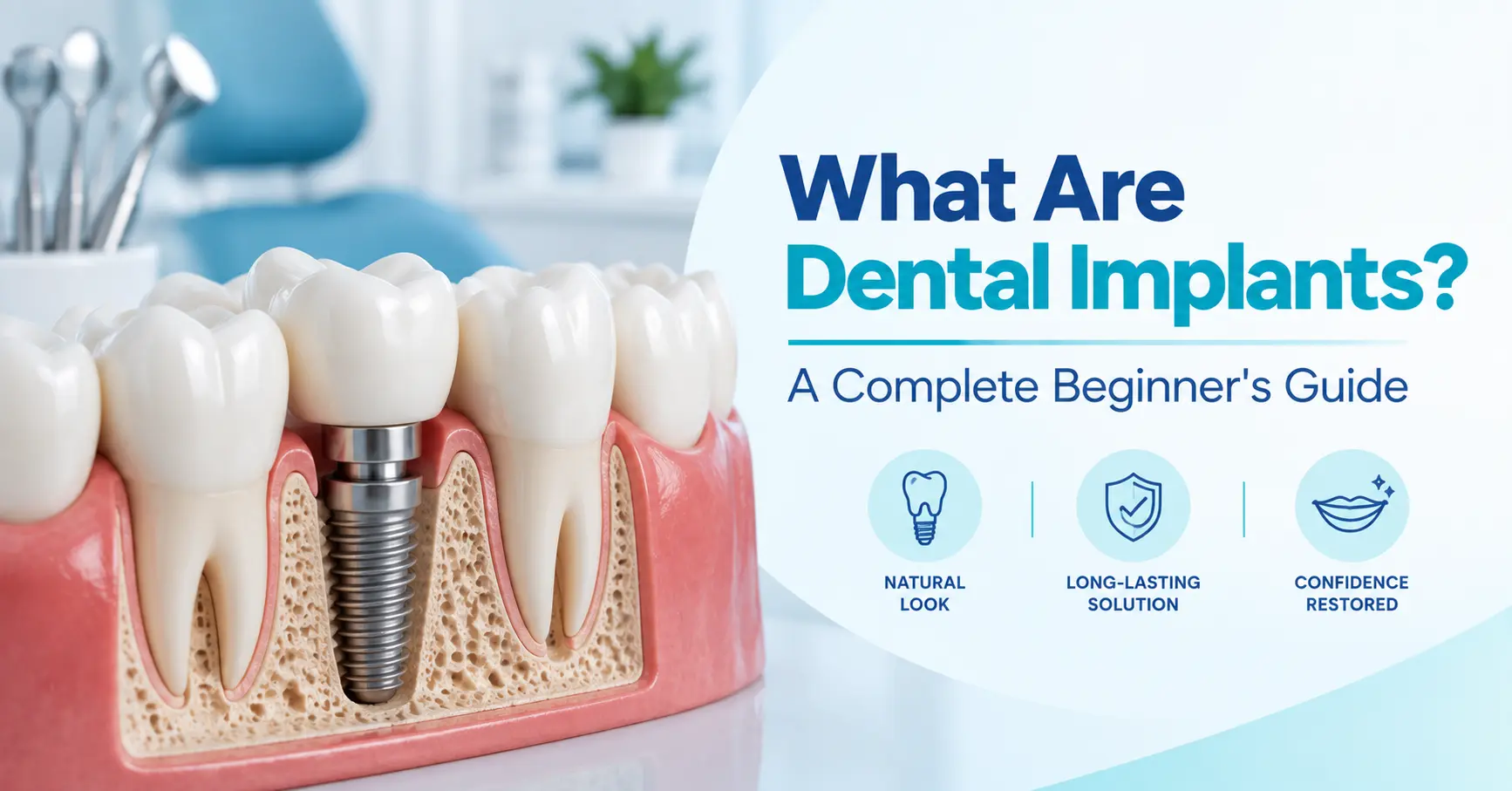
Losing a tooth changes small things first. You start chewing on one side. You cover your mouth when you laugh. You wonder if the gap is the first thing people notice.
If your dentist has mentioned implants — or you’ve been searching for a reliable missing tooth solution — this guide explains everything in plain language. So, what are dental implants, how do they work, and are they right for you? Let’s start with the basics.
What Are Dental Implants?
Dental implants are small titanium posts surgically placed into the jawbone to replace the root of a missing tooth. Once the implant bonds with the bone, a custom-made crown is attached on top. The result looks, feels, and functions like a natural tooth — allowing you to chew, speak, and smile with confidence.
Think of it this way: a natural tooth has two parts — the root below the gum and the crown above it. Every other tooth replacement option only replaces the visible crown. A dental implant is the only solution that replaces the root as well.
That single difference explains almost every advantage implants offer.
Quick Summary Box
| Question | Answer |
| What is it? | An artificial tooth root made of titanium, topped with a crown |
| What is it for? | Replacing one or more missing teeth permanently |
| Is it visible? | No — only the natural-looking crown shows |
| How long does treatment take? | Usually 3–6 months, case-dependent |
| How long does it last? | The implant itself can last decades with good care |
The Three Parts of a Dental Implant
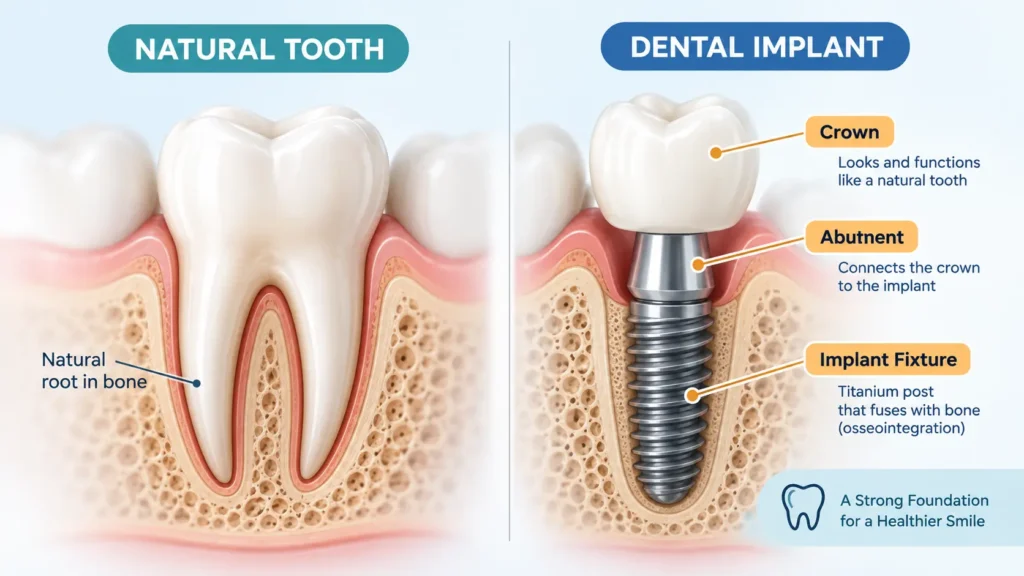
Understanding an implant becomes simple once you know its three components:
- The implant (fixture): A screw-shaped titanium post, typically 8–14 mm long, placed inside the jawbone. This is the artificial root.
- The abutment: A small connector that sits on top of the implant and passes through the gum line.
- The crown: The visible tooth-shaped cap, custom-shaded to match your natural teeth, fixed onto the abutment.
Each part is made and fitted separately, which is why implant treatment happens in stages rather than a single appointment.
How Does a Titanium Tooth Implant Bond With Your Jaw?
A titanium tooth implant bonds with the jaw through a natural biological process called osseointegration. Bone cells grow directly onto the titanium surface over 8–16 weeks, locking the implant firmly in place. This is why a well-integrated implant feels completely stable — it is anchored in bone, not resting on the gums.
Why titanium? Because it is biocompatible — the body accepts it rather than rejecting it as a foreign object. Titanium has been used in orthopaedic and dental medicine for decades precisely because bone bonds to it so predictably.
This bonding period is the “waiting phase” of implant treatment. It cannot be rushed, and respecting it is one of the biggest factors in long-term success.
One more benefit worth knowing: when a tooth root is missing, the jawbone in that area slowly shrinks because it no longer receives chewing stimulation. An implant restores that stimulation, helping preserve the bone — something no bridge or denture can do.
The Dental Implant Journey: What Happens Step by Step
Implant treatment follows a planned sequence over a few months. While every case is different, most patients at City Smiles Dental Care move through five broad stages: assessment, placement, healing, abutment fitting, and crown placement. Here’s what each involves.
- Consultation and planning. Your dentist examines your gums, remaining teeth, and bite, and takes X-rays (and often a 3D scan) to measure bone volume. This is where your personalised treatment plan is created — no two implant cases are planned identically.
- Implant placement. Under local anaesthesia, the titanium post is placed into the jawbone. The procedure for a single implant usually takes 30–60 minutes. Most patients are surprised at how uneventful it feels.
- Healing and osseointegration. Over the next 2–4 months, bone bonds with the implant. You may wear a temporary tooth during this period so you’re never left with a visible gap.
- Abutment placement. Once integration is confirmed, the connector is fitted and the gum is shaped around it.
- Crown placement. Impressions or digital scans are taken, and your custom crown is fabricated and fixed. Your new tooth is now ready for full function.
Recovery after placement is typically mild. Most patients manage any discomfort with routine painkillers and return to work within a day or two.
Dental Implants vs. Other Missing Tooth Solutions
Dental implants, bridges, and dentures all replace missing teeth, but they differ in how they’re supported, how long they last, and how they affect surrounding teeth. Implants stand independently in the jawbone, bridges rely on grinding down neighbouring teeth, and dentures rest removably on the gums.
Here’s how the three main options compare:
| Factor | Dental Implant | Dental Bridge | Removable Denture |
| Replaces the root? | Yes | No | No |
| Affects adjacent teeth? | No | Yes — they must be trimmed | Minimal, but clasps may stress them |
| Preserves jawbone? | Yes | No | No |
| Stability while eating | Like a natural tooth | Good | Can shift or slip |
| Typical lifespan | 15–25+ years (implant) | 7–15 years | 5–8 years |
| Removable? | No — fixed | No — fixed | Yes |
| Upfront cost | Higher | Moderate | Lower |
| Long-term value | Often the best | Moderate | Replacement costs add up |
There is no universally “best” option — a bridge or denture is genuinely the right choice for some patients. The right answer depends on your bone condition, adjacent teeth, budget, and health, which is why a clinical examination always comes before any recommendation.
Benefits of Choosing a Tooth Implant
A tooth implant offers benefits no other replacement can match: it functions like a natural tooth, protects the jawbone from shrinkage, leaves neighbouring teeth untouched, and can last decades with proper care. For many patients, the biggest benefit is simply forgetting the tooth was ever missing.
In practical terms, patients notice:
- Natural chewing power — bite into an apple or chew on both sides without thinking about it.
- No slipping or clicking — unlike dentures, implants never move.
- Healthy teeth stay healthy — no trimming of adjacent teeth, as a bridge requires.
- Bone preservation — the jaw keeps its shape, which also supports your facial structure over time.
- Easy maintenance — brush and floss like a normal tooth; no soaking, no adhesives.
- Confidence — the crown is shade-matched so closely that most people cannot tell it apart from your natural teeth.
Are Dental Implants Safe? Risks and Limitations
Dental implants are among the most predictable procedures in modern dentistry, with long-term success rates widely reported around 95% when placed in healthy patients with good bone. Like any surgical procedure, however, they carry small risks — infection, delayed healing, or, rarely, failure of the implant to integrate.
Honest points every patient should know before deciding:
- Implant failure is uncommon but possible. A small percentage of implants do not integrate and may need replacement. Smoking and uncontrolled diabetes significantly raise this risk.
- Gum health still matters. Implants can’t decay, but the gums around them can become inflamed (peri-implantitis) without good hygiene — the implant equivalent of gum disease.
- It takes time. Anyone promising a permanent tooth “in one day for everyone” is oversimplifying. Immediate-load implants exist, but they suit specific cases only.
- It’s a clinical decision. Bone volume, sinus position, nerve location, and medical history all affect planning. No ethical dentist can confirm you’re a candidate without examination and imaging.
At City Smiles Dental Care, we discuss these factors openly during consultation — an informed patient makes better decisions and heals better too.
Who Is a Good Candidate for Dental Implants?
Most healthy adults with one or more missing teeth are potential candidates for dental implants. The key requirements are healthy gums, adequate jawbone to hold the implant, and overall health that supports normal healing. Age alone is rarely a barrier — patients in their 70s and 80s receive implants successfully.
You may need additional preparation, or a different solution, if you have:
- Significant bone loss in the jaw (bone grafting can often rebuild it)
- Uncontrolled diabetes or conditions that impair healing
- Active gum disease (this is treated first)
- A heavy smoking habit (quitting or reducing markedly improves success)
- Certain medications affecting bone metabolism
For younger patients, implants are generally placed only after jaw growth is complete — usually from the late teens onward.
If you’re in Garia, Jadavpur, Baghajatin, Tollygunge, or anywhere in South Kolkata and unsure whether you qualify, a single consultation with imaging answers the question definitively.
How Long Do Dental Implants Last?
With good oral hygiene and regular dental check-ups, the titanium implant itself can last 20–25 years or more — often for life. The crown on top experiences daily chewing wear and typically needs replacement after 10–15 years, which is a straightforward procedure that doesn’t disturb the implant.
Three habits protect your investment:
- Brush twice daily and clean between teeth — implants need the same care as natural teeth.
- Visit your dentist every six months so implant health can be monitored.
- Avoid using your teeth as tools, and mention nighttime grinding — a night guard may be advised.
What Do Dental Implants Cost in Kolkata?

In Kolkata, a single dental implant with crown generally ranges from around ₹25,000 to ₹50,000+, depending on the implant brand, the type of crown chosen, and whether additional procedures like bone grafting are needed. Premium international implant systems sit at the higher end of this range.
Rather than a fixed price, think of implant cost as a personalised quote — because it genuinely varies with:
- The implant system used (Indian, Korean, European, and American brands differ in cost)
- Crown material (metal-ceramic vs. full ceramic/zirconia)
- Number of teeth being replaced
- Any preparatory work (extractions, bone grafts, sinus lifts)
While the upfront cost is higher than a bridge or denture, implants often cost less over a lifetime because they rarely need replacement. City Smiles Dental Care provides a clear, itemised treatment estimate after your examination, so you know exactly what your case involves before committing to anything.
Dental Implant Myths vs. Facts
Myth: Getting an implant is extremely painful. Fact: The procedure is done under local anaesthesia, and most patients describe it as easier than an extraction. Mild soreness for a few days is typical and manageable with routine painkillers.
Myth: Implants look fake or metallic. Fact: The titanium sits invisibly inside the bone. What you see is a custom-shaded ceramic crown that blends with your natural teeth.
Myth: I’m too old for implants. Fact: There’s no upper age limit. Health and bone condition matter, not age — implants are routinely placed for patients well into their senior years.
Myth: The body rejects metal implants. Fact: Titanium is biocompatible, and true rejection is extremely rare. The rare failures that occur are usually due to infection or healing issues, not the material itself.
Myth: Implants need special, complicated maintenance. Fact: They need exactly what natural teeth need — brushing, flossing, and regular check-ups.
Frequently Asked Questions About Dental Implants
1. What are dental implants made of? Most dental implants are made of medical-grade titanium, the same biocompatible metal used in joint replacements. The crown attached on top is usually ceramic or zirconia, shade-matched to your natural teeth. Some clinics also offer metal-free zirconia implants for specific cases.
2. Is the dental implant procedure painful? No — the placement is done under local anaesthesia, so you feel pressure but not pain. Afterward, most patients experience only mild soreness for 2–3 days, managed easily with common painkillers. Many say it was more comfortable than they expected.
3. How long does the entire implant process take? Most single-implant cases take 3–6 months from placement to final crown. The longest phase is the healing period, when the bone bonds with the titanium post. Complex cases involving bone grafting may take longer.
4. Can a dental implant replace more than one tooth? Yes. Two implants can support a bridge replacing three or four teeth, and full-arch solutions can restore an entire jaw using four to six implants. You don’t need one implant per missing tooth.
5. Will my implant look like a real tooth? Yes — the visible crown is custom-designed for shape, size, and shade to match your surrounding teeth. Once healed, most people cannot identify which tooth is the implant, even up close.
6. Are dental implants safe for diabetic patients? Patients with well-controlled diabetes can usually receive implants safely, though healing is monitored more closely. Uncontrolled diabetes raises failure risk, so your dentist may ask for recent blood sugar reports before planning treatment.
7. What happens if I don’t replace a missing tooth? Over time, neighbouring teeth drift into the gap, the opposing tooth may over-erupt, chewing becomes uneven, and the jawbone in that area shrinks. Replacing the tooth early keeps treatment simpler and often less expensive.
8. Can smokers get dental implants? Yes, but smoking reduces blood flow to the gums and significantly increases the risk of implant failure. Dentists strongly advise stopping — or at minimum pausing — smoking around the time of surgery and healing.
9. How do I clean a dental implant? Exactly like a natural tooth: brush twice daily, clean between teeth with floss or interdental brushes, and attend six-monthly check-ups. No special products or soaking solutions are needed.
10. Where can I get a dental implant consultation in South Kolkata? City Smiles Dental Care in South Kolkata provides implant consultations with clinical examination and imaging-based planning for patients from Garia, Jadavpur, Baghajatin, Tollygunge, Santoshpur, Dhakuria, and nearby areas. You can book an appointment online.
Considering a Dental Implant in South Kolkata?
So, what are dental implants at their core? They’re the closest modern dentistry has come to regrowing a natural tooth — a titanium root that becomes part of your jaw, topped with a crown made just for you. For the right candidate, they restore not just a tooth but the freedom to eat, laugh, and speak without a second thought.
The most important step is also the simplest: a proper clinical assessment. Whether an implant, a bridge, or another missing tooth solution suits you best can only be determined by examining your gums, bone, and bite — never by an article alone.
Ready to find out if a dental implant is right for you?
The team at City Smiles Dental Care offers personalised implant consultations for patients across South Kolkata — including Garia, Baghajatin, Jadavpur, Tollygunge, Santoshpur, and Dhakuria.
👉 Book your consultation online — it takes less than a minute.
You can also find directions, timings, and patient reviews on our Google Business Profile.
A missing tooth doesn’t have to stay missing. Let’s plan your smile back — one step at a time.