


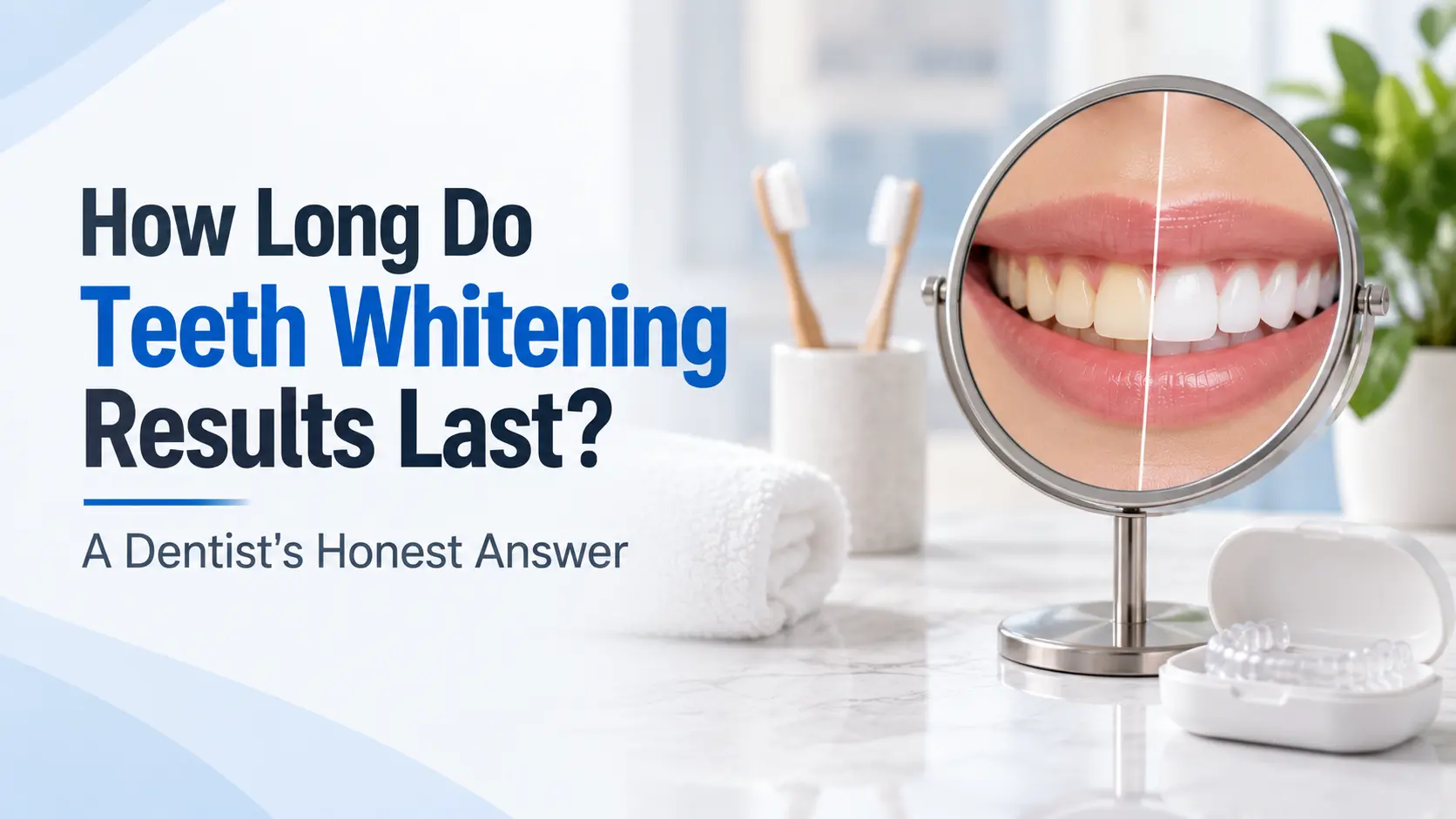
You have probably seen the before-and-after photos. What those photos never show is the same smile eighteen months later.
That is the question patients at our South Kolkata clinic ask most often before booking: how long do teeth whitening results actually last? It deserves a straight answer, because whitening is an investment — and the honest answer is “it depends, but here is exactly what it depends on.”
This guide explains realistic teeth whitening duration, why results differ so much between two people who had the same treatment, and how to keep your smile brighter for longer.
The Quick Answer: Typical Teeth Whitening Duration
Professional teeth whitening results usually last between six months and three years. In-clinic whitening tends to hold longer than home kits, and daily habits — especially tea, coffee, and tobacco — influence longevity more than the treatment itself. Whitening is never permanent, but with good maintenance, many patients enjoy visibly brighter teeth for two years or more.
Here is the honest part most advertisements skip: whitening does not “wear off” on a fixed date. Your teeth gradually pick up new surface stains from everything you eat and drink. The whiter baseline fades slowly, which is why two patients with identical treatments can look very different a year later.
Think of it like painting a wall in a busy household. The paint quality matters, but so does how much the wall gets touched every day.
Why Teeth Whitening Results Vary From Person to Person
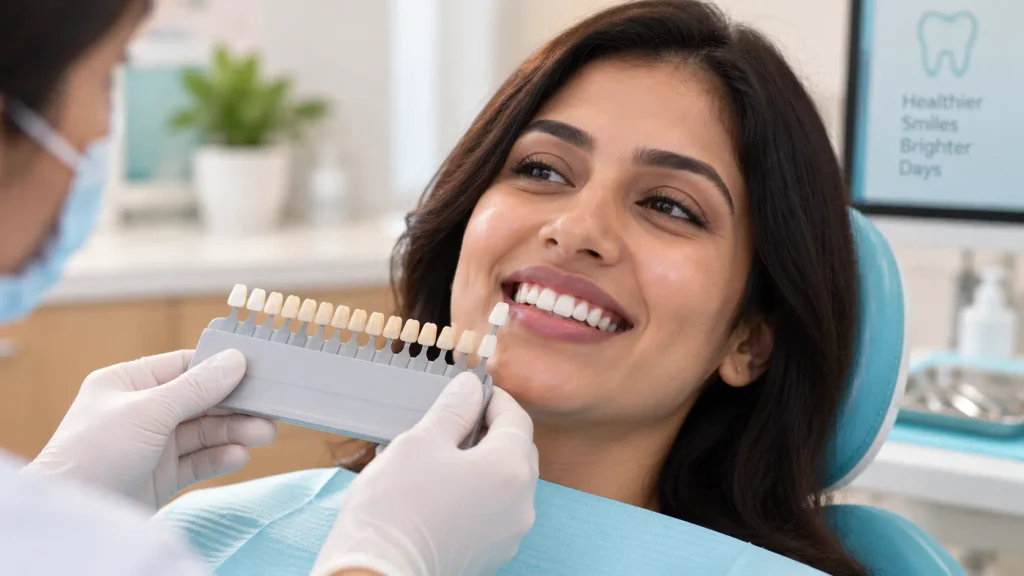
Whitening longevity depends on three main factors: your natural tooth structure, the whitening method used, and your daily staining habits. A patient with thick enamel, professional whitening, and minimal tea intake may stay bright for three years. A heavy chai drinker using strips may see fading within three months.
Your Natural Tooth Shade and Enamel
Teeth are not naturally paper-white. The inner layer (dentine) is yellowish, and it shows through the translucent enamel on top.
People with thicker, smoother enamel hold whitening longer. Thinner or more porous enamel lets stains penetrate faster — and it also means the yellowish dentine shows through more as fading begins. Age plays a role too, because enamel naturally thins over the years.
The Type of Whitening You Choose
Not all whitening is equal, and this is where duration differences are largest.
In-clinic professional whitening uses dentist-grade whitening agents at carefully controlled concentrations, often reaching several shades of improvement in one visit. Dentist-supervised home whitening uses custom-fitted trays worn over one to two weeks. Over-the-counter strips and whitening toothpastes work mostly on surface stains and produce milder, shorter-lived changes.
Daily Habits That Work Against Whitening
This is the factor patients control most — and in Kolkata, it is usually the deciding one. Multiple cups of milk tea or coffee a day, paan or gutkha, smoking, and frequent cold drinks all re-stain teeth steadily.
None of this means you must give up chai to whiten your teeth. It simply means your maintenance habits will decide whether results last one year or three.
Professional Whitening vs Home Kits: Longevity Comparison
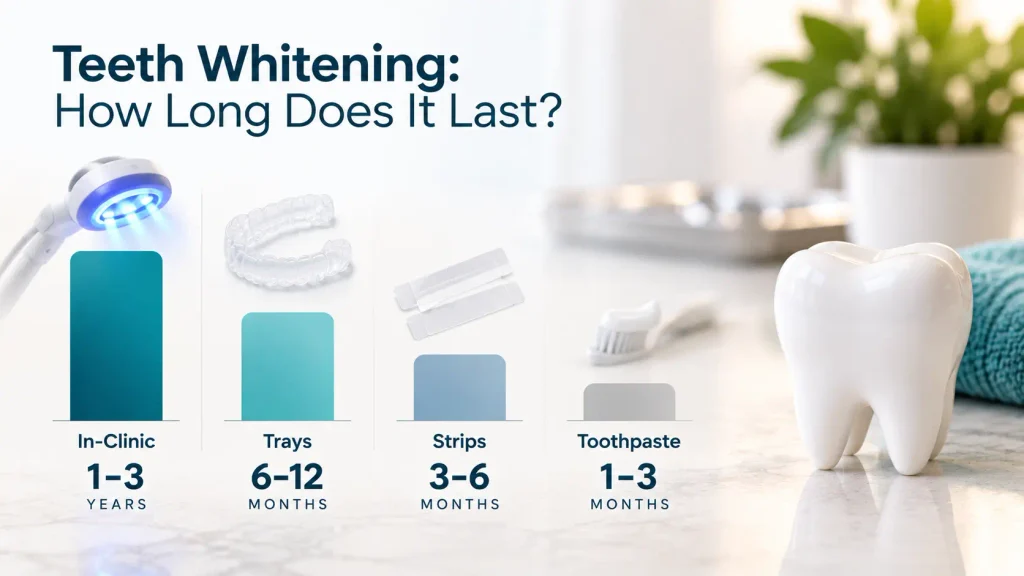
Professional in-clinic whitening generally lasts one to three years, dentist-supervised tray whitening around eight months to two years, and over-the-counter strips roughly three to six months. Whitening toothpaste alone does not change the tooth’s internal shade; it only slows new surface staining.
| Method | Typical Longevity | Shade Improvement | Supervision | Sensitivity Risk |
| In-clinic professional whitening | 1–3 years | Significant (several shades) | Full dentist supervision | Managed professionally |
| Dentist-supervised tray whitening | 8 months – 2 years | Moderate to significant | Partial (custom trays + review) | Low to moderate, monitored |
| Over-the-counter strips | 3–6 months | Mild to moderate | None | Higher if overused |
| Whitening toothpaste | Surface effect only | Minimal | None | Low, but abrasive if overused |
These are general ranges seen in dental practice, not guarantees. Your dentist can give a more personal estimate after examining your enamel condition and stain type.
What Makes Whitening Fade Faster?
The biggest accelerators of whitening fade are pigmented foods and drinks, tobacco in any form, poor brushing habits, and acidic drinks that soften enamel. Most fading is gradual surface staining — which is also why sensible habits can dramatically slow it down.
Watch out for:
- Tea and coffee — the classic culprits, especially strong milk tea taken several times daily
- Tobacco, paan, and gutkha — cause deep, stubborn staining that shortens whitening duration sharply
- Red wine, cola, and dark juices — pigmented and acidic, a double disadvantage
- Turmeric-heavy and deeply coloured curries — mild contributors when consumed daily
- Skipping night brushing — allows stain-forming plaque to sit on teeth for hours
- Acidic drinks and frequent snacking — temporarily soften enamel, making it easier for pigments to settle
One practical reassurance: no single cup of coffee undoes your whitening. It is the daily, repeated exposure without rinsing or brushing that adds up.
Maintaining White Teeth: A Practical Routine That Works
Maintaining white teeth comes down to three things: protecting the first 48 hours after treatment, building small daily anti-stain habits, and scheduling professional cleanings. Patients who follow a simple maintenance routine commonly extend their whitening longevity by a year or more compared to those who do not.
The First 48 Hours After Whitening
Immediately after whitening, teeth are slightly more porous and absorb stains more easily. This short window matters more than most people realise.
For the first two days, dentists usually advise a “white diet” — rice, curd, paneer, milk, bananas, plain rotis — and avoiding tea, coffee, turmeric-rich gravies, and coloured drinks. If you must have tea, this is the time a straw genuinely helps.
Everyday Habits for Long-Lasting Results
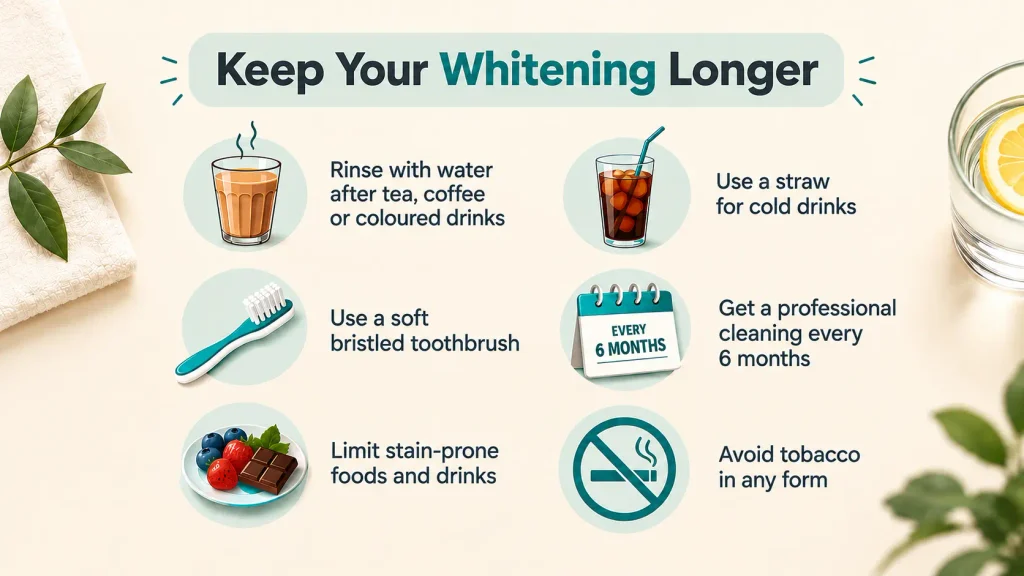
- Rinse with plain water after tea, coffee, or coloured meals — a ten-second habit with outsized results.
- Brush twice daily with a soft brush and non-abrasive fluoride toothpaste.
- Use a straw for cold drinks so pigments bypass your front teeth.
- Don’t brush immediately after acidic drinks — wait 30 minutes so softened enamel can recover.
- Chew sugar-free gum after meals when brushing isn’t possible; saliva is a natural stain-rinser.
- Get professional cleaning every six months — scaling and polishing removes surface stains before they set in.
When to Consider a Touch-Up
Most patients notice gradual dulling rather than sudden yellowing. A good rule: when your teeth no longer look noticeably brighter than before treatment, a touch-up is worth discussing.
For in-clinic whitening, many patients need only a short touch-up session every 12 to 18 months. Tray-based patients may simply wear their custom trays for a night or two with fresh gel, as advised by their dentist. What we do not recommend is unsupervised, repeated bleaching with over-the-counter kits — over-whitening can cause sensitivity and a translucent, unnatural look.
At City Smiles Dental Care, we assess your enamel and gum health before any repeat whitening, so touch-ups stay safe as well as effective.
Myths vs Facts About Whitening Longevity
Myth: Teeth whitening is permanent. Fact: No whitening method is permanent. Teeth continuously face staining foods and natural ageing; results last months to years, then benefit from maintenance or touch-ups.
Myth: Whitening toothpaste keeps professionally whitened teeth white forever. Fact: Whitening toothpaste only polishes away new surface stains. It helps maintenance, but it cannot preserve or recreate the deeper shade change from professional whitening.
Myth: If results fade, whitening again will damage your teeth. Fact: Dentist-supervised repeat whitening at sensible intervals is considered safe for healthy teeth. Problems arise mainly from frequent, unsupervised over-bleaching.
Myth: Whitening also brightens crowns, veneers, and fillings. Fact: Whitening agents only work on natural enamel. Existing crowns and fillings keep their original shade, which is why a pre-whitening dental check-up matters — especially for front teeth.
Myth: Home remedies like lemon or baking soda keep teeth white naturally. Fact: Acidic and abrasive home remedies erode enamel over time. Thinner enamel actually makes teeth look more yellow, the opposite of the goal.
Who Should Get Whitening Checked First?
A short dental examination before whitening protects both your results and your teeth. Whitening over untreated problems can cause avoidable sensitivity — and in some cases, the “stain” is not a stain at all.
You should be examined first if you have:
- Cavities, worn enamel, or exposed roots (whitening gel can cause sharp sensitivity here)
- Gum disease or bleeding gums
- Crowns, veneers, or large fillings on visible front teeth
- Internal discolouration from an old injury or root canal — this often needs a different approach than surface whitening
- Ongoing sensitivity to hot or cold
This is exactly why we begin every whitening consultation at our South Kolkata clinic with a proper clinical examination. Patients visiting us from Garia, Jadavpur, Baghajatin, Tollygunge, and nearby areas often discover that a professional cleaning alone brightens their smile a step — and whitening then builds on a healthy foundation. Treatment recommendations always depend on what we find during your examination, not a one-size-fits-all package.
FAQs About Teeth Whitening Results
How long do teeth whitening results last on average?
Professional teeth whitening results typically last six months to three years. In-clinic whitening lasts longest, dentist-supervised tray whitening slightly less, and over-the-counter products the shortest. Your diet, tobacco use, and oral hygiene habits influence duration more than any other factor.
Does teeth whitening last forever?
No. Whitening is not permanent because teeth continuously encounter staining foods, drinks, and natural age-related changes. However, results can be maintained for years with good habits and occasional dentist-supervised touch-ups.
Will drinking tea or coffee ruin my whitening results?
Not immediately. Occasional tea or coffee causes gradual, not instant, re-staining. Rinsing with water afterwards, using a straw for cold drinks, and brushing twice daily lets most patients enjoy their chai and still keep results for years.
How soon after whitening can I drink tea or coffee?
Wait at least 48 hours. Teeth are temporarily more porous after whitening and absorb pigments faster during this window. After two days, normal habits can resume — ideally with a quick water rinse afterwards.
How often can I whiten my teeth safely?
For most healthy patients, dentist-supervised whitening or touch-ups every 12 to 18 months is considered safe. Frequent unsupervised bleaching can cause sensitivity and enamel translucency, so repeat whitening should always follow a dental assessment.
Why did my friend’s whitening last longer than mine?
Whitening longevity varies with enamel thickness, natural tooth shade, the whitening method used, and daily habits. Heavier tea, coffee, or tobacco use, thinner enamel, or over-the-counter products all shorten duration compared to professional treatment and stain-conscious habits.
Do whitening toothpastes help maintain results?
Yes, modestly. Whitening toothpastes polish away fresh surface stains, which slows visible fading. They cannot deepen or restore the shade change from professional whitening, and abrasive versions should not be overused.
Will my crowns and fillings whiten along with my teeth?
No. Whitening agents work only on natural enamel. Crowns, veneers, and tooth-coloured fillings retain their original shade, so visible restorations may need replacement after whitening to match your new shade — something your dentist plans in advance.
Does teeth whitening damage enamel if I repeat it?
Dentist-supervised whitening at appropriate intervals does not damage healthy enamel. Temporary sensitivity can occur and usually settles within days. Risks rise mainly with frequent, unsupervised use of high-strength or abrasive products.
When should I book a whitening touch-up?
Book a touch-up when your teeth no longer look noticeably brighter than before treatment — typically 12 to 18 months after in-clinic whitening. A quick examination confirms your enamel and gums are ready before repeating treatment.
Conclusion: Realistic Expectations, Brighter for Longer
Teeth whitening results are best thought of as a renewable improvement, not a permanent change. With professional treatment, sensible everyday habits, and the occasional touch-up, most patients keep a visibly brighter smile for years — and the maintenance effort is far smaller than people fear.
The two decisions that matter most are choosing dentist-supervised whitening over unregulated products, and building a few small anti-stain habits into your routine. Everything else is fine-tuning.
Ready for a Smile That Stays Bright?
If you are considering whitening — or your earlier results have started to fade — the right first step is a proper dental examination. At City Smiles Dental Care, we check your enamel, gums, and existing dental work first, then recommend the whitening approach that suits your teeth and your lifestyle, whether you are in Garia, Baghajatin, Jadavpur, Tollygunge, Santoshpur, Dhakuria, or anywhere in South Kolkata.
Book your whitening consultation online — it takes less than a minute.
You can also find directions, timings, and patient reviews on our Google Business Profile.
Your brightest smile deserves an honest plan — let’s build one together.