


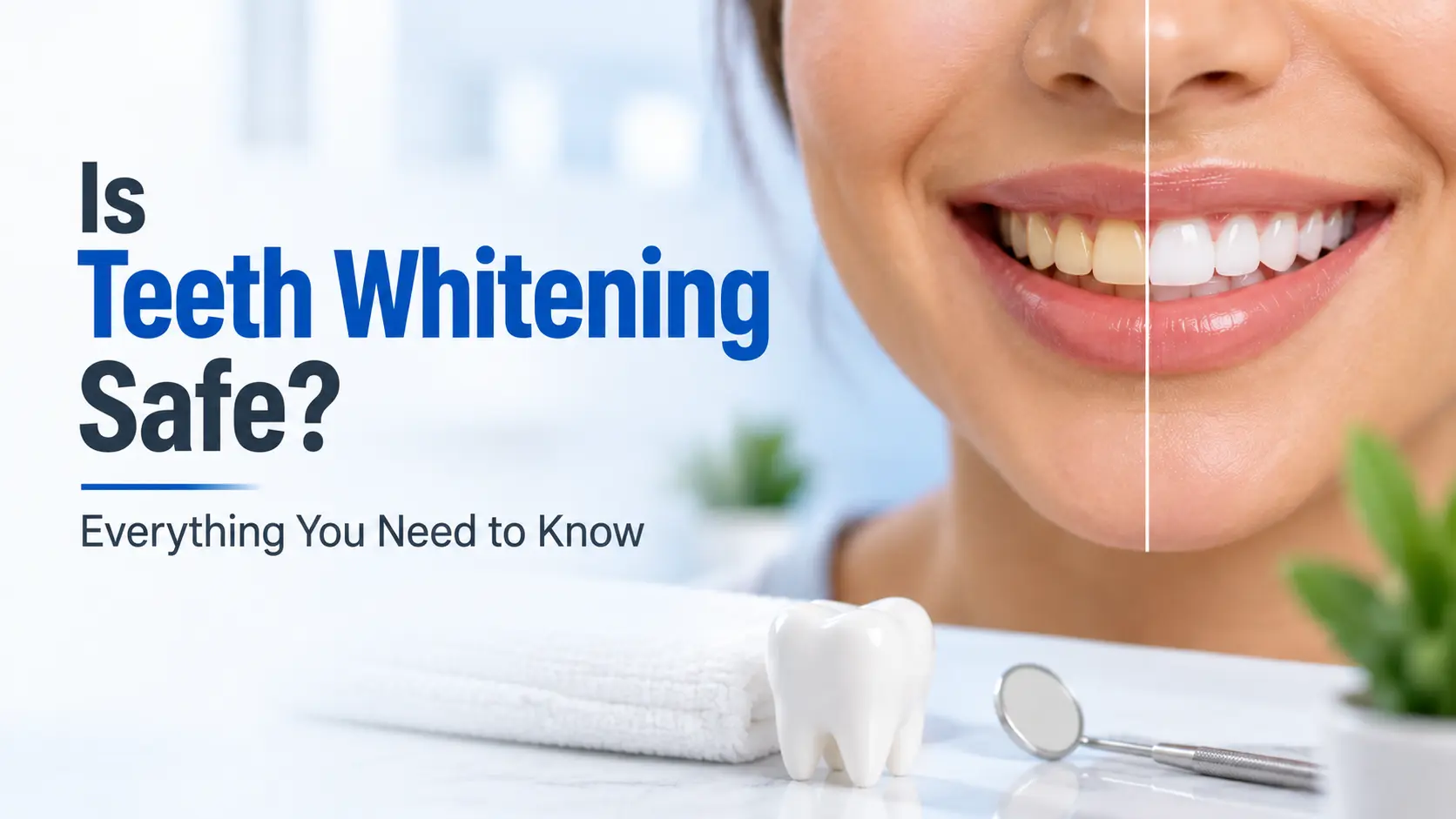
You have probably typed this exact question after seeing a whitening advertisement or a friend’s suddenly brighter smile: is teeth whitening safe, or will you pay for it later with damaged enamel and painful teeth? It is one of the most common questions patients ask us at City Smiles Dental Care in South Kolkata — usually right after “how white will my teeth get?”
The honest answer is reassuring, but it comes with conditions. Whitening done the right way is one of the most studied and predictable procedures in dentistry. Whitening done the wrong way — and there are many wrong ways being sold today — is where the horror stories come from.
This guide explains what actually happens to your teeth during whitening, which side effects are normal, who should avoid it, and how to tell safe bleaching from risky shortcuts.
Is Teeth Whitening Safe? The Short Answer
Yes — professional teeth whitening is safe for most healthy adults when performed or supervised by a dentist. Peroxide-based whitening gels have been studied for decades and do not damage enamel when used correctly. The common side effects, temporary sensitivity and mild gum irritation, resolve within a few days. Risks arise mainly from unsupervised, unregulated, or abrasive whitening methods.

That last sentence deserves emphasis. The safety of dental whitening depends far less on the peroxide itself and far more on who is applying it, at what concentration, and whether your teeth were examined first.
A patient with a hidden cavity, a leaking filling, or inflamed gums can have a genuinely painful experience with the same gel that gives their neighbour a comfortable, even result. That is why a quick clinical examination before whitening is not an upsell — it is the safety step.
How Peroxide Teeth Whitening Actually Works
Peroxide teeth whitening uses hydrogen peroxide or carbamide peroxide gel to break down stain molecules trapped within the tooth. The gel releases oxygen that penetrates enamel and lightens the pigmented compounds inside — it bleaches stains chemically rather than scraping the tooth surface. Enamel structure remains intact throughout the process.
This distinction matters because most fear around whitening assumes it works by stripping or thinning enamel. It does not.
- Hydrogen peroxide works faster and is used in higher concentrations for in-clinic whitening.
- Carbamide peroxide breaks down slowly into hydrogen peroxide, making it ideal for dentist-prescribed take-home trays worn for longer periods.
- Neither agent dissolves enamel minerals when used at professional concentrations for the recommended time.
What peroxide can do is temporarily open the microscopic channels (dentinal tubules) in your teeth, which is why some people feel short-lived sensitivity. Those channels close again on their own — the effect is reversible, not damage.
Not All Whitening Is Equal: Professional vs OTC vs DIY
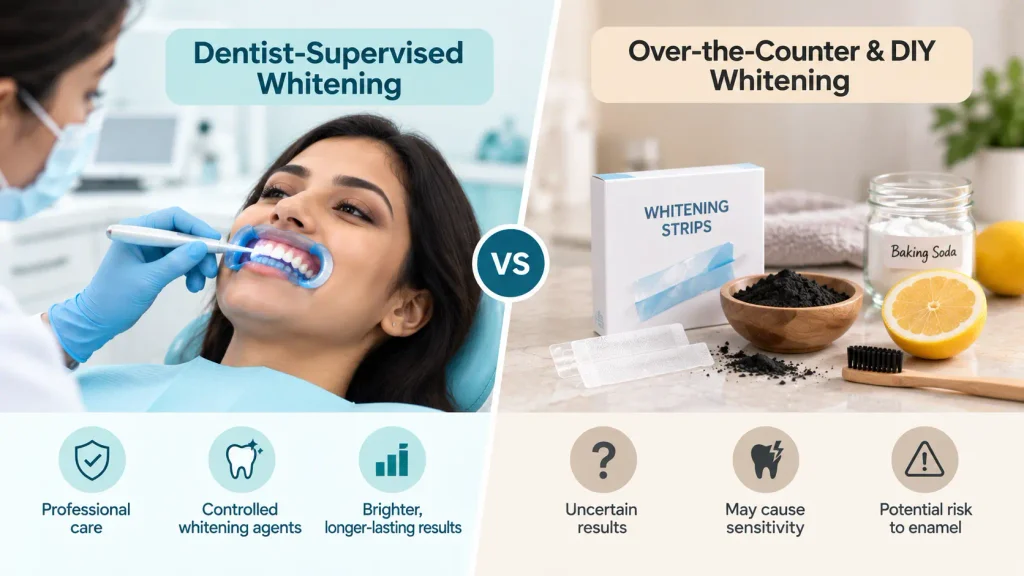
The safety of whitening varies enormously depending on the method. Dentist-delivered whitening is the safest and most effective because concentration, gum protection, and case selection are controlled. Over-the-counter products are milder but unsupervised. DIY and salon methods carry the highest risk with the least benefit.
| Factor | Dentist Whitening (In-Clinic / Prescribed Trays) | OTC Strips & Whitening Toothpastes | Salon / DIY Methods |
| Peroxide strength | High, but professionally controlled | Low | Unknown or unregulated |
| Gum protection | Barrier applied by dentist | None | None |
| Pre-whitening dental check | Always | No | No |
| Works on deep (intrinsic) stains | Yes | Limited | No |
| Result predictability | High, shade-mapped | Variable, often patchy | Poor |
| Enamel safety | Well established | Generally safe if used as directed | Abrasion or acid erosion risk |
| Sensitivity management | Desensitisers used before/after | Self-managed | Not addressed |
Whitening toothpastes deserve a special note: most brighten by mild abrasion or surface-stain removal, not true bleaching. Used occasionally they are harmless; scrubbed aggressively twice daily for months, highly abrasive pastes can wear enamel — the very damage people fear from peroxide, caused instead by the “gentle” option.
Whitening Side Effects: What’s Normal and What’s Not
The two genuine whitening side effects are temporary tooth sensitivity and mild gum irritation. Both are common, both are short-lived, and both can be minimised with proper technique. Severe pain, blistered gums, or sensitivity lasting more than a week are not normal and need a dentist’s attention.
Temporary tooth sensitivity
Roughly half of whitening patients notice brief, sharp twinges — often called “zingers” — during or shortly after treatment, especially with cold water or air. This happens because peroxide temporarily dehydrates the tooth and opens dentinal tubules.
In practice, it fades within 24–72 hours. At City Smiles Dental Care we routinely apply desensitising agents and may recommend a potassium-nitrate toothpaste for a week before and after whitening, which noticeably reduces this for sensitive patients from Jadavpur to Garia who ask us about it in advance.
Gum irritation
If whitening gel sits on gum tissue, it can cause temporary whitening or mild burning of the gum surface. In a clinic, a protective barrier is placed over your gums before the gel is applied, so this is rare. With loose OTC strips or overfilled home trays, it is the most common complaint — and it heals within days once contact stops.
When side effects signal a problem
See a dentist promptly if you experience:
- Throbbing pain in one specific tooth (often a hidden cavity or cracked tooth reacting to peroxide)
- Sensitivity lasting beyond 5–7 days
- White, blistered, or peeling gum patches that persist
- Pain in teeth with old fillings or crowns
These are almost always signs of a pre-existing issue the whitening exposed — which is exactly why examination-first whitening is safer.
Who Should Wait — or Skip Whitening Altogether
Teeth whitening is not recommended for pregnant or breastfeeding women, children under 16–18, or anyone with untreated cavities, gum disease, worn enamel, or exposed roots. It also does not lighten crowns, veneers, or fillings, so patients with visible restorations need a combined plan rather than bleaching alone.
Expanding on each:
- Pregnancy and breastfeeding: There is no proven harm, but there is also no safety data — so dentists worldwide advise postponing purely elective bleaching. It waits well.
- Teenagers: Young teeth have larger pulp chambers and are more sensitivity-prone. Most dentists defer whitening until late teens.
- Active decay or gum disease: Peroxide reaching a cavity or inflamed tissue causes real pain. Treat first, whiten after.
- Intrinsic discolouration: Greyish tetracycline staining or a single dark tooth after root canal treatment respond differently — sometimes needing internal bleaching or veneers instead of standard whitening.
- Existing crowns, veneers, and fillings: These keep their original shade. Whitening around them can leave a visible mismatch, so front-tooth restorations may need replacement after whitening to match your new shade — something we plan for in advance during consultation.
This screening list is precisely what a dentist checks in the ten-minute examination before recommending whitening. Skipping it is where “whitening ruined my teeth” stories usually begin.
Whitening Methods Dentists Advise Against
Some popular whitening trends do more harm than peroxide ever could:
- Lemon juice, vinegar, or “activated” acidic pastes. Acid genuinely erodes enamel. Teeth may look briefly brighter because the surface is being dissolved — permanent damage for a temporary effect.
- Aggressive charcoal or baking-soda scrubbing. Abrasion removes surface stains and, over time, enamel. Thinner enamel exposes yellow dentine underneath, making teeth look more yellow permanently.
- Beauty-salon or kiosk whitening. In India and elsewhere, non-dental staff applying bleaching agents means no examination, no gum protection, and no accountability if something goes wrong.
- Unregulated online kits with unstated peroxide levels. Products shipped without concentration labelling can exceed safe limits for unsupervised use.
None of these save money in the long run, because enamel does not grow back.
How Dentists Make Bleaching Safe
Safe bleaching is a protocol, not just a product. At a dental clinic, whitening follows a sequence designed to prevent every common complication:
- Examination and X-rays if needed — ruling out decay, cracks, gum disease, and failing restorations.
- Cleaning first — scaling and polishing removes surface deposits so the gel works evenly. Many patients in South Kolkata are pleasantly surprised how much brighter teeth look after a professional cleaning alone.
- Shade recording — so results are measured, not guessed.
- Gum barrier and lip protection — isolating soft tissue before high-strength gel touches anything.
- Controlled application — timed cycles, monitored throughout, stopped early if sensitivity appears.
- Desensitising treatment — fluoride or potassium nitrate applied after bleaching.
- Custom take-home trays where suitable — precisely fitted so gel stays on teeth, not gums.
At City Smiles Dental Care, whitening recommendations are always made after clinical examination, because the right method — in-clinic, take-home trays, or a combination — depends on your enamel condition, stain type, sensitivity history, and existing dental work. No single approach suits everyone, and any clinic promising identical guaranteed results for all patients should raise questions.
How Long Do Results Last — and Does Re-Whitening Harm Teeth?
Professional whitening results typically last one to three years, depending on tea, coffee, tobacco, and oral hygiene habits. Periodic top-up whitening — usually a short course of take-home gel once or twice a year — is considered safe and does not cause cumulative enamel damage when dentist-supervised.
To stretch your results:
- Rinse with water after tea, coffee, red wine, or heavily coloured food.
- Avoid tobacco in all forms — the single fastest way to re-stain teeth.
- Maintain six-monthly cleanings; polished teeth stain more slowly.
- Use a sensitivity-friendly, low-abrasion toothpaste rather than harsh “whitening” pastes.
What is not safe is compulsive, back-to-back whitening chasing an unnaturally white shade. Over-bleaching can cause persistent sensitivity and a translucent, greyish edge appearance. A dentist will tell you when your teeth have reached their natural maximum brightness — a limit that exists for everyone.
Myths vs Facts About Dental Whitening
| Myth | Fact |
| “Whitening strips away enamel.” | Peroxide bleaches stains chemically; it does not remove enamel. Abrasive scrubbing and acids do. |
| “If my teeth feel sensitive, they are being damaged.” | Sensitivity reflects temporarily open tubules, which close within days. It is uncomfortable, not destructive. |
| “Natural remedies are safer than chemicals.” | Lemon, vinegar, and hard scrubbing cause permanent erosion. Regulated peroxide does not. |
| “Whitening works on everyone.” | Crowns, veneers, fillings, and some intrinsic stains do not respond. Case selection matters. |
| “One session lasts forever.” | Results last 1–3 years and depend heavily on diet and tobacco habits. |
| “Stronger gel means better results.” | Beyond professional protocols, higher concentration mainly increases sensitivity, not whiteness. |
What Does Safe Teeth Whitening Cost in Kolkata?
In the Kolkata market, professional in-clinic whitening generally ranges from around ₹6,000 to ₹15,000, and dentist-prescribed take-home tray systems from roughly ₹3,000 to ₹8,000, depending on the system used and the number of sessions. These are indicative market figures, not a quotation — your actual cost depends on your examination findings, the stain type, and the method best suited to your teeth.
It is worth comparing that honestly against the alternatives. A drawer full of OTC kits repurchased every few months, or a cosmetic repair bill after acid-damaged enamel, often costs more than doing it properly once. For patients across Baghajatin, Tollygunge, Santoshpur, and Dhakuria, a consultation gives you an exact figure before you commit to anything.
Frequently Asked Questions
Does teeth whitening damage enamel?
No. Professionally supervised peroxide whitening does not remove or soften enamel; long-term clinical studies confirm enamel hardness returns to normal after treatment. Enamel damage linked to “whitening” almost always comes from abrasive scrubbing or acidic DIY remedies, not from dentist-controlled bleaching gel.
How long does sensitivity last after whitening?
Whitening sensitivity typically lasts 24 to 72 hours and fades on its own. Using a potassium-nitrate desensitising toothpaste before and after treatment, and avoiding very hot or cold drinks for a day or two, shortens it further. Sensitivity beyond a week warrants a dental check.
Is teeth whitening safe during pregnancy?
Dentists recommend postponing whitening during pregnancy and breastfeeding. There is no evidence of harm, but because whitening is purely elective and safety data in pregnancy is lacking, waiting is the responsible choice. Routine cleanings, which also brighten teeth, remain completely safe.
Is peroxide teeth whitening safe for sensitive teeth?
Usually yes, with modifications. A dentist can use lower-concentration carbamide peroxide, shorter wear times, and desensitising agents before and after treatment. Telling your dentist about sensitivity beforehand is the key — the protocol is adjusted, not abandoned.
Are home whitening kits from pharmacies safe?
Reputable low-peroxide OTC strips are generally safe when instructions are followed, though results are milder and gum irritation is more common without custom trays. Unbranded online kits with unlisted peroxide levels are best avoided entirely.
Will whitening work on my caps, veneers, or fillings?
No. Crowns, veneers, and composite fillings do not change colour with bleaching. If you have visible restorations on front teeth, your dentist will plan whitening first and then match or replace the restorations to your new shade.
How white will my teeth get?
Most patients lighten by several shades, but the ceiling is set by your natural tooth colour and stain type. Yellowish staining responds best; greyish or medication-related discolouration responds less. A dentist records your starting shade and gives you a realistic expectation before treatment — no ethical clinic guarantees a specific shade.
How often can I safely whiten my teeth?
A full professional whitening every one to three years, with short dentist-guided top-ups in between, is considered safe. Continuous or monthly bleaching is unnecessary and increases sensitivity without making teeth meaningfully whiter.
Can smokers get their teeth whitened?
Yes, and results can be dramatic — but tobacco re-stains bleached teeth faster than anything else, sometimes within months. Whitening works best as a companion to quitting or reducing tobacco, and your dentist can discuss both together.
The Bottom Line: Is Teeth Whitening Safe for You?
So, is teeth whitening safe? For most healthy adults, professionally supervised whitening is a safe, well-researched, and reversible-side-effect procedure — the sensitivity passes, the enamel stays intact, and the results are real. The genuine risks live outside the clinic: acidic home remedies, abrasive scrubbing, salon bleaching, and unregulated kits.
The one non-negotiable safety step is the examination before the gel. It is what separates predictable, comfortable dental whitening from an expensive gamble.
If you are considering whitening, start with an honest assessment of whether your teeth are ready for it — and what result you can realistically expect.
Ready for a Brighter, Safer Smile?
If you live in Garia, Baghajatin, Jadavpur, Tollygunge, Santoshpur, Dhakuria, or anywhere in South Kolkata, City Smiles Dental Care can examine your teeth, answer your safety questions, and recommend the whitening approach that genuinely suits you — with no pressure and no exaggerated promises.
Book your whitening consultation online — it takes less than a minute.
You can also find directions, timings, and patient reviews on our Google Business Profile before you visit.
A safe, confident smile starts with a conversation — not a kit off the shelf.
1 Comment