


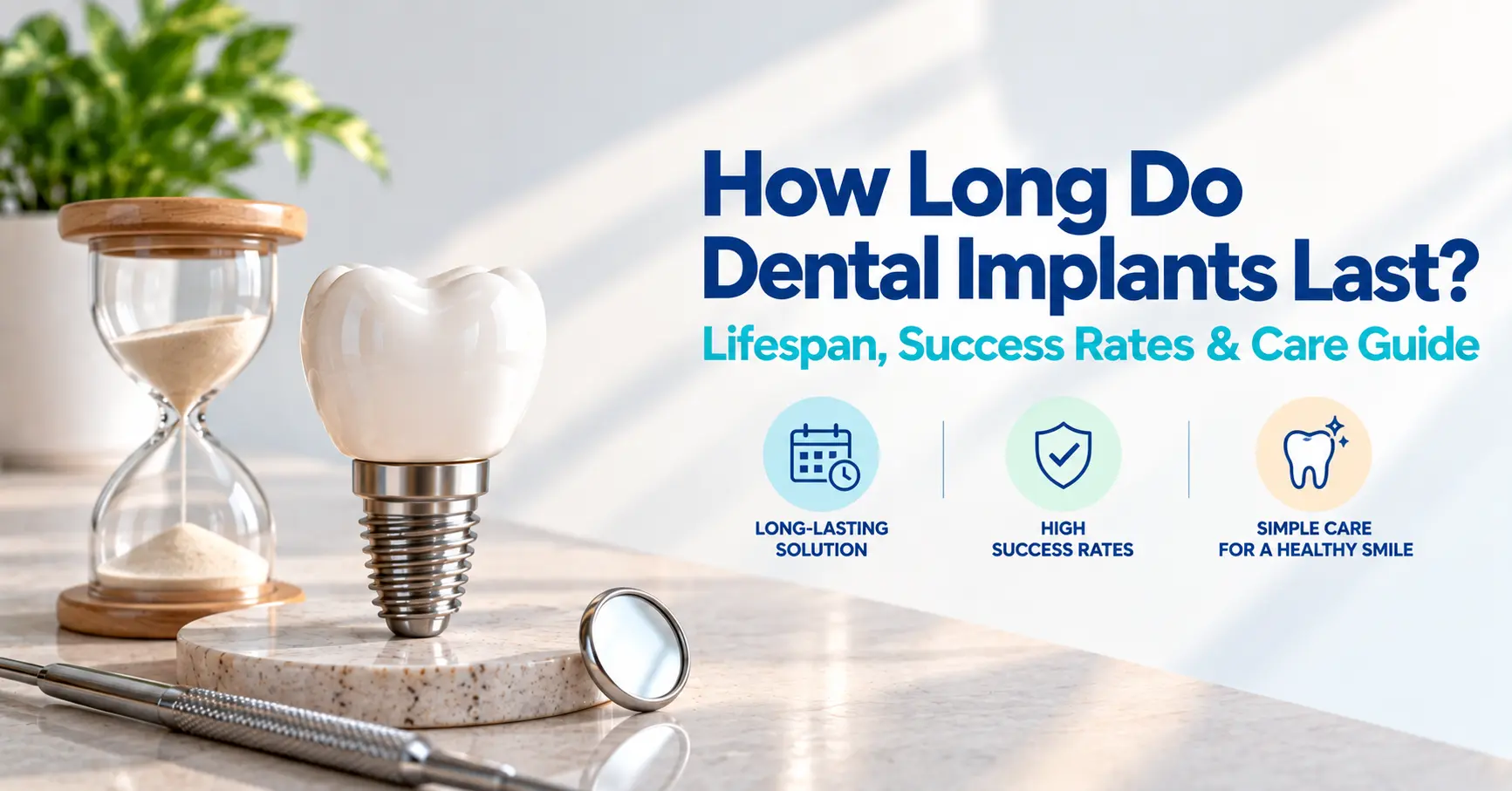
If you’re considering dental implants, one question probably matters more than any other: will this investment actually last? It’s a fair question. Implants cost more than bridges or dentures, and nobody wants to repeat major dental work every few years.
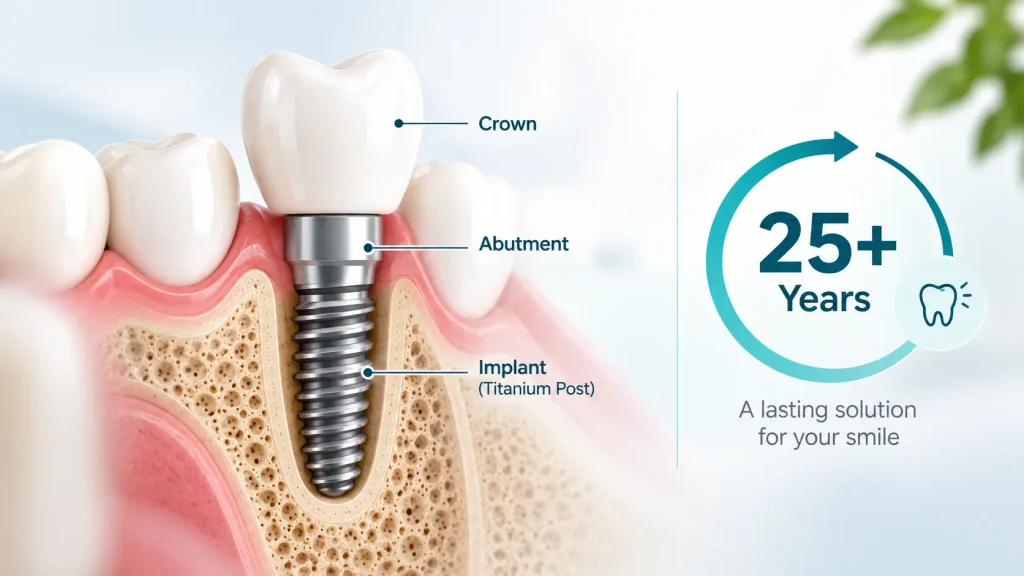
Here’s the honest answer on dental implant lifespan: the implant itself — the titanium post placed in your jawbone — can last 25 years or more, and frequently lasts a lifetime. The crown attached to it usually needs replacement after 10–15 years, which is a far simpler and less expensive procedure.
At City Smiles Dental Care in South Kolkata, this is one of the most common questions patients from Garia, Jadavpur, and Tollygunge ask during implant consultations. This guide explains exactly what determines implant longevity, what the research says about success rates, and — most importantly — what you can do to make your implants last as long as possible.
How Long Do Dental Implants Last?
Dental implants last 25 years or longer on average, and many last a lifetime. The titanium post fuses permanently with your jawbone through a process called osseointegration. The visible crown on top typically lasts 10–15 years before normal chewing wear requires a replacement. With good oral hygiene and regular dental check-ups, most patients never need the implant post itself replaced.
That headline number, however, hides an important distinction most patients aren’t told about. A dental implant is actually three parts, and they don’t age at the same rate.
Implant vs Crown: Which Part Lasts How Long?
A complete dental implant has three components: the implant post inside your bone, the abutment connector, and the crown you see and chew with. Each has a different expected lifespan. The post is the permanent foundation; the crown is a wearing part, much like tyres on a well-maintained car.
| Component | What It Is | Typical Lifespan | Replacement Difficulty |
| Implant post | Titanium screw fused with jawbone | 25+ years, often lifetime | Rarely needed; surgical if required |
| Abutment | Connector between post and crown | 15–20 years | Simple, non-surgical |
| Crown | Visible ceramic/porcelain tooth | 10–15 years | Simple — unscrewed or re-cemented |
This distinction matters when you compare quotes or read reviews. When someone says “my implant broke after 12 years,” it’s almost always the crown — a routine replacement — not a failed implant.
Crowns on back teeth tend to wear faster because they handle heavier chewing forces. Front-tooth crowns often exceed 15 years.
Dental Implant Success Rate: What the Numbers Say
Dental implants have a success rate of approximately 95–98% over 10 years, making them one of the most predictable procedures in modern dentistry. Long-term studies tracking implants over 20+ years consistently report survival rates above 90%. Failure, when it occurs, usually happens either within the first few months or many years later due to gum disease around the implant.
A few points help put these numbers in context:
- Early failures (first 3–6 months) occur when the bone doesn’t integrate with the post. This is uncommon and often linked to smoking, uncontrolled diabetes, or infection.
- Late failures (5+ years) are usually caused by peri-implantitis — gum disease around the implant. This is largely preventable with hygiene and check-ups.
- Lower jaw implants show slightly higher success rates than upper jaw implants, because lower jawbone is typically denser.
Implant durability, in other words, is not a lottery. The overwhelming majority of failures trace back to identifiable, and often controllable, causes.
What Affects Dental Implant Lifespan?
Implant longevity depends on three groups of factors: your daily habits, your dentist’s planning and technique, and your underlying health. Patients control more of this equation than they usually expect — oral hygiene and smoking status alone account for a large share of long-term outcomes.
Factors You Control
- Oral hygiene: Plaque around an implant causes peri-implantitis, the leading cause of late implant failure. Brushing twice daily and cleaning between teeth is non-negotiable.
- Smoking: Smokers face roughly double the failure risk. Smoking restricts blood flow to the gums and slows healing.
- Teeth grinding (bruxism): Grinding overloads the implant and chips crowns. A night guard protects your investment.
- Regular check-ups: Six-monthly visits let your dentist catch early gum inflammation before it threatens the implant.
- Diet habits: Routinely chewing ice, pens, or very hard foods shortens crown lifespan.
Factors Your Dentist Controls
- Treatment planning: Assessing bone volume and quality with proper imaging before surgery.
- Implant quality: Reputable implant systems with documented long-term research outperform unbranded budget alternatives.
- Surgical technique: Correct positioning and depth protect both the implant and neighbouring structures.
- Bite calibration: An implant crown must meet the opposing teeth with balanced force. A poorly adjusted bite quietly overloads the implant for years.
This is why choosing an experienced implant clinic matters as much as choosing to get implants at all. At City Smiles Dental Care, every implant case begins with a detailed clinical and radiographic assessment — because long term implants are planned long before they’re placed.
Health Conditions That Need Extra Attention
- Diabetes: Well-controlled diabetes is compatible with excellent implant outcomes. Uncontrolled blood sugar impairs healing and raises infection risk.
- Gum disease: Active periodontitis must be treated before implant placement.
- Osteoporosis and certain medications: Some bone medications require special planning. Always share your full medical history.
- Age: There is no upper age limit. Healthy patients in their 60s and 70s routinely receive implants that serve them for decades.
None of these conditions automatically rules out implants. They simply mean your treatment plan needs individual attention — which is exactly what a proper consultation determines.
How Implants Compare with Bridges and Dentures for Longevity
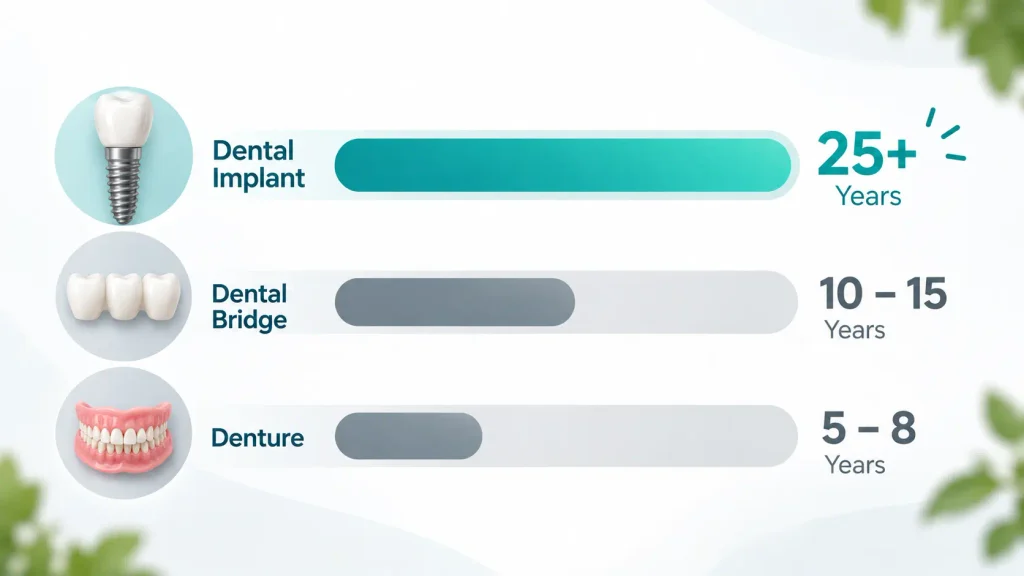
Dental implants outlast every other tooth-replacement option. Bridges typically last 10–15 years and require grinding down healthy neighbouring teeth. Removable dentures need relining or replacement every 5–8 years as the jawbone shrinks. Implants are the only option that preserves jawbone, which is why they remain stable for decades.
| Factor | Dental Implant | Dental Bridge | Removable Denture |
| Typical lifespan | 25+ years (post) | 10–15 years | 5–8 years |
| Preserves jawbone | Yes | No | No |
| Affects adjacent teeth | No | Yes — teeth must be ground down | Minimal |
| Long-term cost pattern | Higher upfront, fewer replacements | Moderate, repeated replacements | Lowest upfront, frequent replacement |
| Stability while eating | Like natural teeth | Good | Can shift or loosen |
Over a 25-year horizon, a bridge may need replacing twice and a denture four or five times. This is why many patients across South Kolkata ultimately find implants the more economical choice despite the higher initial cost — implant longevity changes the mathematics entirely.
How to Make Your Dental Implants Last Longer
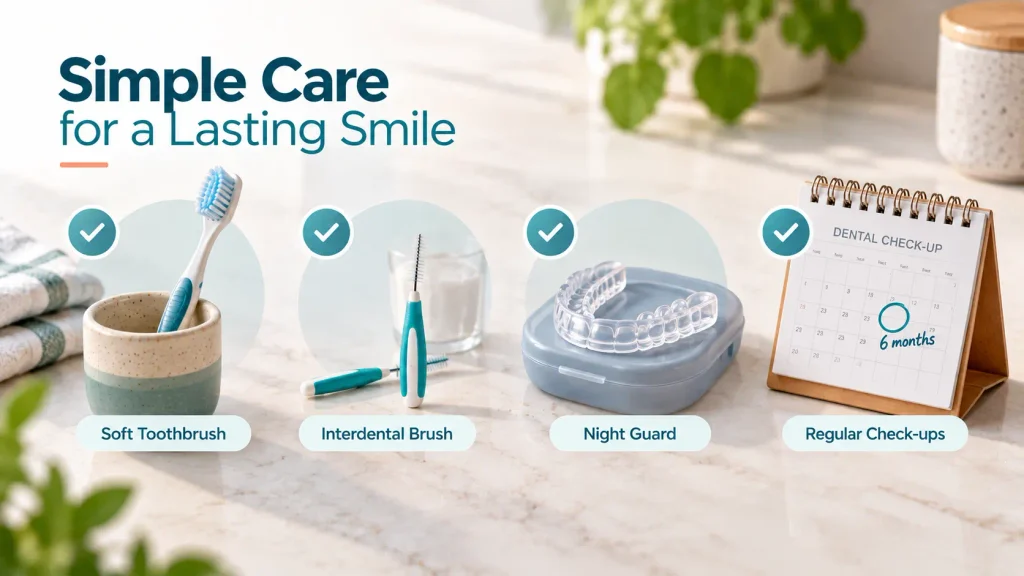
Protecting your implant is simpler than most patients expect. The routine looks almost identical to caring for natural teeth, with a few implant-specific additions:
- Brush twice daily with a soft-bristled brush, paying attention to the gum line around the implant.
- Clean between teeth daily — interdental brushes work particularly well around implants.
- Never skip six-monthly check-ups. Peri-implantitis develops silently; early detection is everything.
- Get professional cleaning as advised — hygienists use implant-safe instruments.
- Wear a night guard if you grind your teeth.
- Quit or reduce smoking. This single change measurably improves implant survival.
- Report any looseness, bleeding, or discomfort immediately rather than waiting for your next visit.
Patients who follow this routine give their implants the best possible chance of lasting a lifetime.
Warning Signs an Implant Needs Attention
An implant should feel like a natural tooth — stable, painless, and unremarkable. Contact your dentist promptly if you notice:
- Bleeding or swelling in the gum around the implant
- A feeling of looseness or movement
- Pain or tenderness when chewing
- Gum recession exposing the metal
- A bad taste or persistent bad breath near the implant
Caught early, most implant problems are fully treatable. Delayed, gum infection around an implant can progress to bone loss. If you’re in Baghajatin, Santoshpur, Dhakuria, or nearby South Kolkata areas, a same-week appointment is far wiser than waiting.
Myths vs Facts About Implant Longevity
Myth: Dental implants last forever, guaranteed. Fact: No ethical dentist guarantees a lifetime. Implants can last a lifetime, and many do — but outcomes depend on hygiene, health, and maintenance.
Myth: If the crown breaks, the whole implant has failed. Fact: Crown damage is routine wear. The crown is replaced on top of the same implant post, usually in one or two visits.
Myth: Implants need special expensive products to maintain. Fact: A soft brush, fluoride toothpaste, interdental cleaning, and regular check-ups are all most patients need.
Myth: Older patients shouldn’t bother with implants because they won’t “get their money’s worth.” Fact: Age is not a barrier. A healthy 65-year-old can reasonably expect their implant to serve them for the rest of their life.
Myth: Once an implant heals, check-ups no longer matter. Fact: Late failures are almost always gum-related and preventable. Maintenance visits are what convert a good implant into a lifelong one.
Are You a Good Candidate for Long-Term Implants?
The honest answer to “how long will my implant last?” can only come from a clinical examination. Bone volume, gum health, bite forces, and medical history differ from patient to patient — which is why City Smiles Dental Care never gives longevity estimates without assessing you first.
During an implant consultation at our South Kolkata clinic, we evaluate:
- Your jawbone quantity and quality
- Gum health and any existing periodontal issues
- Your bite and any grinding habits
- Medical conditions and medications that affect healing
- Your goals — single tooth, multiple teeth, or full-arch solutions
Patients visit us from Garia, Jadavpur, Tollygunge, Baghajatin, Santoshpur, Dhakuria, and surrounding neighbourhoods, and every treatment plan is built individually. If implants aren’t the right choice for you, we’ll tell you that too — trust is worth more to us than any single procedure.
FAQs About Dental Implant Lifespan
Do dental implants last forever? The titanium post can last a lifetime in many patients, but “forever” is never guaranteed. With good hygiene and regular check-ups, implants routinely last 25 years or more. The crown on top typically needs replacement after 10–15 years.
What is the success rate of dental implants? Dental implants succeed in approximately 95–98% of cases over 10 years. Lower jaw implants show slightly higher success rates than upper jaw implants due to denser bone. Most failures are linked to smoking, uncontrolled diabetes, or gum disease around the implant.
Which lasts longer — a dental implant or a bridge? A dental implant lasts significantly longer. Implant posts commonly last 25+ years, while bridges typically need replacement every 10–15 years. Implants also preserve jawbone and don’t require grinding down healthy neighbouring teeth.
Can a failed dental implant be replaced? Yes, in most cases. The failed implant is removed, the site is allowed to heal (sometimes with bone grafting), and a new implant is placed. Your dentist will also identify why the first implant failed to prevent a repeat.
Do dental implants last in diabetic patients? Yes — provided blood sugar is well controlled. Studies show well-managed diabetics achieve implant success rates comparable to non-diabetic patients. Uncontrolled diabetes, however, impairs healing and increases failure risk, so control comes first.
How often should I get my implant checked? Every six months, the same as routine dental check-ups. These visits allow your dentist to monitor gum health around the implant and catch peri-implantitis early, when it’s easily treatable.
Does smoking really affect implant lifespan? Yes, significantly. Smokers face roughly twice the implant failure risk because smoking reduces blood supply to the gums and slows bone healing. Quitting before and after implant surgery measurably improves long-term outcomes.
Why do implant crowns wear out before the implant itself? The crown absorbs daily chewing forces directly, just like natural enamel. Ceramic and porcelain gradually wear or chip over 10–15 years. The implant post, protected inside the jawbone, faces no such surface wear.
Is an implant worth it if I’m over 60? Absolutely. There is no upper age limit for implants — bone health matters, not birthdays. Many patients in their 60s and 70s receive implants that serve them comfortably for the rest of their lives.
Conclusion: A Lifetime Investment, When Cared For
Dental implant lifespan comes down to a simple equation: a well-planned implant, placed in healthy bone, and maintained with everyday hygiene can genuinely last a lifetime. The crown will need renewing once or twice along the way — a minor, predictable expense — but the foundation stays.
That’s what separates implants from every alternative. Bridges and dentures are replacements you keep replacing. An implant, looked after properly, is a decision you make once.
If you’re weighing up implants and want an honest, examination-based answer about how long they’ll last for you, we’re here to help.
Book Your Implant Consultation in South Kolkata
City Smiles Dental Care provides personalised implant assessment and treatment planning for patients across Garia, Baghajatin, Jadavpur, Tollygunge, Santoshpur, Dhakuria, and nearby South Kolkata areas.
Book your appointment online →
Prefer to see what other patients say first? Visit our Google Business Profile for directions, reviews, and clinic timings.
Your implant’s lifespan begins with the right first step. Take it today.