



Gum disease is one of the most common dental problems we see, yet it is also one of the most misunderstood. Many patients only notice it when their gums bleed or a tooth feels loose — often years after it quietly began. This guide gathers the gum disease FAQs patients in South Kolkata ask most, with clear, honest, dentist-level answers.
Whether you are dealing with bleeding gums in Garia, bad breath that won’t go away in Jadavpur, or you simply want to protect your smile, these 25 answers will help you understand what is happening and what to do next. For anything specific to your mouth, a clinical examination at City Smiles Dental Care is the only reliable way to know for sure.
Medical note: This article is for education. Gum disease severity and treatment can only be confirmed by a dentist after examining your gums, teeth and X-rays.
Gum Disease Basics: What Every Patient Should Know
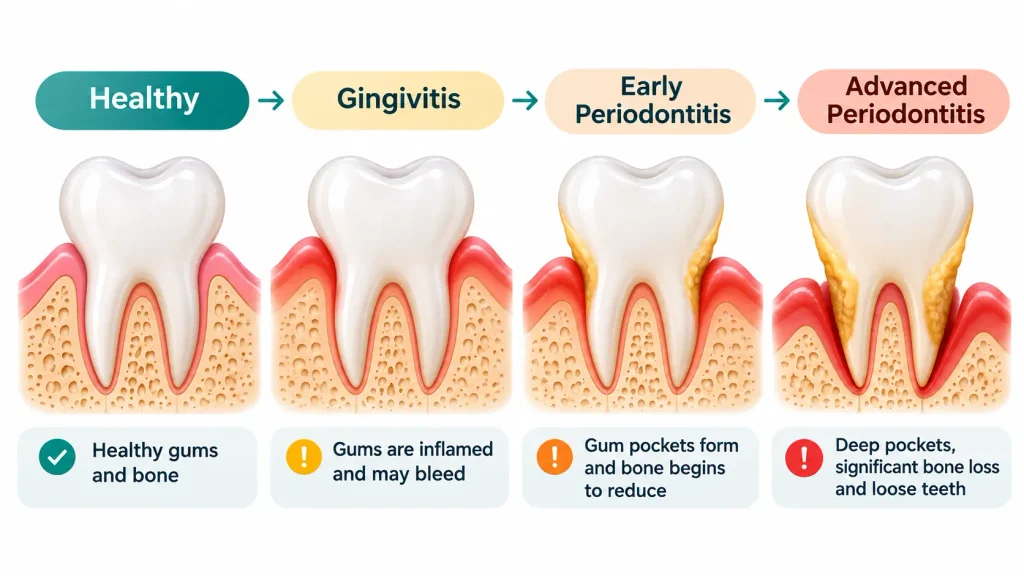
Gum disease (periodontal disease) is an infection of the tissues that hold your teeth in place, caused mainly by bacterial plaque. It ranges from mild, reversible gum inflammation (gingivitis) to advanced disease that damages bone (periodontitis). Caught early, it is highly treatable; left alone, it is a leading cause of adult tooth loss.
1. What is gum disease?
Gum disease is a bacterial infection of the gums and the supporting structures around your teeth. It starts when plaque — a sticky film of bacteria — builds up along the gumline. Over time this triggers inflammation that can spread deeper if it is not cleaned away.
2. What is the difference between gingivitis and periodontitis?
Gingivitis is the early, mild stage affecting only the gums, and it is reversible. Periodontitis is the advanced stage where the infection reaches the bone and ligaments that anchor teeth. Gingivitis can be undone; periodontitis can usually only be controlled, not reversed.
3. Is gum disease common?
Yes — some degree of gum disease is very common among adults worldwide, especially mild gingivitis. The good news is that the early stage is easy to treat. Most cases are preventable with good daily cleaning and routine dental visits.
4. Is gum disease serious?
It can be. Mild gingivitis is not dangerous and reverses quickly, but untreated periodontitis is the leading cause of tooth loss in adults. It has also been linked to wider health conditions, which is why early attention matters.
What Causes Gum Disease? Risk Factors Explained
Gum disease is caused by bacterial plaque building up along and below the gumline, but several factors raise your risk. Smoking, uncontrolled diabetes, hormonal changes, certain medications, genetics and inconsistent oral hygiene all make gums more vulnerable. Plaque is the trigger; these factors decide how fast and how severely the disease progresses.
5. What causes gum disease?
The root cause is plaque — bacteria that accumulate on teeth and harden into tartar if not removed. These bacteria inflame the gums and, over time, damage the deeper support around teeth. Poor cleaning lets plaque thrive, but other factors speed things up.
6. Is gum disease caused only by poor brushing?
No. Brushing matters, but even careful brushers can get gum disease if they skip cleaning between teeth, smoke, or have conditions like diabetes. Genetics and hormonal shifts play a role too. It is usually a combination of factors, not one habit.
7. Can smoking cause gum disease?
Smoking is one of the strongest risk factors. It reduces blood flow to the gums, weakens the body’s ability to fight infection, and often masks bleeding — so the disease advances silently. Smokers also respond less well to treatment than non-smokers.
8. Does diabetes affect gum disease?
Yes, and the relationship runs both ways. Poorly controlled diabetes makes gums more prone to infection, and active gum disease can make blood sugar harder to manage. Patients with diabetes benefit greatly from closer gum monitoring.
9. Can gum disease run in families?
There is a genetic component — some people are more susceptible even with good hygiene. If close family members lost teeth to gum problems, mention it to your dentist. It does not mean you will definitely get it, but it is a reason for closer, earlier monitoring.
10. Can pregnancy affect my gums?
Yes. Hormonal changes in pregnancy can make gums more sensitive, swollen and prone to bleeding — often called pregnancy gingivitis. It is usually manageable with good hygiene and professional cleaning, and it is safe and important to continue routine dental care during pregnancy.
Warning Signs: Symptoms You Should Never Ignore
The earliest and most common sign of gum disease is gums that bleed during brushing or flossing. Other warning signs include red, swollen or tender gums, persistent bad breath, gums pulling away from the teeth, and teeth that feel loose or shift. Pain often appears only in advanced stages, so never wait for pain to seek care.
11. What are the early signs of gum disease?
Look for gums that are red, puffy or tender, and that bleed easily. Bad breath that keeps returning is another early clue. At this stage the damage is usually reversible, so acting now is far easier than treating advanced disease later.
12. Why do my gums bleed when I brush?
Bleeding gums are not normal and should not be ignored. They usually signal inflammation from plaque at the gumline — the body’s response to bacteria. The fix is rarely to brush less; it is to clean more thoroughly and have a dentist assess the cause.
13. Does gum disease cause bad breath?
Often, yes. Bacteria trapped below the gumline release compounds that cause persistent bad breath (halitosis) that brushing alone cannot clear. If fresh breath does not last despite good hygiene, gum disease is a common culprit worth checking.
14. Are receding gums a sign of gum disease?
Gum recession — where gums pull back and teeth look longer — can be a sign of periodontitis, though aggressive brushing can also cause it. Recession can expose roots and cause sensitivity. A dentist can tell which cause applies and how to manage it.
15. Can gum disease make my teeth loose?
Yes. In advanced periodontitis, the bone and fibres that hold teeth in place break down, so teeth can loosen, shift or drift apart. Loose adult teeth are a late warning sign and need prompt attention to try to save them.
16. Is gum disease painful?
Not always, and that is the danger. Early and even moderate gum disease is frequently painless, which is why many patients discover it late. Pain, abscesses or discomfort while chewing usually mean the disease has advanced.
Healthy gums vs gum disease at a glance:
| Healthy gums | Gum disease warning signs |
| Firm, pink, tight around teeth | Red, swollen or tender |
| No bleeding when brushing | Bleed when brushing or flossing |
| Fresh breath | Persistent bad breath |
| Teeth feel stable | Teeth loosen, shift or look longer |
Diagnosis and Treatment: Your Gum Disease Answers
Gum disease is diagnosed with a clinical examination, gentle measurement of the space (pocket) between gum and tooth, and X-rays to check bone levels. Treatment depends on severity: professional cleaning for gingivitis, deep cleaning (scaling and root planing) for periodontitis, and surgery only for advanced cases. Early treatment is simpler, cheaper and more successful.
17. How is gum disease diagnosed?
Your dentist examines the gums and uses a small probe to measure pocket depths around each tooth — deeper pockets suggest more advanced disease. X-rays reveal whether the supporting bone has been affected. This combination gives an accurate picture that symptoms alone cannot.
18. Can gum disease be cured or reversed?
Gingivitis can be fully reversed with professional cleaning and good home care. Periodontitis cannot be reversed — lost bone does not grow back on its own — but it can be stopped and kept under control. The earlier you act, the more you can save.
19. What is scaling and root planing (deep cleaning)?
It is the main non-surgical treatment for periodontitis. Scaling removes plaque and hardened tartar from above and below the gumline, and root planing smooths the tooth roots so gums can reattach and heal. It is usually done under local anaesthesia for comfort.
20. Does deep cleaning hurt?
Deep cleaning is performed with local anaesthesia, so the procedure itself is comfortable. Mild soreness or sensitivity for a day or two afterwards is normal and manageable with simple care. Most patients find it far easier than they expected.
21. Will I need gum surgery?
Most patients do not. Surgery is reserved for advanced periodontitis that does not respond to deep cleaning, or where deep pockets and bone loss need correction. Your dentist will always try the least invasive effective option first and explain why if surgery is recommended.
22. Do I need antibiotics for gum disease?
Not usually on their own. Antibiotics are sometimes used as an add-on to cleaning for certain cases, but they do not replace the physical removal of plaque and tartar. Treatment decisions are individual and depend on your clinical examination.
Gingivitis vs periodontitis — how they compare:
| Feature | Gingivitis | Periodontitis |
| Stage | Early, mild | Advanced |
| Tissue affected | Gums only | Gums + bone and ligament |
| Reversible? | Yes | No — controllable only |
| Typical treatment | Professional cleaning | Deep cleaning ± surgery |
| Tooth loss risk | Very low | High if untreated |
Prevention, Whole-Body Health and Local Care
You can prevent most gum disease with daily brushing, cleaning between your teeth, a balanced diet and routine dental check-ups. Because gum health is linked to conditions like diabetes and heart health, protecting your gums supports your whole body. For patients across South Kolkata, early professional care keeps small problems from becoming serious ones.
23. How can I prevent gum disease at home?
Brush twice a day for two minutes, clean between your teeth daily with floss or interdental brushes, and avoid tobacco. A balanced diet and a professional cleaning once or twice a year complete the routine. Consistency matters more than any single product.
24. Can gum disease affect my overall health?
Research has linked gum disease with conditions including diabetes, heart disease and adverse pregnancy outcomes. These are associations, and gum treatment is not a cure for other diseases — but keeping your gums healthy is a sensible part of looking after your general health.
25. How much does gum treatment cost in Kolkata, and when should I see a dentist?
Costs vary with severity: a routine scaling and polishing is modest, while deep cleaning or surgery for advanced cases costs more. As a general guide, routine cleaning in Kolkata often ranges roughly ₹1,000–₹2,500, with deep cleaning higher per session.
See a dentist promptly if your gums bleed, feel sore, recede, or if a tooth feels loose. Patients in Garia, Baghajatin, Jadavpur, Tollygunge, Santoshpur and Dhakuria can visit City Smiles Dental Care for an assessment. The exact plan and fee are confirmed only after a clinical examination.
(Figures are general South Kolkata market ranges, not clinic-specific fees — see flags.)
Gum Disease Myths vs Facts
| Myth | Fact |
| “Bleeding gums are normal.” | Bleeding is an early sign of inflammation and should be checked. |
| “If it doesn’t hurt, my gums are fine.” | Gum disease is often painless until it is advanced. |
| “Brushing harder cleans gums better.” | Hard brushing can damage gums and cause recession; technique beats force. |
| “Losing teeth with age is unavoidable.” | Most age-related tooth loss comes from preventable gum disease. |
| “Mouthwash can replace brushing and flossing.” | Rinses help freshen breath but cannot remove plaque the way cleaning does. |
Conclusion
Gum disease is common, often silent, and highly manageable when caught early — that single idea sits behind almost every one of these gum disease FAQs. Bleeding gums, bad breath or a slightly loose tooth are your body’s early signals, not problems to wait out. Acting at the gingivitis stage can reverse the damage entirely; acting early in periodontitis can save teeth that would otherwise be lost.
If any of these answers describe what you are experiencing, the next step is a proper check-up. The team at City Smiles Dental Care in South Kolkata can examine your gums, explain exactly where you stand, and build a treatment plan around your needs.
Book Your Gum Check-Up at City Smiles Dental Care

Worried about bleeding gums or persistent bad breath? Do not wait for pain to appear. City Smiles Dental Care offers careful, patient-friendly gum assessments for families across South Kolkata — Garia, Baghajatin, Jadavpur, Tollygunge, Santoshpur, Dhakuria and nearby areas.
- 📅 Book online: Request an appointment
- 📍 Find us / read reviews: City Smiles Dental Care on Google
- 📞 Call the clinic: 062890 04840
Your healthiest smile starts with healthy gums. Book your visit today.