


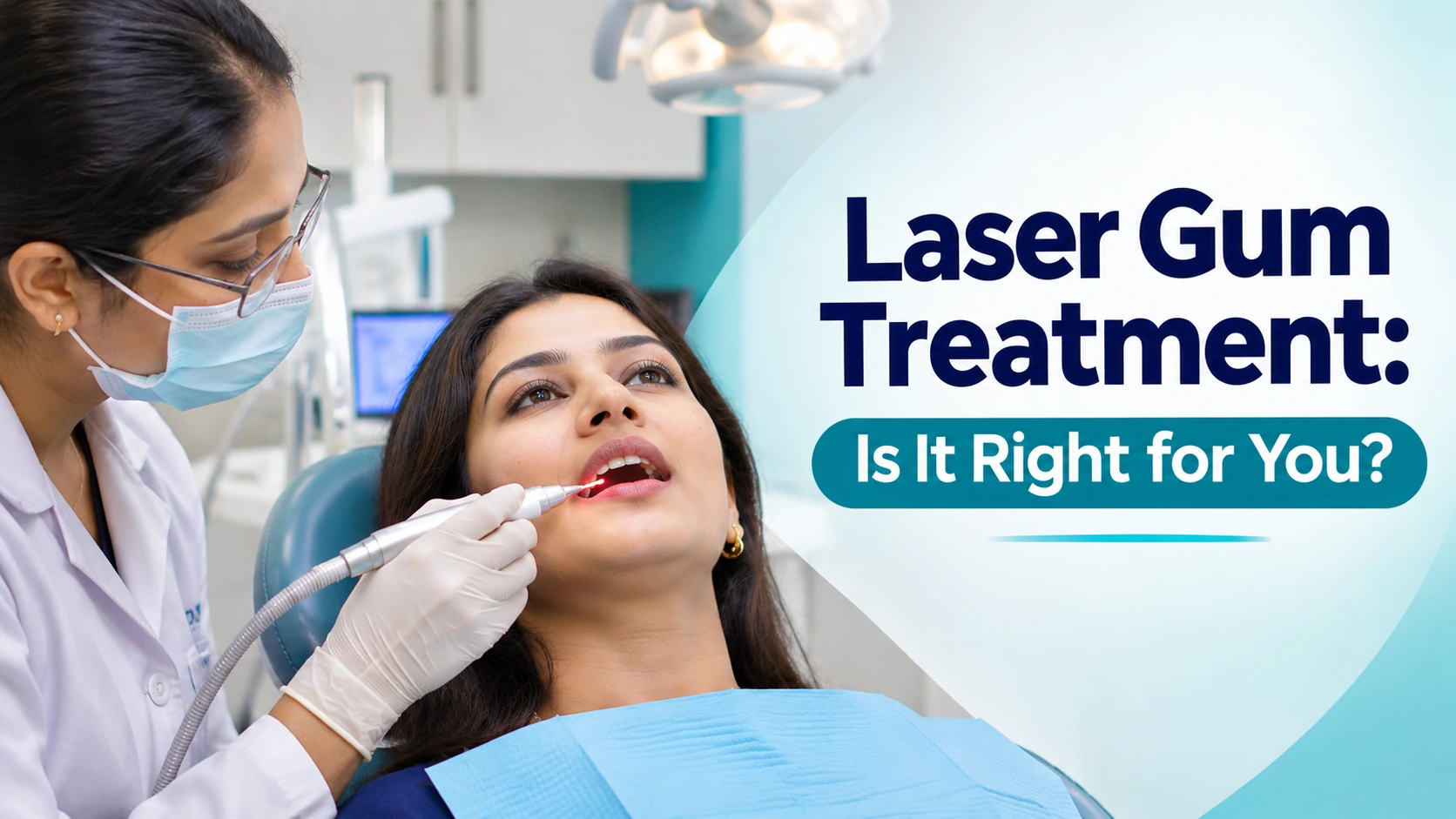
Bleeding gums that keep coming back are worrying. When a friend or an advertisement mentions laser gum treatment as a quick, no-cut fix, it can sound almost too good to be true. Sometimes it is a sensible option, and sometimes it is not.
This guide explains what laser gum treatment is, who benefits, what the research says and what to ask before you agree to it. It is written for patients who want a straight answer, not a sales pitch.
The short version: a laser can help some people with moderate to advanced gum disease, but a proper gum examination always comes first.
Key Takeaways
- Laser gum treatment targets the infected lining of gum pockets in periodontitis. It is not meant for mild gingivitis.
- Deep cleaning (scaling and root planing) is still the standard first treatment. Lasers are usually an add-on.
- LANAP gum treatment is a specific branded protocol, not a name for every gum laser.
- Evidence is mixed. Extra long-term benefit over deep cleaning is unproven for most lasers.
- Results last only as long as daily cleaning and regular maintenance visits continue.
- Your pocket depths, X-rays and health decide whether a laser suits you.
What Is Laser Gum Treatment?
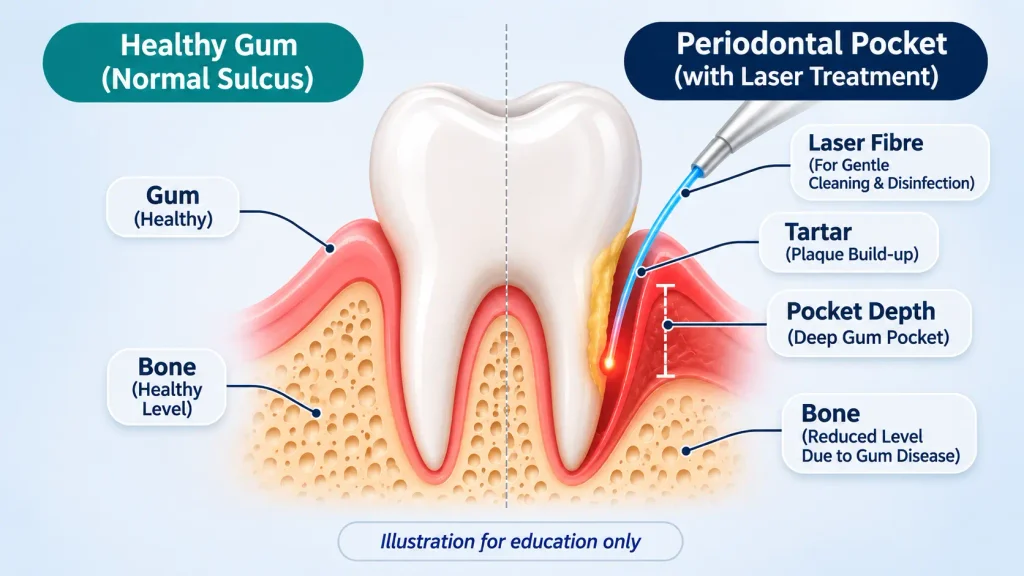
Laser gum treatment uses focused light energy to treat gum disease. The laser removes infected tissue lining the gum pockets and reduces harmful bacteria, usually alongside a thorough cleaning of the tooth roots. It is a group of techniques, not one procedure, so results depend on the laser type, the protocol and how advanced your gum disease is.
You may also hear it called gum laser surgery, laser periodontics or laser gum cleaning. These terms overlap. Laser gum cleaning usually means a laser used alongside a routine deep cleaning, while gum laser surgery points to deeper treatment of infected pockets.
Gum disease begins as gingivitis, with red, swollen gums that bleed when you brush. Left untreated, it can become periodontitis, where bacteria destroy the bone and fibres that hold teeth in place. Lasers are meant for this second stage, because early gingivitis usually settles with a professional cleaning and better home care.
Types of Laser Gum Treatment: Diode, Nd:YAG, Er:YAG and LANAP
Dentists mainly use three laser types on gums: diode, Nd:YAG and Er:YAG. A diode laser is usually an add-on after deep cleaning. LANAP gum treatment is a specific branded protocol built around a pulsed Nd:YAG laser, so it is not another name for every gum laser.
| Laser type | Typical use | Things to know |
| Diode | Reduces bacteria and treats the pocket lining after deep cleaning | Not used to scrape root surfaces. Extra benefit over cleaning alone is modest |
| Nd:YAG | Pocket treatment, and the laser used in the LANAP protocol | LANAP follows fixed steps and needs matching equipment and training |
| Er:YAG | Works on gum and hard tissue such as tartar and bone | Needs careful settings to protect the root surface |
LANAP stands for Laser-Assisted New Attachment Procedure. The US FDA cleared the protocol in 2004, and a 2016 clearance added a claim for periodontal regeneration when the full protocol is followed. Offering it properly needs the matching laser and protocol-specific training.
Ask any dentist which laser and which protocol they actually use. The answer tells you a lot about how your treatment will go.
Who Is a Good Candidate for Laser Gum Treatment?
The best candidates have moderate to advanced gum disease, with pockets of about 4 mm or deeper, bleeding gums and bone loss on X-ray. People with mild gingivitis rarely need a laser. Smokers, people with poorly controlled diabetes and those with very loose teeth need a careful assessment first.
Take a typical case: a 48-year-old with bleeding gums and a bad taste for months. Probing shows 5 to 6 mm pockets, and X-rays show bone loss around a few molars. This is the kind of gum disease where laser-assisted treatment may be discussed alongside deep cleaning.
Someone with mild bleeding and 2 to 3 mm pockets needs a thorough cleaning and a better brushing routine, not a laser.
Often a good fit
- Pockets of about 4 mm or deeper that bleed when measured (healthy gums measure about 1 to 3 mm)
- Gum disease that has not settled after a standard deep cleaning
- Patients who would like to avoid a scalpel and stitches where it is clinically appropriate
- People ready to commit to daily cleaning and regular maintenance visits
Needs extra caution or a different plan
- Mild gingivitis: professional cleaning is usually enough
- Very loose teeth with severe bone loss: surgery, splinting or extraction may need to be discussed
- Poorly controlled diabetes or heavy tobacco use: healing is slower and results are less predictable
- Pregnancy or a complex medical history: timing and approach should be agreed with your doctor
What Happens During Laser Gum Treatment?
A typical laser gum treatment has six stages: a gum examination with X-rays, local anaesthesia, laser treatment of the gum pockets, tartar removal from the roots, a bite check and follow-up care. Most patients feel pressure rather than pain. Some cases are split across two visits.
- Gum examination. The dentist measures pocket depths around every tooth, checks bleeding and tooth movement, and reviews X-rays.
- Local anaesthesia. The treated area is numbed so you stay comfortable.
- Laser treatment. A thin laser fibre is guided into each pocket to remove diseased lining and reduce bacteria.
- Root cleaning. Ultrasonic or hand instruments remove hardened tartar, because most lasers do not remove it well on their own.
- Sealing and bite check. The gum is gently pressed back against the tooth. High bite contacts may be adjusted so teeth are not overloaded while they heal.
- Follow-up. You return for a review after a week or two, then for regular maintenance cleanings.
The exact sequence varies with the laser and protocol. Full LANAP follows a fixed series of steps, while a diode laser is often a short step added to a deep cleaning visit.
Laser vs Conventional Gum Treatment: What Does the Evidence Say?
Scaling and root planing, the standard deep cleaning, is still the first-line treatment for gum disease and has the strongest evidence. Laser treatment is usually an add-on. Reviews find small or inconsistent extra benefit for most lasers, while LANAP has human studies behind it but still needs more independent long-term research.
| Deep cleaning (scaling and root planing) | Laser-assisted treatment | Flap surgery | |
| Main role | First-line treatment for gum disease | Add-on to cleaning, or a full protocol such as LANAP | Gives access to deep pockets and bone defects |
| Anaesthesia | Local | Local | Local |
| Cuts and stitches | None | Usually none | Incisions and stitches |
| Healing | Mild soreness | Often mild, varies by case | More discomfort, risk of gum recession |
| Evidence | Strongest, long track record | Mixed. Promising for some protocols, long-term data still limited | Well established for suitable cases |
| Best for | Mild to moderate gum disease | Moderate to advanced pockets in selected patients | Deep pockets and bone defects |
In plain terms, a laser is a tool, not a cure. Your outcome depends mostly on how completely bacteria and tartar are removed and how well you clean your teeth afterwards.
Published guidance from bodies such as the American Dental Association and the American Academy of Periodontology has not made diode lasers the standard of care for non-surgical gum treatment. That does not make lasers useless. It means the choice should be made case by case, with an honest talk about what is proven.
Benefits and Limitations of Laser Gum Treatment
Possible benefits include less bleeding during treatment, no scalpel or stitches in many cases and a gentler healing period. Limitations include higher cost, limited long-term evidence for some lasers and the need for a well-trained dentist. A laser cannot replace brushing, flossing and regular maintenance visits.
| Possible benefits | Limitations |
| Often less cutting and bleeding than flap surgery | Usually costs more than standard deep cleaning |
| Fewer or no stitches in many cases | Extra benefit over deep cleaning is unproven for most lasers |
| Healing can feel more comfortable for some patients | Results depend on the dentist’s training and the settings used |
| Precise treatment of the pocket lining | Not suitable for every case, and some patients still need surgery |
Possible side effects
Common side effects are short-term: tender gums, sensitivity to hot and cold, and sometimes temporary looseness of treated teeth. Heat or tissue damage can occur if a laser is used at the wrong settings, which is why training and technique matter.
Recovery and Aftercare After Laser Gum Treatment
Most people return to their normal routine within a day or two, with mild soreness, gum tenderness and sensitivity for a few days. Follow your dentist’s instructions on soft foods and cleaning the treated area. Tobacco delays healing, and gums keep settling for several weeks.
- Eat soft, cool or lukewarm food for the first few days. Skip very hot, spicy or crunchy items such as fried snacks until the gums settle.
- Clean the treated area exactly as your dentist advises. Do not stop cleaning altogether, and do not scrub hard.
- Avoid tobacco in any form, including smoking, gutka and paan with tobacco.
- Take any prescribed rinse or medicine as directed.
- Attend every follow-up visit, because maintenance is what protects the result.
Call your dentist if you notice swelling that is increasing, fever, bleeding that will not stop or a tooth that feels more loose each day.
Laser Gum Treatment Cost and How Long Results Last
Cost depends on how many teeth and areas need treatment, the laser and protocol used, and the dentist’s experience. Results can last for years when gum disease is controlled with good home care and regular maintenance, but gum disease can return. A fair estimate is only possible after a gum examination.
What usually affects the price:
- Number of teeth and areas (quadrants) treated
- Severity of pocket depth and bone loss
- Whether the laser is an add-on or a full protocol such as LANAP
- Number of visits and follow-up appointments
- Extra steps, such as X-rays or a bite adjustment
Gum disease is a chronic condition. Treatment stops the active infection, but keeping it away depends on daily cleaning, professional maintenance visits (often every three to six months for gum patients) and managing risk factors such as smoking and diabetes. Always ask for a written estimate that lists what is included.
Myths vs Facts About Laser Gum Treatment
| Myth | Fact |
| Laser gum treatment is completely painless. | Local anaesthesia is normally used. Most people feel pressure, but some soreness afterwards is normal. |
| One session cures gum disease for life. | Periodontitis is chronic. It needs daily care and regular maintenance. |
| A laser means no cleaning is needed. | Tartar still has to be removed, and most lasers do not do that well alone. |
| Laser treatment regrows all lost bone. | Some regeneration has been reported with specific protocols in studies, but results vary and cannot be guaranteed. |
| All gum lasers are the same. | Wavelengths, settings and protocols differ, and so do the results. |
Questions to Ask Before You Agree to Laser Gum Treatment
Ask which laser and protocol will be used, what training the dentist has, what your pocket depths are and why a laser is better than deep cleaning in your case. Also ask about total cost, the number of visits and the follow-up plan. A good dentist answers clearly and never promises guaranteed results.
- What are my pocket depths, and what do my X-rays show?
- Which laser and which protocol will you use?
- Why is laser treatment better for me than a standard deep cleaning?
- How many visits will I need, and what happens afterwards?
- What will it cost in total, in writing?
- What happens if my gums do not improve?
Getting Your Gums Assessed in South Kolkata
If your gums bleed, feel loose or smell bad, start with a periodontal examination, not a treatment decision. At City Smiles Dental Care in South Kolkata, we measure your pocket depths, review your X-rays and explain your options clearly. Patients from Garia, Baghajatin, Jadavpur, Tollygunge, Santoshpur and Dhakuria can book an appointment online.
Our clinic on Baghajatin Road is within easy reach for patients in Jadavpur, Garia, Dhakuria, Tollygunge and Santoshpur. We will tell you whether laser-assisted treatment, a standard deep cleaning or a referral to a gum specialist suits your case. Treatment recommendations always depend on a clinical examination, and we never promise guaranteed results.
You can check directions and opening hours on our Google Business Profile.
Frequently Asked Questions About Laser Gum Treatment
Is laser gum treatment painful?
Most patients feel pressure or mild vibration, not sharp pain, because the gums are numbed with local anaesthesia. Soreness, tenderness and sensitivity for a few days afterwards are common. Pain that worsens after the first few days, or comes with swelling or fever, needs a call to your dentist.
How long does laser gum treatment take, and how many visits are needed?
A session often lasts between one and two hours, depending on how many teeth and areas are treated. Many patients need two sessions, treating one half of the mouth at a time, plus follow-up checks. Your dentist can give a realistic plan after measuring your gum pockets.
Is laser gum treatment better than deep cleaning?
Not necessarily. Deep cleaning has the strongest evidence and remains the standard first treatment. A laser may add comfort or extra bacterial reduction in selected cases, but the additional long-term benefit is small or inconsistent for most lasers. Your pocket depths and bone loss decide which approach suits you.
What is LANAP gum treatment?
LANAP stands for Laser-Assisted New Attachment Procedure. It is a branded protocol that uses a pulsed Nd:YAG laser to treat infected gum pockets without a scalpel or stitches. It is meant for moderate to severe gum disease and needs specific equipment and training.
Can laser gum treatment fix receding gums?
No. Lasers treat infection and inflamed tissue inside gum pockets. They do not reliably regrow gum that has already receded. Receding gums may need a change in brushing technique or, in some cases, a gum graft after examination.
Is laser gum treatment safe?
When a trained dentist uses the right settings, laser gum treatment is generally considered safe. Short-term tenderness and sensitivity are the most common effects. Risks such as heat damage to tissue or the root surface rise when a laser is misused, so ask about training and the protocol.
Can laser gum treatment cure gum disease permanently?
No. Periodontitis is a chronic condition that can return if plaque builds up again. Treatment can stop active infection and stabilise your gums. You keep that result with daily brushing, cleaning between teeth, regular maintenance visits and avoiding tobacco.
When should I see a dentist about my gums?
See a dentist if your gums bleed regularly, look swollen, smell bad or are receding, or if teeth feel loose or look longer. Do not wait for pain, because gum disease is often painless until it is advanced. Early assessment gives you more treatment options.
Final Thoughts: Is Laser Gum Treatment Right for You?
Laser gum treatment can be a useful tool in laser periodontics, but it is a tool, not a cure. It may suit some people with moderate to advanced gum disease, and it adds little for mild gingivitis. The right choice depends on your pocket depths, X-rays, general health and daily habits.
Be wary of anyone who promises guaranteed results or skips the examination. The best gum treatment is the one that is matched to your diagnosis, explained honestly and followed by good maintenance.
Book a Gum Check-Up at City Smiles Dental Care
Do not wait for loose teeth or constant bleeding to find out where you stand. A short gum examination can tell you whether you need a routine cleaning, a deeper gum treatment or just a better home routine.
- Book online: Request your appointment
- Call or WhatsApp the clinic: +91 6289 004 840
- Visit us: City Smiles Dental Care, Baghajatin Road, South Kolkata. See directions and opening hours on our Google Business Profile
This article is for general education and does not replace a clinical examination. Your dentist will recommend treatment based on your own diagnosis.