


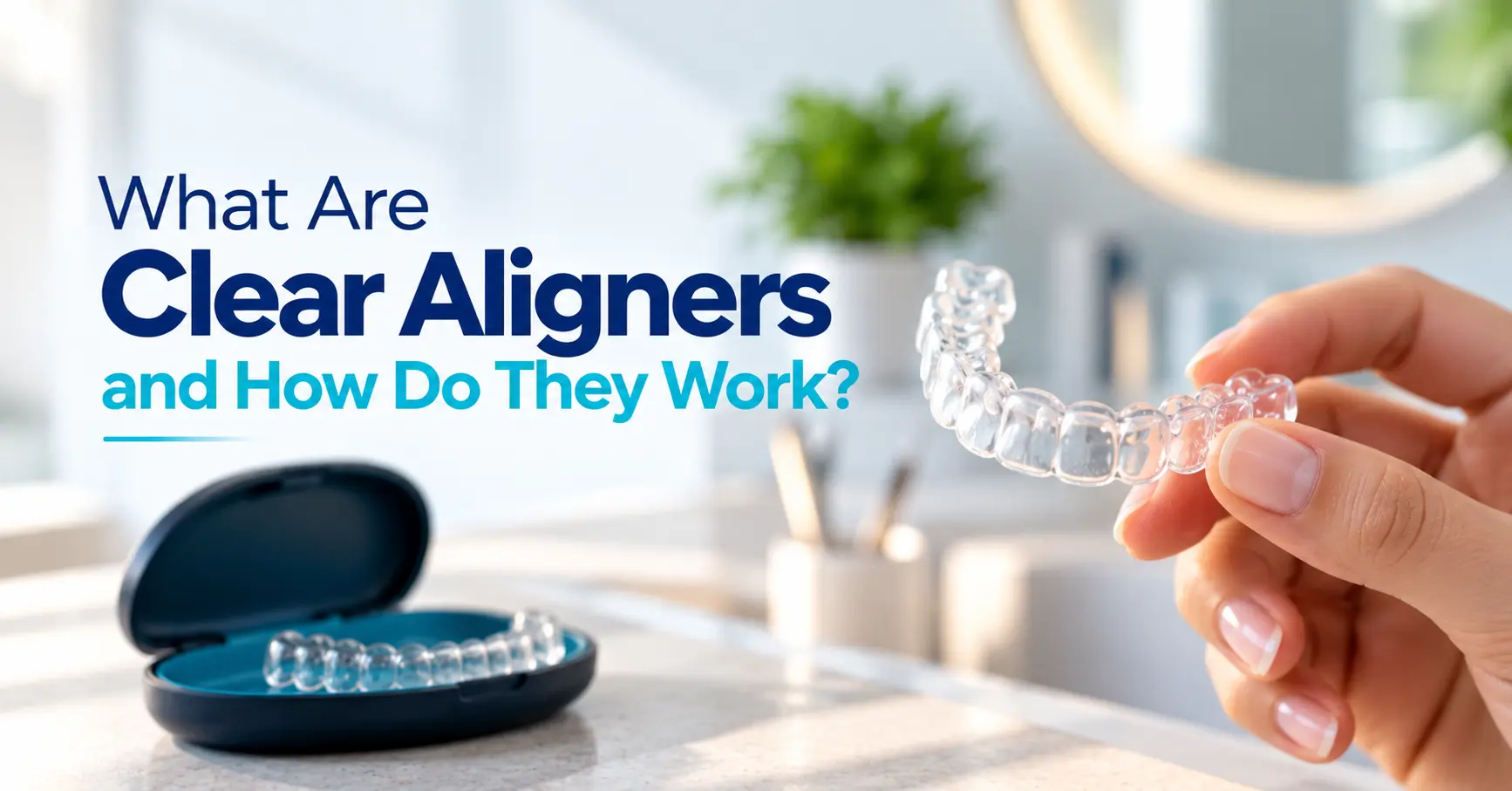
If you have been wondering what are clear aligners and whether they can really straighten teeth without metal braces, you are not alone. Clear aligners are custom-made, nearly invisible plastic trays that move your teeth gradually into better positions, one small step at a time.
They are one of the most requested orthodontic options we discuss with patients at City Smiles Dental Care in South Kolkata. Most people love the idea of discreet treatment, but they are sceptical about how a thin piece of plastic can shift a tooth anchored in bone.
This guide explains exactly that — the science, the treatment journey, the real commitment involved, and the cases where aligners may not be the right answer.
What Are Clear Aligners? A Simple Definition
Clear aligners are a series of removable, transparent trays made from medical-grade thermoplastic, custom-fitted to your teeth. Each tray is designed to move specific teeth slightly. You wear each set for one to two weeks before switching to the next, and over months the sequence guides your teeth into their planned final position.
Unlike braces, there are no brackets glued to the front of your teeth and no wires to tighten. The trays snap snugly over your teeth and are almost unnoticeable in conversation.
Because they are removable, you take them out to eat, brush and floss. That flexibility is their biggest advantage — and, as we’ll see, their biggest responsibility.
Clear Aligners vs “Invisible Braces” — Are They the Same?
In everyday language, yes. “Invisible braces” is the popular term patients search for, and it usually refers to clear aligners.
Technically, though, aligners are not braces at all. Braces use fixed brackets and wires, while a clear aligner system uses a sequence of removable trays. Some people also use “invisible braces” to describe ceramic (tooth-coloured) braces or lingual braces fixed behind the teeth — so it’s worth clarifying which option a clinic means.
How Do Clear Aligners Move Teeth? The Aligner Mechanics Explained
Clear aligners move teeth by applying gentle, continuous pressure in a planned direction. Each tray is manufactured slightly different from your current tooth position — typically around 0.25 mm of movement per stage. As the tray pushes, the bone around the tooth slowly reshapes, allowing the tooth to shift. The next tray continues the movement.
Think of it as a staircase rather than a leap. No single aligner does much on its own; the result comes from dozens of small, precisely calculated steps.
The Biology Behind Teeth Movement With Aligners
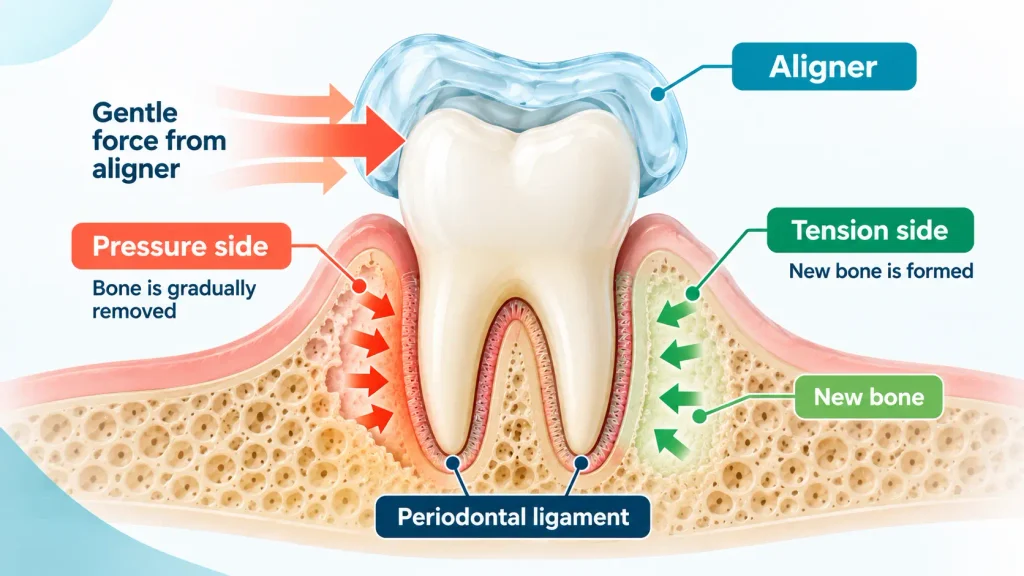
Your teeth are not fused to your jawbone. Each one sits in a socket, held by a thin, elastic layer of fibres called the periodontal ligament.
When an aligner presses on a tooth, the ligament is squeezed on one side and stretched on the other. The body responds naturally:
- On the pressure side, specialised cells (osteoclasts) gently remove bone, making space.
- On the tension side, other cells (osteoblasts) lay down new bone behind the moving tooth.
- Over days and weeks, the tooth settles into its new position with healthy bone around it.
This process — called bone remodelling — is the same biology that makes metal braces work. The difference is only in how the force is delivered.
That is also why teeth cannot be moved quickly. Light, steady force produces healthy movement; heavy or rushed force can harm the roots and gums.
Attachments: The Small Bumps That Do the Heavy Lifting
Many patients are surprised to learn that aligners often need attachments. These are tiny, tooth-coloured composite bumps bonded to certain teeth.
A smooth plastic tray can tip a tooth, but it struggles to grip a tooth firmly enough to rotate it, raise it, or move its root. Attachments act like handles, giving the aligner something to push against.
They are shaped and positioned according to the digital plan, blend in with your natural teeth, and are polished off painlessly once treatment ends.
Interproximal Reduction (IPR): Creating Room to Move
When teeth are crowded, there may simply not be enough space for them to line up. In some cases, the dentist removes a very thin layer of enamel from between selected teeth — usually a fraction of a millimetre.
This is called interproximal reduction (IPR). It is painless, requires no injection in most cases, and is planned precisely so the enamel remains healthy. Not every patient needs it, and your dentist will explain beforehand if your plan includes it.
The Clear Aligner System, Step by Step
A clear aligner system follows a planned sequence: a clinical examination, a digital scan of your teeth, a 3D simulation of the final result, manufacture of your custom trays, and regular review visits. Treatment usually ends with refinement trays if needed, followed by retainers to hold the new position.
Here is what the journey typically looks like at City Smiles Dental Care:
- Consultation and examination. We check your gums, existing fillings, bite and jaw joint. X-rays are taken where needed. Any decay or gum disease must be treated first — aligners should only go on healthy teeth.
- Digital scan or impressions. A 3D record of your teeth is taken, usually with an intraoral scanner instead of messy putty.
- Treatment planning. Your teeth are moved virtually, step by step, to plan each stage. You can often see a simulation of the expected result before committing.
- Aligner fitting. Attachments are placed if your plan needs them. You receive your first trays and learn how to insert, remove and clean them.
- Progress reviews. You visit every 6–10 weeks so we can check the teeth are “tracking” — moving as planned.
- Refinements. It’s common to need a short set of additional aligners near the end to fine-tune the result. This is a normal part of treatment, not a failure.
- Retention. Once teeth reach position, you wear retainers to keep them there.
Patient insight: A common worry we hear is, “What if the trays stop fitting?” If an aligner doesn’t seat fully, it usually means wear time has slipped or a tooth is lagging. Contact the clinic early — small tracking issues are easy to correct when caught quickly.
How Long Does Clear Aligner Treatment Take?
Clear aligner treatment typically takes between 6 and 18 months, depending on how much correction is needed. Mild spacing or crowding may finish in 6–12 months, while moderate bite corrections take longer. Consistent wear of 20–22 hours per day is the single biggest factor in staying on schedule.
| Case type | Typical duration* | Notes |
| Minor relapse after previous braces | 3–6 months | Often limited to front teeth |
| Mild crowding or spacing | 6–12 months | Common for adult cosmetic cases |
| Moderate crowding, mild bite issues | 12–18 months | May need attachments and IPR |
| Complex bite corrections | 18+ months | May need elastics, or braces may be advised |
*Estimates only. Your actual timeline depends on your clinical assessment, how your teeth respond, and wear consistency.
What Can Clear Aligners Fix — and What Are Their Limits?
Clear aligners can treat many common problems, including crowding, gaps, mild overbites, underbites and crossbites, and relapse after earlier braces. However, severe rotations, large vertical tooth movements and skeletal jaw problems may be treated more predictably with fixed braces or combined orthodontic-surgical care.
Cases That Often Suit Aligners
- Crowded or overlapping teeth (mild to moderate)
- Gaps between teeth
- Mild to moderate overbite or overjet
- Some crossbites and underbites
- Teeth that have shifted after childhood braces
- Adults and teenagers who can commit to the wear time
When Braces or Other Treatment May Be Better
Aligners have improved enormously, but honest advice means acknowledging where they are less predictable:
- Severe rotations, especially of rounded teeth like lower premolars
- Significant vertical movements, such as pulling a tooth down into the bite
- Large skeletal discrepancies, where the jaws themselves are misaligned
- Patients who struggle with wear discipline, where fixed braces remove the need for daily compliance
Sometimes a hybrid approach works best. The right choice depends on your teeth, your bite and your lifestyle — which is exactly what a consultation is for. For a detailed side-by-side, read our guide to clear aligners vs metal braces.
Living With Aligners: What Daily Life Really Looks Like
Life with clear aligners means wearing them 20–22 hours a day and removing them only to eat, drink anything other than plain water, and clean your teeth. Expect mild pressure for a day or two with each new tray. Most patients adapt within the first week.
A few practical realities our patients appreciate knowing upfront:
- Speech: A slight lisp is common for the first few days, then fades.
- Eating: No food restrictions — you remove the trays. Brush before putting them back to avoid trapping food.
- Tea and coffee: Take trays out, or you risk staining and trapping sugar against the teeth.
- Travel and events: Carry your case. A pooja, wedding or long workday shouldn’t mean trays sitting in a napkin for hours.
| Pros | Cons |
| Nearly invisible in daily life | Requires strict 20–22 hour daily wear |
| Removable for eating and cleaning | Easy to lose or forget if careless |
| No wires or brackets to irritate cheeks | Must remove for every meal and sweet drink |
| Fewer emergency visits for broken parts | Less predictable for some complex movements |
| Digital preview of planned result | Attachments and IPR may be needed |
Clear Aligner Myths vs Facts
| Myth | Fact |
| “Aligners are only for tiny cosmetic fixes.” | Modern aligners treat many moderate crowding and bite cases — though not every complex case. |
| “They don’t hurt at all.” | Most patients feel mild pressure for 1–2 days with each new tray. It’s usually manageable and a sign the aligners are working. |
| “I can wear them only at night.” | Night-only wear won’t move teeth as planned. Aligners need 20–22 hours daily. |
| “Mail-order aligners are the same as clinic aligners.” | Without an in-person examination, X-rays and reviews, problems like gum disease or bite issues can be missed. |
| “Once treatment ends, my teeth stay straight forever.” | Teeth naturally tend to drift. Retainers are needed long-term to protect the result. |
Clear Aligners in South Kolkata: Why the Dentist Matters
The aligners themselves are only as good as the treatment plan behind them. A dentist examines your gums, bite and X-rays, designs each tooth movement, decides where attachments and IPR are needed, and monitors progress in person. That clinical oversight is what makes outcomes safer and more predictable.
At City Smiles Dental Care, every aligner case starts with a full examination and a personalised plan. We will tell you honestly if aligners are a good fit — or if braces, or another approach, would serve you better.
Many of our aligner patients are working professionals and college students from Garia, Baghajatin, Jadavpur and Tollygunge who want to fit treatment around busy schedules. Having a clinic close to home in South Kolkata makes the regular review visits simple to keep up.
Wondering about fees? Our guide to clear aligners cost in Kolkata explains the factors that affect pricing.
Frequently Asked Questions
1. What are clear aligners made of?
Clear aligners are made from medical-grade, BPA-free thermoplastic material. It’s thin, transparent and flexible enough to snap over your teeth, yet firm enough to apply steady, controlled pressure that gradually moves them.
2. Do clear aligners really work?
Yes. Clear aligners work through the same bone-remodelling process as braces. Success depends on proper case selection, a well-designed treatment plan, regular dental reviews, and wearing the aligners 20–22 hours every day.
3. How many hours a day should I wear clear aligners?
Wear them 20–22 hours daily. Remove them only for eating, drinking anything other than plain water, and brushing. Reduced wear slows progress and can cause the trays to stop fitting properly.
4. Do clear aligners hurt?
Most people feel mild pressure or tightness for one to two days after switching to a new tray. This is normal and usually eases quickly. Sharp pain is unusual and should be reported to your dentist.
5. How often do I change to a new aligner?
Typically every one to two weeks, depending on your treatment plan. Your dentist decides the schedule based on how your teeth are responding. Never skip ahead to the next tray without advice.
6. Can I eat and drink with clear aligners on?
You should remove aligners to eat and to drink anything except plain water. Food can damage them, and sugary or hot drinks can stain the trays or trap sugar against your teeth.
7. What are attachments on clear aligners?
Attachments are small, tooth-coloured bumps bonded to certain teeth. They give the aligner extra grip for movements like rotations. They’re removed and polished off at the end of treatment.
8. Do I need a retainer after clear aligners?
Yes. Teeth naturally tend to move back after straightening. A retainer, usually worn at night long-term after an initial phase, protects your result. Your dentist will advise the right retainer type for you.
9. Am I too old for clear aligners?
There is no upper age limit. Adults of any age can move teeth, provided their gums and supporting bone are healthy. A clinical examination confirms whether your teeth are ready for treatment.
Conclusion
So, what are clear aligners? They are a precise, removable orthodontic system that straightens teeth through a series of custom trays, each applying gentle, planned pressure. The science is well-established — it’s the same bone remodelling that makes braces work.
What makes aligners succeed is not the plastic, but the plan and your commitment. A thorough examination, a carefully designed sequence, regular reviews, and 20–22 hours of daily wear are what turn a digital simulation into a real result.
If you’re considering invisible braces, the best first step is an honest assessment of whether they suit your teeth.
Book Your Clear Aligner Consultation in South Kolkata
Curious whether clear aligners could work for your smile? At City Smiles Dental Care, we’ll examine your teeth, discuss your goals, and explain every option clearly — with no pressure to commit.
Book your appointment online or call the clinic to schedule a visit. We welcome patients from Garia, Baghajatin, Jadavpur, Tollygunge, Santoshpur, Dhakuria and across South Kolkata.
You can also find us on Google for directions, clinic hours and reviews from our patients.
Medical disclaimer: This article is for general information and does not replace a professional dental examination. Treatment suitability and outcomes vary between individuals.