


Most parents in Garia, Jadavpur, Tollygunge, and across South Kolkata share the same assumption: baby teeth are temporary, so they can’t be that important. After all, they fall out on their own — right?
It is one of the most common and most costly misconceptions in paediatric dentistry.
The importance of baby teeth goes far beyond filling a young smile. Milk teeth shape how a child eats, speaks, learns, and ultimately grows into the permanent dentition that will serve them for life. Understanding what is at stake — and what can go wrong — is the first step toward protecting your child’s oral health from the very beginning.
What Are Baby Teeth and When Do They Appear?
Baby teeth — also called milk teeth, primary teeth, or deciduous teeth — are the first set of 20 teeth that develop in early childhood. They typically begin erupting around six months of age, with the lower central incisors appearing first. By the time a child reaches two to three years of age, all 20 primary teeth are usually present.
These teeth begin forming in the jaw before birth. By the time your baby is born, the crowns of the primary teeth are already partially developed beneath the gumline — and the permanent teeth are beginning to form directly beneath them.
Primary teeth are not placeholders. They are working teeth with living nerves, blood vessels, and roots, just like adult teeth.
What Do Baby Teeth Actually Do?
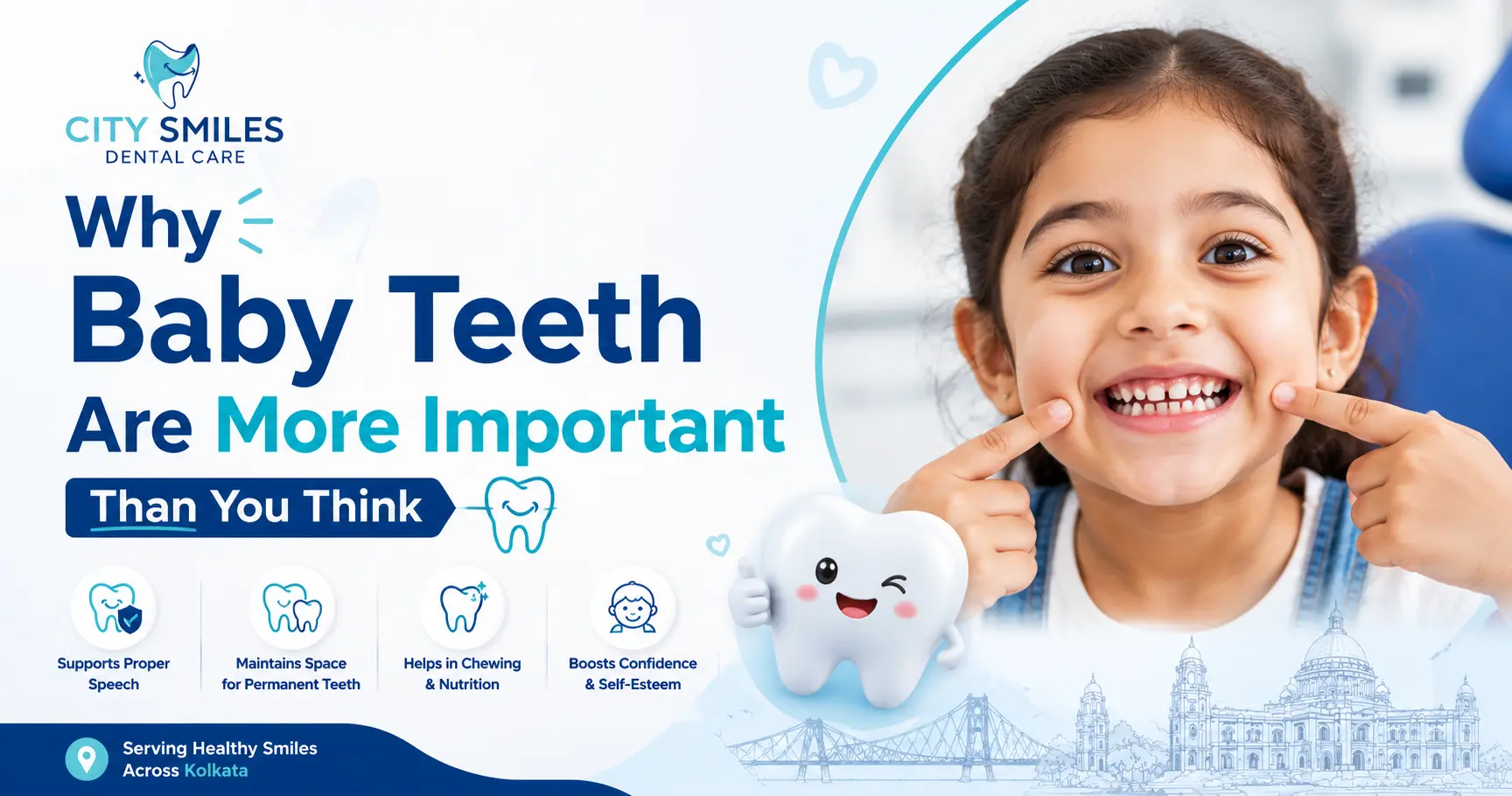
Baby teeth serve four essential functions in a child’s development. They are not decorative — they are structural and functional, and their health or neglect has direct consequences that extend well into adulthood.
Chewing and Nutrition
A child with painful or decayed baby teeth struggles to chew properly. This affects food choices, limits nutritional intake, and can interfere with healthy growth at a stage when the body is developing rapidly. A toddler avoiding hard or crunchy foods because of tooth pain is a child whose diet is being shaped by dental neglect.
Speech and Language Development
The tongue, lips, and teeth work together to produce speech sounds. Several consonants — particularly ‘s’, ‘f’, ‘th’, ‘d’, and ‘t’ — require the front teeth for correct articulation. Children who lose front baby teeth too early, or whose teeth are severely decayed, frequently develop speech difficulties. Some of these patterns persist even after the permanent teeth arrive.
Holding Space for Permanent Teeth
This is perhaps the most misunderstood function of milk teeth. Each baby tooth acts as a natural space maintainer, reserving the correct position in the dental arch for the permanent tooth developing beneath it.
When a baby tooth is lost prematurely — whether from decay, trauma, or extraction — the neighbouring teeth drift into the gap. The permanent tooth, when it eventually erupts, finds insufficient space. The result is crowding, misalignment, and frequently, the need for orthodontic treatment that could have been avoided.
Jaw and Facial Development
Chewing exerts mechanical forces on the jaw that stimulate bone growth. Without this stimulation — because a child avoids chewing due to pain, or because multiple teeth have been extracted — normal jaw development can be compromised. The shape of the dental arch, the width of the jaw, and ultimately the profile of the face are all influenced by the health of the primary dentition.
What Happens When Baby Teeth Are Neglected?
Dental Decay in Milk Teeth
Early childhood caries — commonly known as bottle tooth decay or nursing caries — is one of the most prevalent childhood diseases globally. It progresses rapidly in primary teeth because the enamel layer is thinner than in permanent teeth.
A decayed baby tooth is not an inconvenience to be tolerated until it falls out. Decay creates a bacterial reservoir in the mouth. If the infection reaches the root and spreads to the jaw, it can damage the permanent tooth bud forming underneath, sometimes permanently altering its structure or delaying its eruption.
Children with untreated dental decay also experience chronic pain that affects concentration, sleep, appetite, and school performance.
Early Tooth Loss and Space Loss
When a baby tooth is extracted or falls out significantly before its natural time, the gap it leaves is rapidly colonised by neighbouring teeth. This process — called mesial drift — occurs within weeks and can create serious space loss within months.
The permanent tooth that was meant to occupy that space now has nowhere to go. It may erupt rotated, impacted, or crowded against adjacent teeth.
Space maintainer appliances can be fitted by a paediatric dentist to prevent this — but the best outcome is always the natural baby tooth remaining in place until it is developmentally ready to fall out on its own.
Impact on Permanent Teeth
The relationship between primary and permanent teeth is intimate. The root of each baby tooth sits directly above the developing crown of the permanent tooth beneath it. Severe infection in a baby tooth can discolour, malform, or damage the enamel of the permanent tooth — a condition called Turner’s hypoplasia.
In short: what happens to the milk teeth does not stay with the milk teeth.
Myths vs. Facts About Baby Teeth
| Myth | Fact |
| Baby teeth will fall out, so cavities don’t need treatment. | Untreated cavities can infect the permanent tooth forming underneath and cause lasting damage. |
| Baby teeth don’t have nerves, so they don’t hurt. | Primary teeth have pulp tissue with nerves and blood supply. Decay is painful. |
| My child is too young for a dentist visit. | The first dental visit is recommended by the first birthday or when the first tooth appears. |
| Losing a baby tooth early is no big deal. | Early loss causes neighbouring teeth to drift, leading to crowding of permanent teeth. |
| Brushing baby teeth isn’t really necessary. | Brushing should begin with the very first tooth, using a rice-grain amount of fluoride toothpaste. |
When Should Your Child First See a Dentist?
The Indian Academy of Paediatrics and the American Academy of Paediatric Dentistry both recommend the first dental visit no later than the child’s first birthday, or within six months of the first tooth appearing — whichever comes first.
This early visit is not about drilling and filling. It is a brief, gentle examination to assess tooth development, check for early signs of decay, counsel parents on brushing technique and diet, and establish a comfortable relationship between the child and the dental environment.
Children who attend early and regularly are significantly less likely to develop dental anxiety as they grow older.
At City Smiles Dental Care in South Kolkata, the team works gently with young patients, making the first dental experience as positive and stress-free as possible. Families from Baghajatin, Santoshpur, Dhakuria, and surrounding areas regularly bring their children for paediatric dental assessments.
Book a paediatric dental visit for your child →
How to Care for Baby Teeth at Home
Effective home care is straightforward once parents know what to do.
From birth to first tooth: Wipe the gums with a clean, damp cloth after feeds. This clears milk residue and introduces the habit of oral hygiene.
First tooth onwards: Begin brushing twice daily using a soft-bristle infant toothbrush and a rice-grain amount of fluoride toothpaste (for children under 3 years).
Ages 3–6: Increase toothpaste to a pea-sized amount. Supervise brushing — children at this age lack the fine motor control to brush effectively on their own.
Diet: Avoid prolonged bottle feeding at night. Milk and juice left in contact with teeth overnight are the primary cause of nursing caries. Water is the safest bedtime drink.
Regular dental visits: Every six months once the first tooth appears. Early detection of decay allows minimally invasive treatment.
Frequently Asked Questions About Baby Teeth
Do cavities in baby teeth affect permanent teeth? Yes. Severe decay or infection in a baby tooth can damage the developing permanent tooth forming directly beneath it. The bacteria from an infected baby tooth can affect the enamel structure of the permanent tooth, potentially causing discolouration or structural defects.
At what age do baby teeth fall out? Baby teeth typically begin falling out around age 6, starting with the lower central incisors. The process continues through adolescence, with the last primary molars usually lost around age 12.
What happens if a baby tooth is pulled out too early? Neighbouring teeth drift into the empty space, causing the permanent tooth to erupt in the wrong position. A paediatric dentist may recommend a space maintainer to prevent this.
Is fluoride toothpaste safe for babies? Yes, in the correct amount. A rice-grain-sized amount is safe for children under 3 years. A pea-sized amount is appropriate from age 3 onwards. The key is supervision to ensure the child does not swallow large amounts.
My child is scared of the dentist. What should I do? Introduce dental visits early — ideally before any problem develops. Avoid using dental visits as a threat. Choose a clinic experienced in paediatric care where the environment is child-friendly and staff are trained to work gently with young patients.
When should my child start flossing? Flossing should begin as soon as two adjacent teeth are in contact — typically around age 2 to 3. A parent should floss the child’s teeth until they have the dexterity to do it independently, usually around age 10.
Can decay in baby teeth be treated? Yes. Depending on the severity, treatment may include fluoride varnish, dental sealants, fillings, or pulp therapy (similar to a root canal for primary teeth). The goal is always to preserve the tooth until it falls out naturally.
Why does my child have a gap between their baby teeth? Gaps between baby teeth are actually a positive sign. They indicate there is sufficient space in the jaw for the larger permanent teeth that will eventually replace them.
Is it normal for a baby tooth and permanent tooth to be visible at the same time? This is known as a shark tooth situation and is relatively common, particularly with the lower front teeth. In many cases the baby tooth falls out on its own within a few weeks. A dentist should assess it if the baby tooth shows no signs of loosening.
How many baby teeth does a child have? A child has 20 primary teeth in total — 10 in the upper arch and 10 in the lower arch.
The Importance of Baby Teeth Cannot Be Overstated
By the time a child reaches their teens, they will have transitioned through two complete sets of teeth. But the condition of those adult teeth — their alignment, their structural integrity, even their position in the jaw — is shaped largely by what happened during the primary dentition years.
The importance of baby teeth is not sentimental. It is structural, functional, and developmental.
If your child has not yet had their first dental check-up, or if you have noticed any signs of early decay, early sensitivity, or a tooth that seems loose before the natural time, this is the right moment to act.
At City Smiles Dental Care in South Kolkata, experienced clinicians assess each child’s dental development individually and guide parents through every stage — from the first tooth to the final permanent tooth.
Book an appointment for your child today →
Find us on Google Maps and read reviews from families across South Kolkata: City Smiles Dental Care on Google