


Cavities are one of the most common dental problems in children — and most of them start in exactly the same place: the deep grooves of the back teeth.
If your child’s dentist has recommended dental sealants, you likely have questions. Are they safe? What does the procedure involve? Is it really worth the cost?
This guide answers all of it — clearly, honestly, and in plain language.
What Are Dental Sealants?
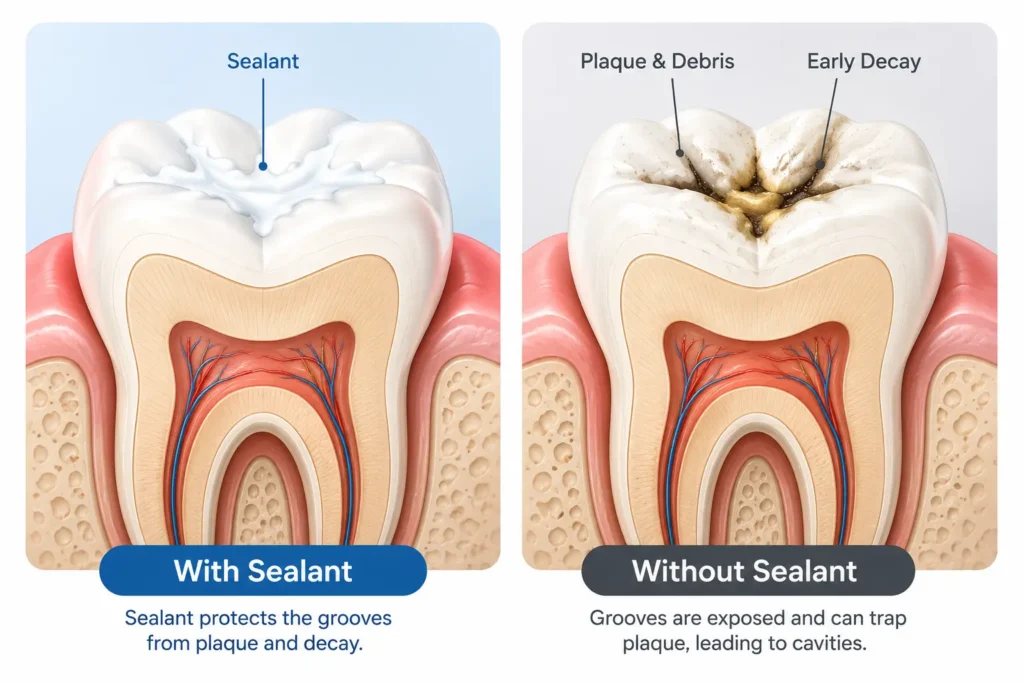
Dental sealants are thin, plastic coatings painted onto the chewing surfaces of the back teeth — mainly the molars and premolars — to protect them from decay. They seal off the deep pits and grooves where food and bacteria commonly get trapped. The procedure is simple, non-invasive, and takes less than an hour. Sealants are one of the most cost-effective preventive treatments in paediatric dentistry.
Why Back Teeth Are So Vulnerable to Cavities
Your child’s molars do most of the chewing — and they’re designed for it. Their chewing surfaces are covered in deep pits and grooves that help grind food down efficiently.
The problem? Those same grooves are extremely difficult to clean, even with a toothbrush.
Food particles and bacteria settle into these crevices. Acid builds up. Enamel breaks down. And before you know it, a cavity has formed — often without any visible warning sign.
This is why children — especially those between ages 6 and 14 — are so prone to molar cavities. It’s not always about brushing habits. Sometimes the anatomy of the tooth simply makes it hard to keep clean.
Who Should Get Dental Sealants?
Dental sealants are most beneficial for children between the ages of 6 and 14, as this is when the first and second permanent molars typically emerge. Sealing these teeth shortly after they come in gives them the best protection during the cavity-prone years.
Your child may be a good candidate for sealants if they:
- Have deep grooves or pits in their back teeth
- Have a history of frequent cavities
- Have difficulty with consistent, effective brushing
- Are between 6 and 14 years old with newly erupted permanent molars
Sealants can also be placed on baby teeth in some cases, particularly if a milk tooth has deep grooves and needs to stay healthy until the permanent tooth is ready to erupt.
At City Smiles Dental Care in South Kolkata, we assess each child individually before recommending sealants — because not every child needs them, and not every tooth requires treatment.
The Sealant Procedure: What to Expect
One of the biggest reasons parents hesitate is the fear that their child will be uncomfortable. The good news: the sealant procedure is completely painless and requires no drilling or anaesthesia.
Here’s what happens during a typical appointment:
Step 1 — Cleaning The dentist cleans the tooth surface thoroughly to remove any food debris or plaque.
Step 2 — Drying Each tooth is dried carefully. Cotton or absorbent material is placed around the tooth to keep it dry during the procedure.
Step 3 — Etching A mild acid gel is applied to the chewing surface for a few seconds. This creates a slightly rough surface so the sealant can bond properly. The gel is then rinsed off and the tooth is dried again.
Step 4 — Applying the Sealant The liquid sealant material is painted directly onto the tooth enamel. It flows into the grooves and pits naturally.
Step 5 — Curing A special curing light is used to harden the sealant in place. This takes just a few seconds per tooth.
The entire process — for all four back teeth — is usually done within 30 to 45 minutes. Most children find it easy and comfortable.
Benefits of Dental Sealants for Kids
Child cavity prevention is one of the core goals of paediatric dentistry — and dental sealants are among the most reliable tools available.
Proven cavity protection. Research shows that pit and fissure sealants can reduce the risk of cavities in molars by up to 80% in the first two years after placement.
Non-invasive. No drilling. No injections. No discomfort.
Cost-effective long-term. One sealant appointment is far less expensive than a filling, root canal, or crown — which are the likely alternatives if a cavity is allowed to develop.
Durable. Tooth sealants can last 5 to 10 years with regular dental check-ups.
Builds healthy habits. Children who experience positive dental visits early are more likely to continue seeking preventive care as adults.
How Long Do Tooth Sealants Last?
With proper maintenance and regular dental check-ups, dental sealants typically last 5 to 10 years.
Your child’s dentist will check the sealants at each routine visit to ensure they haven’t chipped or worn away. If a sealant has come partially loose, it can be reapplied.
Sealants do not require any special maintenance beyond routine brushing and flossing — though it’s worth noting that sealants do not replace good oral hygiene habits. They protect specific surfaces but do not cover the sides or spaces between teeth.
Pit and Fissure Sealants vs No Sealants
| Factor | With Pit & Fissure Sealants | Without Sealants |
| Cavity risk (molars) | Reduced by up to 80% | Significantly higher |
| Procedure | Painless, 30–45 min | Not applicable |
| Cost upfront | Moderate | None |
| Long-term cost | Lower (avoids fillings) | Potentially higher |
| Durability | 5–10 years | Not applicable |
| Age suitability | 6–14 years (ideal) | All ages (higher risk) |
| Drilling required | No | No (until cavity forms) |
Are Dental Sealants Safe?
Yes — dental sealants are considered safe by the Indian Dental Association and are widely used in paediatric dentistry worldwide.
The materials used are BPA-free in most modern formulations and the acid etching gel used to prepare the tooth surface is mild and rinsed off completely before the sealant is applied.
There is no known risk from properly placed dental sealants. The procedure does not alter the tooth structure in any permanent way, and sealants can be removed by a dentist if necessary.
As with any dental material, your child’s dentist will confirm the appropriate product for your child’s age and dental condition.
Myths vs Facts About Dental Sealants
Myth: Sealants are only for children with poor dental hygiene. Fact: Even children who brush and floss diligently can have deep grooves that are structurally difficult to clean. Sealants protect anatomy, not just habits.
Myth: Sealants replace the need for brushing. Fact: Sealants protect the chewing surfaces of back teeth only. Regular brushing, flossing, and fluoride use remain essential for complete oral health.
Myth: The procedure is painful. Fact: No drilling or anaesthesia is involved. Most children tolerate the procedure easily and comfortably.
Myth: Sealants can trap decay inside the tooth. Fact: Sealants are only placed on clean, cavity-free tooth surfaces. If tooth decay is already present, a sealant will not be applied — treatment of the decay comes first.
Myth: Sealants are a permanent fix. Fact: They typically last 5 to 10 years. Regular monitoring at check-up visits ensures they remain intact and effective.
Dental Sealant Cost in Kolkata
The cost of dental sealants in Kolkata generally depends on:
- The number of teeth being sealed
- The type of sealant material used
- The clinic you visit
As a general reference, sealants are typically priced per tooth. Sealing four molars in a single visit is among the more affordable preventive dental investments available for children — especially when compared to the cost of treating a cavity that could have been prevented.
For accurate pricing tailored to your child’s needs, we recommend booking a consultation at City Smiles Dental Care. Our team in South Kolkata — serving families from Garia, Baghajatin, Jadavpur, Tollygunge, Santoshpur, and Dhakuria — will assess your child’s teeth and give you a transparent cost estimate before any treatment begins.

Frequently Asked Questions
At what age should my child get dental sealants? The ideal age is between 6 and 7, when the first permanent molars come in, and again around 11 to 13 when the second molars erupt. Early placement offers the most protection during the cavity-prone years.
Are dental sealants the same as fillings? No. A filling replaces tooth structure that has been damaged by decay. A sealant is a preventive coating placed on a healthy tooth to prevent decay from developing in the first place.
Can adults get dental sealants? Yes. While sealants are most commonly recommended for children, adults with deep grooves in their back teeth and no existing decay or fillings can also benefit from them.
Will my child feel anything during the procedure? No. The procedure is completely painless. There is no drilling and no injection required. The acid etching gel may feel slightly cold or tingly, but it is rinsed off quickly.
Do dental sealants affect the bite? Immediately after placement, some children notice a slight feeling of thickness on their back teeth. This usually resolves within a day or two as the sealant settles. Your dentist will check and adjust the bite if needed.
Can sealants fall off? Sealants can chip or wear over time, which is why they are checked at every routine dental visit. If a sealant has partially come loose, it can be reapplied easily and quickly.
Do dental sealants contain BPA? Most modern dental sealants are formulated to be BPA-free or to release negligible amounts well below any threshold of clinical concern. Your dentist can advise on the specific material being used.
How do I know if my child needs sealants? A dentist can assess this during a routine examination. If your child’s molars have deep pits and fissures and no existing decay, sealants are likely to be recommended as a preventive measure.
Can my child eat normally after getting sealants? Yes. There is no recovery period. Your child can eat and drink normally immediately after the procedure. It is advisable to avoid very hard or sticky foods in the first 24 hours.
Are sealants covered by dental insurance in India? Coverage varies by policy. It is worth checking with your insurance provider. Even where not covered, the cost of sealants is typically much lower than the cost of restorative dental treatment.
Conclusion
Dental sealants for kids are one of the most straightforward, evidence-backed preventive treatments in paediatric dentistry. A single short appointment can protect your child’s molars through the most cavity-prone years of their life — without any drilling, pain, or stress.
If your child is between 6 and 14 years old, or if a dentist has flagged their back teeth as cavity-prone, it’s well worth a conversation about pit and fissure sealants. Prevention is always less costly — financially and emotionally — than treatment.
At City Smiles Dental Care in South Kolkata, we take a careful, individual approach to every child’s dental health. We do not recommend treatments that aren’t clinically indicated. If sealants are right for your child, we’ll explain exactly why, walk you through the procedure, and give you a clear cost estimate before anything begins.
Book Your Child’s Sealant Consultation
If you’re in Garia, Jadavpur, Baghajatin, Tollygunge, Santoshpur, Dhakuria, or anywhere in South Kolkata, City Smiles Dental Care is here to help.
Schedule an appointment online or find us on Google Maps.
Your child’s smile deserves a head start — and dental sealants are one of the best ways to give it.