


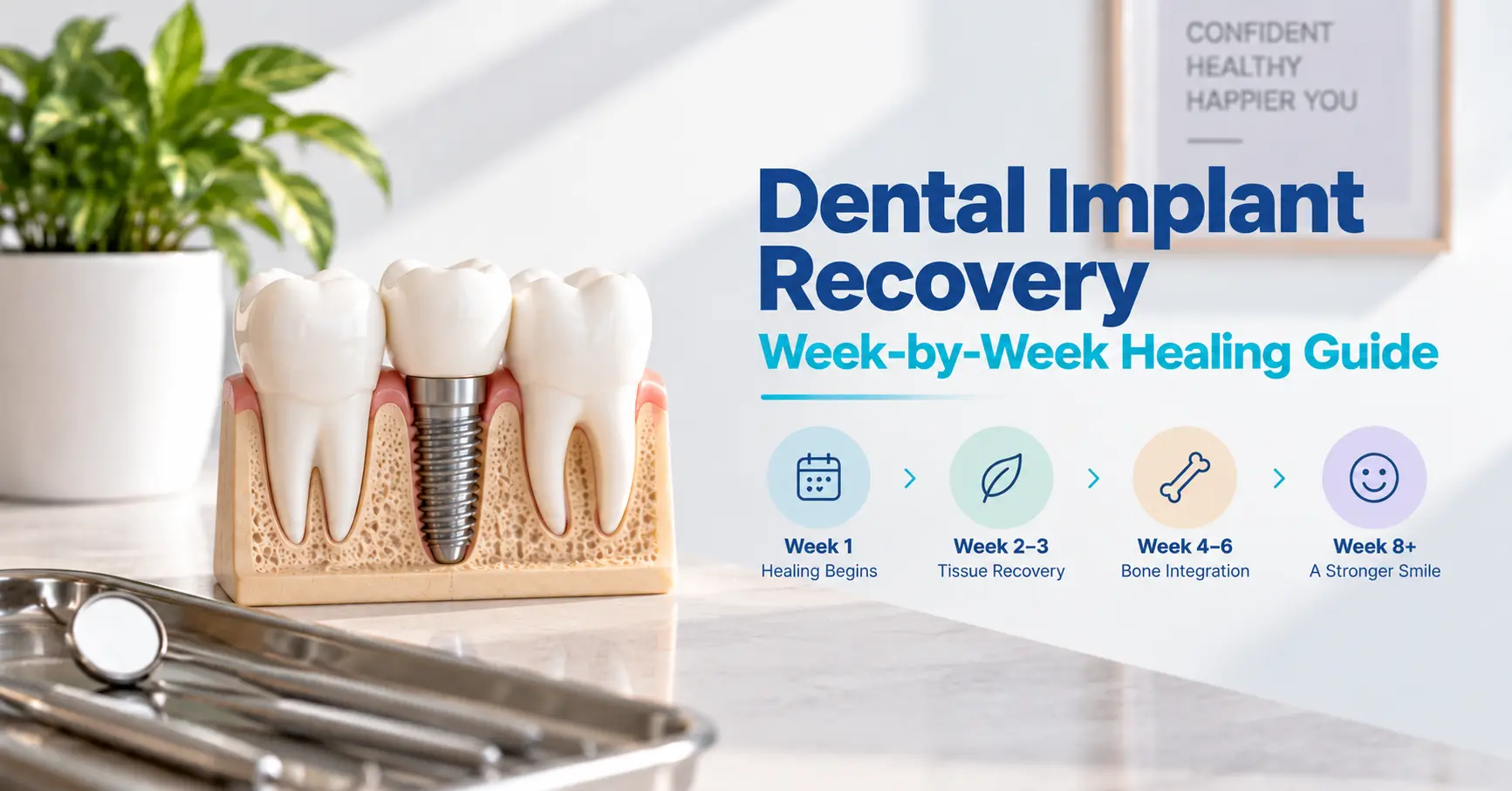
The surgery is done. Now comes the part nobody fully prepares you for — the waiting, the soft food, and the 2 a.m. question: “Is this swelling normal?”
Dental implant recovery is smoother and more predictable than most patients expect, but only when you know what each stage should look like. This week-by-week guide from the team at City Smiles Dental Care in South Kolkata walks you through the entire implant healing journey — from the first 24 hours to the day your final crown is fitted.
Whether you have just had surgery in Garia or are preparing for an implant appointment in Jadavpur, keep this guide handy. It tells you what is normal, what is not, and exactly what to do at every stage.
How Long Does Dental Implant Recovery Take?
Initial dental implant recovery takes about 1 to 2 weeks, during which swelling and tenderness settle and gums begin to heal. Complete recovery — where the implant fuses with your jawbone through osseointegration — typically takes 3 to 6 months. Most patients return to work within 2 to 3 days of surgery.
It helps to think of recovery in two layers:
- Surface healing — what you feel. Gum tissue closes and discomfort fades within 1–2 weeks.
- Deep healing — what you cannot feel. Bone slowly bonds with the titanium implant over several months.
Most of the “recovery experience” happens in the first two weeks. The rest is quiet biology working in the background.
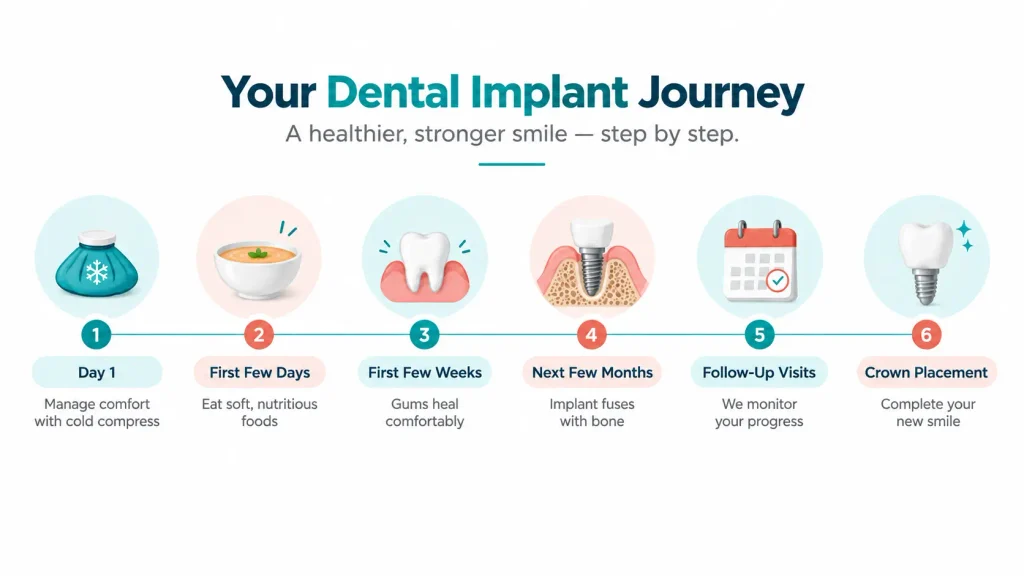
Dental Implant Recovery Timeline at a Glance
| Stage | What Is Happening | How You Feel | Key Care Focus |
| First 24 hours | Blood clot forms at surgical site | Numbness fading, mild oozing | Rest, gauze pressure, cold compress |
| Days 2–3 | Peak swelling and tenderness | Puffy cheek, manageable soreness | Medication as prescribed, soft cold foods |
| Week 1 | Gum tissue begins closing | Discomfort steadily reduces | Gentle rinsing, soft diet, no straws |
| Weeks 2–4 | Soft tissue largely healed | Near-normal comfort | Careful brushing, gradual diet return |
| Months 2–6 | Osseointegration (bone fusion) | No symptoms | Oral hygiene, follow-up visits |
| Final stage | Abutment + crown placement | Minor gum tenderness for a few days | Adjusting bite, normal function returns |
Every patient heals at their own pace. Your dentist will confirm your personal timeline at follow-up visits.
The First 24 Hours After Implant Surgery
The first day sets the foundation for everything that follows. Your only job is to protect the blood clot forming at the implant site — it is the scaffolding your body uses to start healing.
In the first 24 hours:
- Bite gently on the gauze for 30–60 minutes to control bleeding.
- Apply a cold compress to your cheek — 15 minutes on, 15 minutes off.
- Take prescribed medication on schedule, not just when pain appears.
- Rest with your head slightly elevated, even while sleeping.
- Eat only cool, soft foods — curd, smoothies (spoon, not straw), lukewarm dal.
Strictly avoid on day one: rinsing or spitting forcefully, drinking through straws, hot food and drinks, smoking, alcohol, and touching the site with your tongue or fingers.
Slight oozing of blood mixed with saliva is normal on day one. Steady, active bleeding is not — if gauze pressure does not control it within an hour, call your dentist.
Week 1: Swelling, Soft Foods, and Gentle Care
The first week is the most noticeable phase of implant surgery recovery. Swelling peaks around day 2 or 3, then improves daily. By day 7, most patients feel close to normal, though the site remains tender to touch.
What Is Normal in Week 1
- Cheek swelling that peaks on day 2–3 and fades by day 5–7
- Mild bruising on the cheek or jaw (more common in older patients)
- Jaw stiffness and tenderness while chewing on the other side
- Minor sensitivity around neighbouring teeth
- Discomfort controlled well by prescribed medication
A patient from Tollygunge recently told us she panicked on day 3 because her swelling looked worse than day 1. That is exactly the pattern to expect — swelling rises for about 72 hours before it falls. Day 3 is usually the peak, not a setback.
What to Do — and What to Avoid
Do:
- Start gentle warm salt-water rinses from day 2 (do not swish forcefully)
- Brush your other teeth normally; clean near the implant site with a soft brush from day 3–4, as advised
- Eat soft, nutritious food — khichdi, dal, mashed vegetables, paneer, eggs, oats, curd
- Stay hydrated and rest well; healing is faster when your body is not exhausted
- Attend your first follow-up visit even if everything feels fine
Avoid:
- Smoking and tobacco in any form — the single biggest threat to implant healing
- Alcohol, which interferes with healing and some medications
- Hard, crunchy, spicy, or very hot foods
- Vigorous exercise or heavy lifting for at least 4–5 days
- Chewing directly on the implant side
Weeks 2 to 4: Gum Healing and Returning to Routine
By the second week, the gum tissue over and around the implant has largely closed. Stitches (if non-dissolving) are usually removed between days 7 and 14. Most patients are back to full work, social, and exercise routines.
During weeks 2 to 4:
- Reintroduce firmer foods gradually — soft rice meals first, then normal textures
- Continue meticulous but gentle cleaning around the implant area
- Expect occasional mild twinges as tissue matures; sharp or worsening pain is different and needs a call to your dentist
- Keep chewing pressure light on the implant side until your dentist clears it
Many patients assume recovery is “finished” at this point because they feel fine. On the surface, it nearly is — but the most important phase of implant healing is only just beginning underneath.
Months 2 to 6: Osseointegration — the Silent Phase of Implant Healing
Osseointegration is the process by which your jawbone grows onto and fuses with the titanium implant surface, locking it in place like a natural tooth root. It typically takes 3 to 6 months, produces no symptoms, and determines the long-term success of your dental implant.
You will not feel osseointegration happening. There is no pain, no swelling, no signal — which is exactly why patients sometimes get careless during this phase.
What matters during these months:
- Oral hygiene: Plaque around a healing implant can trigger inflammation that compromises bone fusion. Brush twice daily and clean between teeth as your dentist demonstrates.
- Follow-up visits: Your dentist checks implant stability and gum health at intervals. These short visits catch small issues before they become failures.
- Bite discipline: Avoid using the implant area to crack nuts, chew ice, or open packets — habits we see surprisingly often in Kolkata patients.
- Lifestyle: Continued smoking during this phase significantly raises failure risk. If you quit for surgery, this is the reason to stay quit.
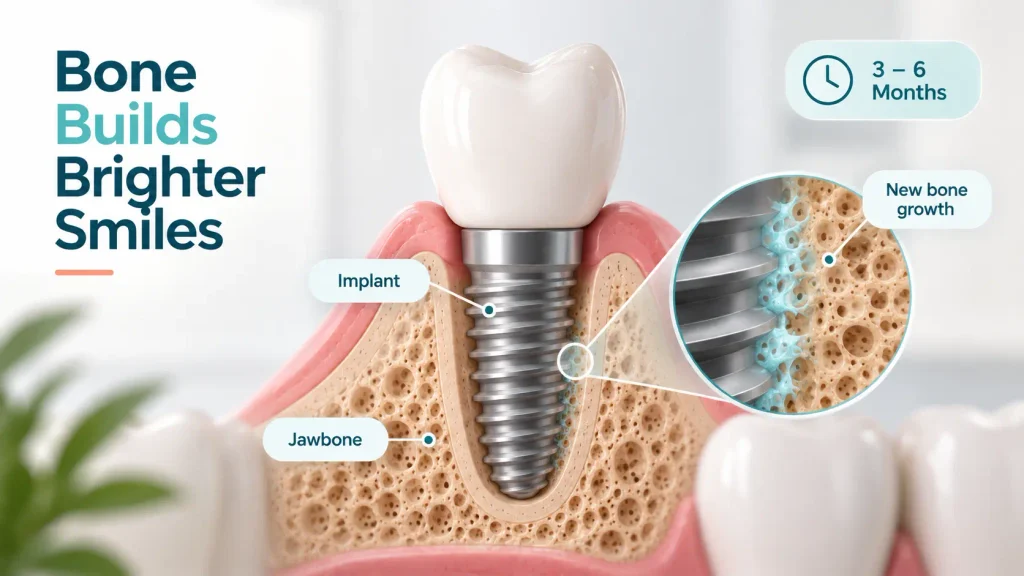
Healing time varies with bone quality, implant location (lower jaw often integrates faster than upper), and whether bone grafting was performed. At City Smiles Dental Care, we confirm integration clinically before moving to the final restoration — never by the calendar alone.
The Final Step: Abutment and Crown Placement
Once the implant has fused with the bone, a small connector called an abutment is attached, and your permanent crown is fixed onto it. This stage involves little to no downtime — most patients experience only minor gum tenderness for a few days.
The sequence usually looks like this:
- Your dentist confirms the implant is stable and fully integrated.
- The abutment is placed; gums may need 1–2 weeks to shape around it.
- Impressions or digital scans are taken for your custom crown.
- The crown is fitted, and your bite is checked and adjusted.
From this point, your implant looks, feels, and functions like a natural tooth. You can eat normally — including the crusty bread and guava you have been avoiding — while maintaining the same hygiene care you would give any tooth.
What to Eat During Dental Implant Recovery
| Recovery Stage | Recommended Foods | Foods to Avoid |
| Day 1 | Curd, lassi (no straw), smoothies, lukewarm soup, mashed potato | Anything hot, spicy, crunchy, or chewy |
| Days 2–7 | Khichdi, dal, oats, scrambled eggs, paneer, mashed vegetables, soft fish | Fried food, nuts, raw vegetables, hard rotis |
| Weeks 2–4 | Soft rice meals, well-cooked vegetables, soft chapati, pasta, ripe fruits | Very hard or sticky foods; chewing on implant side |
| After clearance | Normal balanced diet | Ice-chewing and using teeth as tools — permanently |
Protein deserves special mention. Tissue and bone repair depend on it, so include dal, eggs, paneer, fish, or chicken daily during implant healing. Patients on restricted diets should mention this at their consultation so we can plan around it.

Post Implant Care: Daily Habits That Protect Your Implant
Good post implant care in the first six months protects an investment meant to last decades. The routine is simple but non-negotiable:
- Brush twice daily with a soft-bristled brush, including gently around the implant site once your dentist approves
- Clean between teeth daily — floss, interdental brushes, or a water flosser as recommended
- Rinse with warm salt water or a prescribed mouthwash during early healing
- Never skip scheduled follow-up appointments, even when everything feels perfect
- Report anything unusual early — small problems around implants are easy to fix; ignored ones are not
Implants cannot decay, but the gum and bone around them can still become inflamed — a condition called peri-implantitis. Daily hygiene is your primary defence against it.
Warning Signs You Should Never Ignore
Most dental implant recovery is uneventful. But contact your dentist the same day if you notice any of the following:
- Severe pain that worsens after day 3–4 instead of improving
- Swelling that increases after day 4, or returns after settling
- Pus, discharge, or a bad taste from the implant site
- Fever above 100.4°F (38°C)
- Bleeding that does not stop with gentle gauze pressure
- Numbness in the lip, chin, or tongue that persists beyond the anaesthetic wearing off
- Any feeling that the implant is loose or moving
None of these automatically mean implant failure — but all of them need prompt professional assessment. Patients across South Kolkata, from Baghajatin to Santoshpur, can reach our team quickly for same-day evaluation when something feels wrong.
What Affects Your Implant Surgery Recovery Speed?
Two patients can have identical surgery and heal on very different timelines. The main factors:
- Bone quality and density — denser bone integrates faster; grafted sites need extra months
- Implant location — lower jaw implants often integrate sooner than upper jaw
- Smoking and tobacco — slows blood supply to healing tissue and multiplies failure risk
- Diabetes and medical conditions — well-controlled diabetes heals nearly normally; uncontrolled sugar levels delay healing significantly
- Oral hygiene — clean sites heal; inflamed sites struggle
- Age — healing may be somewhat slower with age, but success rates remain high in healthy older adults
- Following instructions — the most controllable factor of all
This is why implant treatment at City Smiles Dental Care always begins with a detailed clinical examination and health history — your recovery plan is built around your body, not a template.
Dental Implant Recovery: Myths vs Facts
Myth: Implant surgery means weeks of severe pain. Fact: Most patients report less discomfort than they expected — often comparable to a tooth extraction — and manage it with routine medication for a few days.
Myth: If the implant does not hurt, everything is fine and check-ups are optional. Fact: Osseointegration and early gum problems are painless. Follow-up visits detect issues you cannot feel.
Myth: You must eat only liquids for a month. Fact: Soft solid foods are appropriate within days; most patients eat a near-normal diet within 2–4 weeks.
Myth: A few cigarettes will not affect healing. Fact: Even light smoking measurably reduces blood flow to healing tissue and is one of the leading causes of implant failure.
Myth: Older patients heal too slowly for implants to work. Fact: Healthy patients in their 60s, 70s, and beyond routinely have successful implants; overall health matters far more than age.
FAQs About Dental Implant Recovery
How long does pain last after dental implant surgery? Discomfort typically peaks within 48–72 hours and fades substantially by day 5–7. Most patients need prescribed pain relief for only 2–4 days. Pain that worsens after day 4 is not normal and should be assessed by your dentist promptly.
When can I go back to work after implant surgery? Most patients return to desk work within 1–3 days. If your job involves heavy physical labour, plan for 4–5 days off to avoid raising blood pressure at the surgical site. Your dentist will advise based on your specific procedure.
When can I eat normal food after a dental implant? Soft foods are recommended for the first week, with a gradual return to normal textures over 2–4 weeks. Avoid chewing hard foods directly on the implant side until your dentist confirms healing is on track.
How do I know if my dental implant is healing correctly? Healthy implant healing shows steadily decreasing swelling and discomfort, gum tissue that looks pink rather than red, and no discharge or bad taste. Your dentist confirms deeper bone healing at follow-up visits, since osseointegration itself produces no symptoms.
Can I brush my teeth after implant surgery? Yes — brush your other teeth normally from day one, avoiding the surgical site for the first 2–3 days. After that, clean gently around the implant area with a soft brush as your dentist directs. Good hygiene speeds healing rather than harming it.
Why does dental implant recovery take 3 to 6 months? The implant must fuse with your jawbone through osseointegration — new bone cells gradually growing onto the titanium surface. This biological process cannot be rushed and is what gives implants their strength and decades-long lifespan.
Is swelling on day 3 after implant surgery normal? Yes. Swelling typically peaks around 48–72 hours after surgery before improving. Swelling that continues increasing after day 4, or returns after settling, is the pattern that needs a dentist’s attention.
Can smoking really cause implant failure? Yes. Smoking restricts blood supply to healing gum and bone, slows osseointegration, and significantly increases infection and failure risk. Dentists strongly advise avoiding all tobacco for a minimum of 2 weeks after surgery — and ideally throughout the healing period.
Do dental implants hurt once fully healed? No. A fully integrated implant with its crown should feel like a natural tooth — no pain, no looseness, no sensitivity. Any new pain around a healed implant warrants a dental visit, as it may indicate gum inflammation around the implant.
How soon after surgery is the crown placed? Usually 3 to 6 months after implant placement, once osseointegration is confirmed. In selected cases with excellent bone quality, earlier loading may be possible — a decision your dentist makes based on clinical findings, not the calendar.
Healing Well Starts with the Right Support
Dental implant recovery is a journey measured in weeks on the surface and months underneath — and nearly all of it goes smoothly when you know what to expect and follow your care plan. Protect the site in week one, be patient through osseointegration, keep the area clean, and never skip a follow-up.
Just as importantly, heal with a team that stays involved. At City Smiles Dental Care, implant treatment does not end when surgery does — we monitor every stage of your implant healing, adjust your care as needed, and remain a phone call away for patients across Garia, Baghajatin, Jadavpur, Tollygunge, Santoshpur, Dhakuria, and nearby South Kolkata areas.
Planning an implant, or recovering from one and have questions?
📅 Book an appointment at City Smiles Dental Care — whether it is a pre-surgery consultation, a healing check, or a second opinion on how your recovery is progressing.
📍 Find directions, timings, and patient reviews on our Google Business Profile.
A well-planned implant, healed well, can serve you for decades. Let us make sure yours does.