


Medically reviewed by: [Dr. RajsheKhar Banerjee, BDS, MDS (Orthodontics)], City Smiles Dental Care. Last updated: October 2026.
Before patients ask about cost, comfort or colour of the brackets, most ask one thing: how long will I have to wear these? It’s a fair question, because braces treatment time shapes exam plans, wedding dates and work schedules.
The short answer is that most people wear braces for 12 to 24 months. Simple cases can finish sooner, and complex bite corrections take longer.
This guide explains the full orthodontic timeline, what decides your braces duration, and what you can do to stay on schedule. It reflects how our team at City Smiles Dental Care in South Kolkata plans treatment for every patient.
How Long Does Braces Treatment Take on Average?
Most braces treatment takes 12 to 24 months. Mild crowding or small gaps can often be corrected in 6 to 12 months, while bite problems, tooth extractions or jaw-related issues can extend treatment to 24–30 months or more. Your exact timeline depends on your bite, your teeth and how consistently the plan is followed.
Published research supports this range. A 2016 systematic review of 22 clinical studies found that comprehensive fixed-brace treatment lasted about 20 months on average, with roughly 18 appointments along the way.
Those studies were done in university hospital settings, so individual cases vary in both directions. The table below shows how case severity typically affects braces duration.
| Case type | What it usually involves | Typical braces duration |
| Minor | Small gaps, slight crowding, one or two rotated teeth | 6–12 months |
| Moderate | Noticeable crowding or spacing, mild overbite | 12–18 months |
| Complex | Severe crowding, deep bite, underbite, crossbite or open bite; cases needing extractions | 18–30 months |
| Surgical | Jaw size or position mismatch treated with braces plus jaw surgery | 24–36 months or longer |
These are general ranges, not promises. A reliable estimate is only possible after a clinical examination, X-rays and a bite assessment.
The Orthodontic Timeline: What Happens at Each Stage
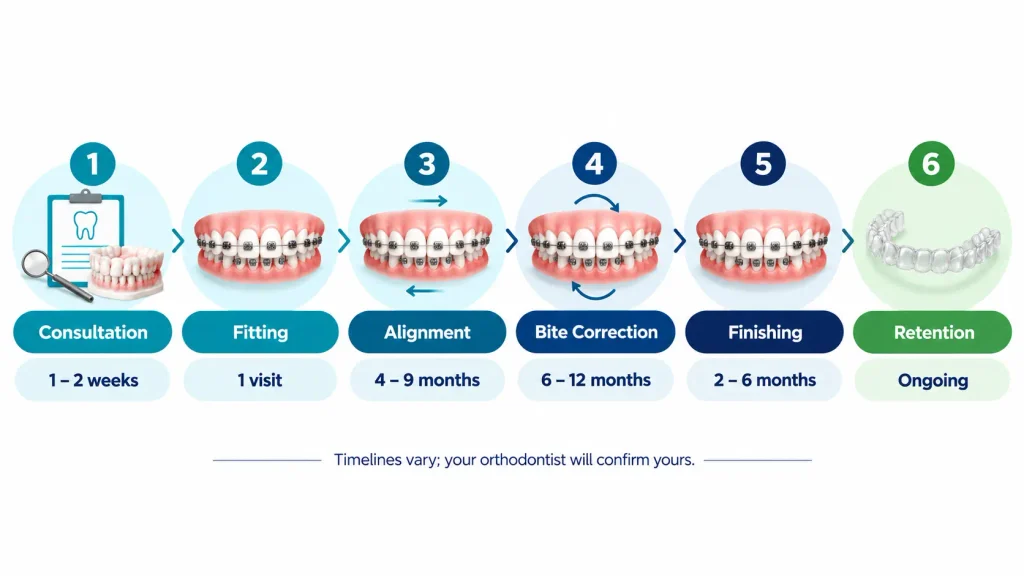
A typical orthodontic timeline has five active stages: consultation and planning, fitting the braces, alignment, bite correction, and finishing. Active treatment usually runs 12 to 24 months. It is followed by a retention phase, in which retainers hold the teeth in their new positions while the surrounding bone and gums settle.
During active treatment, you will usually visit every 4 to 8 weeks for adjustments. Most visits take 15 to 30 minutes.
Stage 1: Consultation and Records (1–2 weeks)
Your orthodontist examines your teeth, bite, gums and jaw, and takes X-rays, photographs and impressions or scans. These records are used to diagnose the problem and plan each tooth’s movement.
Cavities or gum inflammation are treated first. This can add a few weeks at the start, but it prevents bigger delays later.
Stage 2: Fitting the Braces (one visit)
Brackets are bonded to the teeth and the first archwire is placed, usually in a single 1–2 hour appointment. Some soreness for 3 to 5 days is normal while your mouth adjusts.
Stage 3: Levelling and Alignment (about 4–9 months)
Light, flexible wires gradually untangle crowding and rotate twisted teeth. This is when patients see the most visible change. Many notice their front teeth looking straighter within the first few months.
Stage 4: Space Closure and Bite Correction (about 6–12 months)
Stiffer wires and elastics (small rubber bands) close remaining gaps and bring the upper and lower teeth into a correct bite. If teeth were removed, those spaces are closed in this stage.
This stage often feels slow because the teeth already look straight. The work happening here is what makes the result stable and functional, so it can’t be skipped.
Stage 5: Finishing and Detailing (about 2–6 months)
Small adjustments refine tooth positions, root angles and the way the teeth meet. Once your orthodontist is satisfied, the braces are removed and the teeth are polished.
After Braces: The Retention Phase
Teeth naturally try to drift back after braces come off, a process called relapse. Retainers prevent this. Most patients wear them full-time at first and then at night, often for the long term, as advised by their orthodontist.
What Decides Your Braces Treatment Time?
Your braces treatment time depends on how severe the problem is, whether teeth need to be removed, the type of bite correction required, your gum and bone health, and your own cooperation. Missed appointments, broken brackets and skipped elastics are among the most common reasons treatment runs over schedule.
Factors Set at the Start
- Severity of crowding or spacing. More movement simply takes more time.
- Type of bite problem. Overbites, underbites, crossbites and open bites take longer than straightening alone, especially when the jaws themselves are involved.
- Extractions. Closing the space left by a removed tooth adds months to treatment.
- Impacted teeth. A tooth stuck in the jaw, often an upper canine, may need to be uncovered and guided into place slowly.
- Gum and bone health. Healthy support tissues allow steady, safe tooth movement.
Factors You Control
| Keeps treatment on track | Commonly delays treatment |
| Attending every adjustment visit | Missed or postponed appointments |
| Wearing elastics for the hours prescribed | Skipping elastics, even for a few days |
| Avoiding hard and sticky foods | Broken or loose brackets from biting hard foods, sugarcane or hard sweets |
| Brushing around brackets and using interdental brushes | Swollen gums or white spots, which may force a pause |
| Calling the clinic as soon as something breaks | Waiting weeks to report a broken wire |
Each broken bracket or missed visit may only add a couple of weeks. Over a year, several small delays can add up to months.
Does Age Change Braces Duration?
Not as much as most people think. A 2020 meta-analysis found no significant difference in comprehensive fixed-brace treatment time between adults and adolescents.
Adults may need extra steps, such as gum treatment, replacing missing teeth or coordinating with crowns and implants. Children, on the other hand, can benefit from growth, which is why some bite problems are treated early. Our guide to braces for children covers the right age to start.
Does the Type of Braces Change Orthodontic Treatment Length?
For most patients, the type of braces affects orthodontic treatment length far less than the problem being corrected. Metal and ceramic braces work at a broadly similar pace. Self-ligating braces have not been shown to finish cases meaningfully faster, and clear aligners match braces mainly in mild-to-moderate cases with consistent wear.
| Type | Typical timeframe | What affects the pace |
| Metal braces | 12–24 months | Most versatile for complex bite and jaw corrections |
| Ceramic braces | Similar to metal | Brackets are more brittle; breakages can add extra visits |
| Self-ligating braces | Similar to conventional braces | May mean quicker adjustment visits; overall time is broadly comparable |
| Lingual braces | Similar or slightly longer | Hidden behind the teeth; adjustments are more technical |
| Clear aligners | Often 6–18 months for suitable cases | Need 20–22 hours of wear a day; complex cases may take longer or need braces |
If you are choosing on appearance, our comparisons of ceramic vs metal braces and clear aligners vs metal braces explain the trade-offs in detail.
What About “Accelerated” Orthodontics?
Vibration devices and minor surgical techniques that claim to speed up tooth movement are available. Current evidence for them is mixed, and any time saved is usually modest. We discuss these options honestly where they suit a case, but we never recommend shortcuts that put roots or gums at risk.
Real Situations We Hear About in the Clinic
Patients usually ask about braces duration because something important is coming up: board exams, a wedding, a new job or a move. The right approach is not to rush treatment. It is to plan around those dates from the very first visit, with an honest estimate and clear milestones.
The situations below are illustrative composites of questions we hear often, not individual patient stories.
- A Class 9 student from Jadavpur wants the braces off before college. Starting early in school gives enough room for a moderate case, and adjustment visits can be planned around exam months.
- A bride-to-be from Tollygunge has a wedding in ten months and a moderately crowded smile. If the case can’t be completed safely in time, we say so, and we discuss discreet options such as ceramic braces or, where suitable, aligners.
- A parent from Garia notices their 8-year-old’s crossbite. A short phase of early treatment may correct it while the jaw is still growing and make later treatment simpler.
- A software professional from Baghajatin is relocating abroad in about 14 months. We map the plan against the move date and discuss what happens if treatment needs to continue elsewhere.
In each case, the answer depends on a clinical examination. The timeline is built around the patient, not the other way around.
Myths vs Facts About Braces Duration
| Myth | Fact |
| “Braces always take at least two years.” | Many mild cases finish in 6–12 months. The research average for comprehensive treatment is just under two years. |
| “Tightening braces harder makes them work faster.” | Teeth move through gradual bone remodelling. Excessive force can harm roots and gums without speeding results. |
| “Adults take much longer than teenagers.” | Studies show no significant average difference, though adults may need extra preparatory steps. |
| “Clear aligners are always faster.” | Aligners only keep pace when worn 20–22 hours a day, and only in suitable cases. |
| “Missing one appointment doesn’t matter.” | Each missed visit can delay progress by weeks, and repeated misses add months. |
| “Once the braces come off, treatment is over.” | Retainers are essential. Without them, teeth can drift back. |
How City Smiles Dental Care Plans Your Timeline
At City Smiles Dental Care, your braces treatment time is estimated only after a full clinical examination, X-rays and a bite analysis. We explain the expected range, the milestones to watch for, and what could change the estimate. That way, you know what to expect before a single bracket is placed.

Here is what that looks like in practice:
- A personalised treatment plan based on your teeth, bite and goals, not a standard package.
- Clear milestones at each stage, so you can see progress instead of guessing.
- Honest discussion of delays if something changes, along with what we will do about it.
- Appointment scheduling that works around school, college and office hours where possible.
- A retention plan explained before your braces come off, so your result is protected.
Patients visit us from Garia, Baghajatin, Jadavpur, Tollygunge, Santoshpur, Dhakuria and across South Kolkata. If you’re comparing clinics, our guide on choosing the best orthodontist in Kolkata lists the questions worth asking.
Frequently Asked Questions
How long does braces treatment take for adults?
Most adults wear braces for 12 to 24 months, similar to teenagers. Research shows no significant average difference between age groups. Adults may need extra time for preparatory steps such as gum treatment or coordinating with crowns and implants.
Can braces be done in 6 months?
Yes, but only for minor problems such as small gaps or slight crowding of the front teeth. Short-term treatment usually focuses on appearance and may not correct the bite. Your orthodontist can tell you whether your case is suitable.
How often do I need to visit the orthodontist with braces?
Most patients have adjustment visits every 4 to 8 weeks. Each visit usually takes 15 to 30 minutes. Keeping these appointments is one of the most effective ways to finish on time.
Why is my braces treatment taking longer than expected?
Common reasons include missed appointments, broken brackets, skipped elastics, gum inflammation and teeth responding more slowly than predicted. Talk to your orthodontist, who can explain the cause and adjust the plan.
Do rubber bands make braces work faster?
Elastics don’t speed treatment up beyond the plan, but they are essential for correcting the bite. Skipping them is one of the most common reasons treatment overruns. Wear them for the hours your orthodontist prescribes.
How long do I need to wear a retainer after braces?
Most patients wear retainers full-time for the first few months, then at night. Many orthodontists advise night-time wear for the long term, because teeth can drift throughout life.
Are clear aligners faster than braces?
Not always. For mild-to-moderate cases, aligners can take a similar time to braces when worn 20 to 22 hours a day. Complex bite or jaw problems are often treated more predictably with fixed braces.
Can braces be removed early for a wedding or event?
Removing braces before treatment is complete risks an unfinished bite and relapse. If you have an important date, mention it at your consultation so the plan can be built around it, or discuss less visible options.
How long does early orthodontic treatment for children take?
Early, or interceptive, treatment for children aged around 7 to 10 often lasts 6 to 12 months. It aims to correct developing problems such as crossbites. Some children need a second phase of braces later.
The Bottom Line on Braces Treatment Time
For most people, braces treatment time falls between 12 and 24 months, with the average for comprehensive cases just under two years. Your bite, any extractions and your own consistency matter far more than the type of brackets you choose.
The most reliable number is the one you get after a proper examination. A good plan explains the range, the milestones and what could change it, before treatment begins.
Get Your Personal Braces Timeline in South Kolkata
Wondering how long your braces would take? Book an orthodontic consultation at City Smiles Dental Care. We’ll examine your teeth and bite, explain your realistic orthodontic timeline, and answer every question before you decide.
- Book online: Schedule your braces consultation
- Call us: 062890 04840
- Visit us: Find directions and read patient reviews on our Google Business Profile
We welcome patients from Garia, Baghajatin, Jadavpur, Tollygunge, Santoshpur, Dhakuria and nearby South Kolkata neighbourhoods.
This article is for general information and does not replace a clinical examination. Treatment duration varies between individuals.