


The day your braces come off is a big moment. After a year or two of adjustments, wires and careful eating, you finally see the smile you worked for. Good after braces care is what keeps that smile straight for decades, not just months.
Here is a pattern dentists see often. A college student finishes braces, wears the retainer faithfully for a few months, then forgets it during exams or a trip home. A year later, the lower front teeth have started to crowd again — and the retainer no longer fits.
This guide explains why that happens and exactly how to prevent it. You will learn which retainers exist, how long to wear them, how to care for them, and what to do when something goes wrong.
Why Do Teeth Move Back After Braces?
Quick answer: Teeth move back after braces because the gum fibres and bone around them need time to adapt to their new positions. Elastic fibres in the gums can pull teeth towards where they started for a year or more. On top of this, everyone’s teeth change gradually throughout life. A retainer holds teeth in place while this happens.
The biology behind orthodontic relapse
Braces move teeth by gently reshaping the bone around their roots. Each tooth sits in a cushion of fibres called the periodontal ligament, which reorganises within a few months.
The fibres in the gum around the neck of each tooth are slower. They can stay stretched and “remember” the old position for a year or longer. This pull is the main reason teeth drift back soon after treatment — a process called orthodontic relapse.
Your teeth keep changing throughout life
Even people who never had braces see their teeth change with age. Lower front teeth commonly become more crowded in the late teens, twenties and beyond.
This is why teeth retention is not a short phase you “finish”. It is long-term protection against natural, lifelong change.
The First Few Weeks Without Braces: What’s Normal
Quick answer: In the first few weeks after braces, it is normal for teeth to feel slightly loose or sensitive, for gums to look a little puffy, and for speech to change briefly with a new retainer. These usually settle within days to weeks. Persistent pain, swelling or a retainer that won’t fit should be checked by your dentist.
When braces are removed (called debonding), the brackets are gently released and the leftover adhesive is polished away. Your retainer is ideally fitted the same day or very soon after.
Common experiences in the first few weeks include:
- Slight looseness. Teeth have just finished moving, so they may feel a little mobile. They firm up over the following weeks.
- Sensitivity. Enamel that was under the brackets may feel sensitive to cold for a short period.
- Puffy gums. Gums often recover quickly once cleaning becomes easier.
- A mild lisp. New retainers can affect speech for a few days. Reading aloud helps your tongue adjust faster.
- White marks on teeth. Some patients notice chalky white spots where plaque collected around brackets. These are early enamel demineralisation. Your dentist can advise on options such as fluoride-based remineralisation, and some marks soften over time.
Types of Orthodontic Retainers
Quick answer: There are three main types of orthodontic retainer: removable clear retainers, Hawley retainers made of wire and acrylic, and fixed (bonded) retainers glued behind the front teeth. Your orthodontist recommends a type based on your original problem, your bite, your oral hygiene and how reliably you can wear a removable appliance.
Removable clear retainers
These are thin, transparent plastic trays made from a mould of your teeth. They are almost invisible, which makes them popular with working professionals and students. They can wear or crack with time and need replacing more often than other types.
Hawley retainers
A Hawley retainer has a wire across the front teeth attached to an acrylic plate that rests against the palate or inside the lower teeth. It is durable and can be adjusted. The wire is visible when you smile.
Fixed (bonded) retainers
A fixed retainer is a thin wire bonded to the back surface of the front teeth, usually the lower six. You cannot remove it, so it works without daily effort. It needs careful cleaning and can come loose without you noticing.
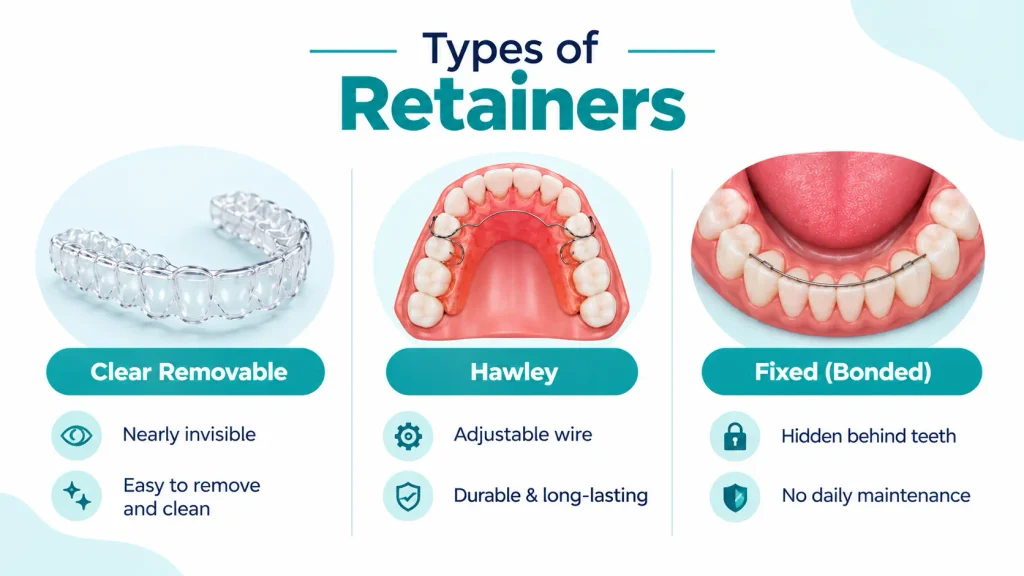
Many patients get a combination — for example, a fixed retainer on the lower teeth plus a removable retainer for the upper and lower arches.
| Feature | Clear Removable | Hawley | Fixed (Bonded) |
| Visibility | Nearly invisible | Wire visible at front | Hidden behind teeth |
| Depends on you wearing it | Yes | Yes | No |
| Cleaning | Easy — brush the tray | Easy — brush the plate and wire | Harder — needs floss threaders or interdental brushes |
| Typical durability | Shorter; wears with use | Long-lasting with care | Long-lasting, but can debond |
| Adjustable | No | Yes | No |
| Main drawback | Easy to lose; can warp in heat | Bulkier; affects speech at first | Plaque build-up; loose bonds may go unnoticed |
How Long Should You Wear Your Retainer?
Quick answer: Most patients wear a removable retainer for most of the day and night for the first few months after braces, then switch to night-time wear. Because teeth keep changing throughout life, many orthodontists now advise night-time wear long term. Your exact schedule depends on your case and your orthodontist’s instructions.
A typical retention schedule looks like this:
| Phase | Typical timing | What it usually involves |
| Debond day | Day braces are removed | Retainer fitted the same day or very soon after |
| Settling phase | Roughly the first 3–6 months | Wear removable retainers most of the day and night; remove only to eat, drink anything other than water, and clean |
| Transition | After your review | Switch to night-time wear if teeth are stable |
| Long-term retention | Ongoing | Night-time wear, often indefinitely; fixed retainers stay in place and are checked at regular visits |
This is a general pattern, not a rule for every patient. Cases involving large gaps, rotated teeth or significant crowding may need longer full-time wear. Always follow the schedule your own orthodontist gives you.
Your Daily After Braces Care Routine
Quick answer: Good after braces care means brushing twice daily with fluoride toothpaste, cleaning between teeth daily, cleaning removable retainers every time you brush, and storing them in a case. Rinse retainers in cool or lukewarm water, avoid hot water and harsh chemicals, and keep regular dental check-ups to monitor retainers and gums.
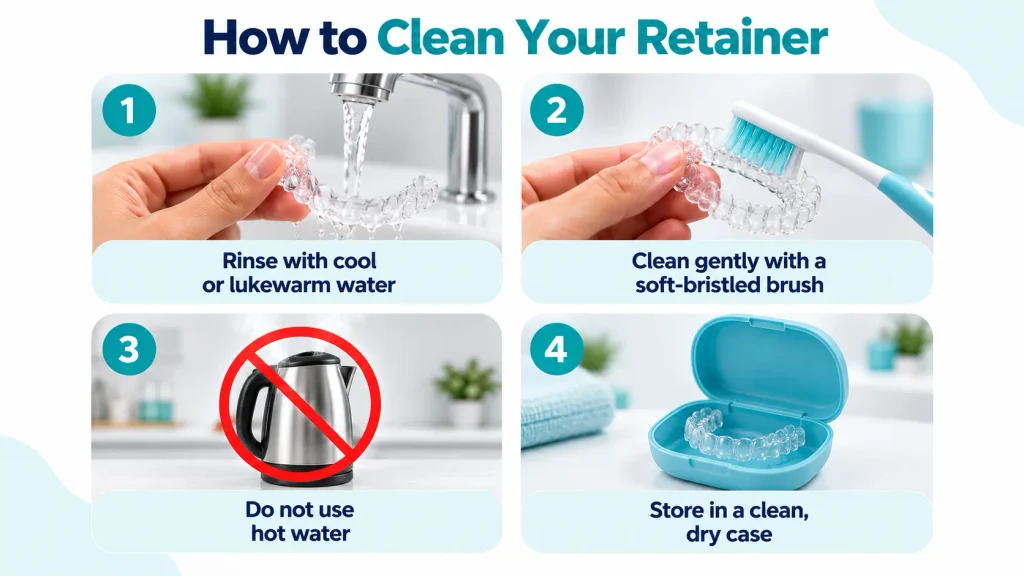
Cleaning a removable retainer
- Rinse the retainer as soon as you take it out.
- Brush it gently with a soft toothbrush and cool or lukewarm water.
- Avoid abrasive toothpaste on clear retainers — it can scratch and cloud the plastic.
- Never use hot or boiling water, which can warp the fit.
- Only use soaking products your dentist recommends.
- Let it dry, then store it in its case.
Cleaning around a fixed retainer
Plaque and tartar build up quickly behind lower front teeth, especially around a bonded wire. Use a floss threader or super floss to pass under the wire daily, or an interdental brush if the gaps allow.
Regular professional cleaning matters more with a fixed retainer. Your dentist can remove hardened tartar safely and check that every bond is still secure.
Habits that protect your retainer (and your result)
- Never wrap a retainer in a tissue or napkin. It is the most common way retainers end up in the bin at restaurants and family functions.
- Keep it away from pets. Dogs are drawn to retainers and can destroy them in minutes.
- Remove clear retainers before tea, coffee or sweet drinks. Sipping cha with a retainer in traps sugar and acid against your teeth and stains the plastic.
- Keep it out of heat. A car dashboard or a spot near the stove can warp it.
- Avoid biting hard objects like pens, ice or nails, which can bend wires or break fixed bonds.
- Mention teeth grinding. If you clench or grind at night, tell your dentist. A night guard or a modified retainer may be advised.
Warning Signs Your Teeth Are Shifting
Quick answer: Early signs of teeth shifting after braces include a removable retainer feeling tight, small gaps reappearing, front teeth starting to overlap, a change in how your bite feels, or a fixed retainer wire feeling loose or rough. Catching these early usually makes correction simpler, so contact your dentist promptly.
Watch out for:
- A retainer that feels tight or won’t sit fully
- New gaps, especially between upper front teeth
- Lower front teeth beginning to overlap or twist
- Food catching in places it never used to
- A wire on a fixed retainer that feels loose, sharp or “clicks”
- Your bite feeling different when you close
Lost, Broken or Tight Retainer? What to Do Next
Quick answer: If your retainer is lost, broken or suddenly tight, contact your dentist as soon as possible. Wear a previous retainer if it still fits comfortably, but never force one into place. Teeth can begin to shift within days to weeks without retention, and early replacement is much simpler than correcting relapse later.
- Call the clinic promptly. Don’t wait for your next routine visit.
- Use a backup if you have one. An older retainer that still fits comfortably can hold teeth in the meantime.
- Don’t force a tight retainer. Forcing it can cause pain or damage. Let your dentist check the fit.
- Don’t glue or bend it yourself. Home repairs usually change the fit.
- For a loose fixed retainer, avoid hard and sticky food on that side and get it re-bonded early.
- Ask about a spare. Many patients find a backup retainer worth having, especially if they travel often.
Myths vs Facts About Teeth Retention
Quick answer: The biggest myths are that treatment ends when braces come off, that retainers can be stopped once teeth “feel fine”, and that wisdom teeth are the main reason teeth shift. In reality, retention is the final phase of treatment, shifting is gradual and easy to miss, and natural lifelong changes play a larger role.
| Myth | Fact |
| “Treatment is over when braces come off.” | Retention is the final phase of orthodontic treatment, not an optional extra. |
| “If my teeth feel fine, I can stop wearing my retainer.” | Teeth shift slowly. Most people only notice once the change is already visible. |
| “Wisdom teeth are the main reason teeth crowd after braces.” | Research does not support wisdom teeth as the main cause. Natural age-related change and stopping retention matter more. |
| “A fixed retainer means I never have to think about it.” | Fixed retainers need daily cleaning and regular checks, as bonds can loosen without pain. |
| “My old retainer will push shifted teeth back.” | An old retainer may help only if it still fits comfortably. Significant relapse needs a proper assessment. |
Post Braces Maintenance at City Smiles Dental Care, South Kolkata
Quick answer: City Smiles Dental Care in South Kolkata provides post braces maintenance including retainer checks, retainer replacement, fixed retainer repair and professional cleaning. Patients who completed braces elsewhere are welcome too. Every recommendation is based on a clinical examination of your teeth, gums and retainer, so your plan suits your specific case.
Many patients finish braces in one city and then move for work or study. Others had treatment years ago and have lost touch with their original clinic. Whichever applies to you, a retention check-up gives a clear picture of where your teeth stand today.
At City Smiles Dental Care, a post braces maintenance visit can include:
- Checking the fit and condition of your retainers
- Examining fixed retainer bonds and repairing any that have loosened
- Making replacement retainers when needed
- Professional cleaning around fixed retainers and along the gumline
- Assessing early relapse and explaining options honestly, including when re-treatment may be needed
Patients visit us from across South Kolkata, including Garia, Baghajatin, Jadavpur, Tollygunge, Santoshpur and Dhakuria. If you are not sure whether your teeth have moved, you can book a retention check-up and get a clear answer.
Frequently Asked Questions
How long do I need to wear a retainer after braces?
Most patients wear a removable retainer almost full-time for the first few months, then switch to night-time wear. Because teeth keep changing throughout life, many orthodontists recommend night-time wear long term. Your orthodontist will set a schedule based on your original case.
What happens if I stop wearing my retainer?
Your teeth may gradually drift back towards their original positions. Lower front teeth and closed gaps are the most common areas to relapse. The change can be slow and easy to miss until it becomes visible.
Is it normal for teeth to feel loose after braces come off?
Yes, slight looseness is normal for a few weeks after braces are removed. The bone and fibres around the teeth are still settling. Wearing your retainer as instructed helps them stabilise. Increasing looseness or pain should be checked by your dentist.
Can I eat with my retainer in?
No, you should remove a removable retainer before eating and before drinking anything other than plain water. Food and sugary drinks trapped under the retainer can cause decay and staining. Always store it in its case while you eat. Fixed retainers stay in, but avoid biting hard foods with your front teeth.
Which is better: a fixed or removable retainer?
Neither is better for everyone. Fixed retainers work without daily effort but need careful cleaning and regular checks. Removable retainers are easier to clean but only work when you wear them. Many patients benefit from a combination, recommended after a clinical examination.
How often should a retainer be replaced?
It depends on the type and how you care for it. Clear retainers usually wear out faster than Hawley retainers, while fixed retainers can last many years if the bonds stay intact. Replace any retainer that is cracked, warped, loose-fitting or causing discomfort.
My retainer feels tight. Is that a bad sign?
A retainer that feels tight usually means your teeth have started to move, often after missed nights. If it still goes in comfortably, wear it consistently and the tightness may ease. If it won’t seat fully or causes pain, don’t force it — contact your dentist.
Can teeth that have shifted after braces be corrected?
Yes, in many cases. Minor shifting may be managed with a new retainer, while more noticeable relapse may need a short course of re-treatment, such as clear aligners or braces. The right option depends on a clinical examination.
When can I whiten my teeth after braces?
Many dentists suggest waiting a few weeks after braces are removed so the enamel and gums can settle. Whitening does not change the colour of bonding material on a fixed retainer. A dental check-up beforehand helps rule out sensitivity, decay or white spot issues.
Conclusion
Taking your braces off is the end of one stage, not the end of your treatment. Teeth naturally try to drift back, and they keep changing throughout life, so your retainer is what protects your investment.
Consistent after braces care is simple once it becomes a habit. Wear your orthodontic retainer as advised, clean it daily, store it safely, and treat tightness or damage as a reason to call your dentist promptly.
With good habits and regular check-ups, the smile you worked so hard for can last for years to come.
Protect Your Straight Smile — Book a Retention Check-Up
Finished braces recently, or had them years ago and noticed changes? The team at City Smiles Dental Care can check your retainers, repair or replace them, and give you an honest assessment of your teeth retention.
- 📅 Book online: Schedule your appointment
- 📞 Call the clinic: 062890 04840
- 📍 Find us on Google: View City Smiles Dental Care on Google Maps for directions, opening hours and patient reviews
Conveniently located for patients in Garia, Baghajatin, Jadavpur, Tollygunge, Santoshpur, Dhakuria and across South Kolkata.
This article is for general information and does not replace a clinical examination. Retention plans vary from patient to patient.