


Parents across South Kolkata often ask us the same question during a child’s routine check-up: is it time for braces yet? The honest answer is that the best age for braces depends less on the calendar and more on how your child’s teeth and jaws are developing. For most children, braces begin between 10 and 14 — but the first orthodontic check-up should happen much earlier, around age 7.
Adults aren’t left out, either. Healthy teeth can be moved at any age, and many people in their 30s, 40s and beyond complete orthodontic treatment successfully.
This orthodontic age guide explains what happens at each stage, when early orthodontics genuinely helps, when waiting is the wiser choice, and how the team at City Smiles Dental Care decides the right time for each patient.
What Is the Best Age for Braces?
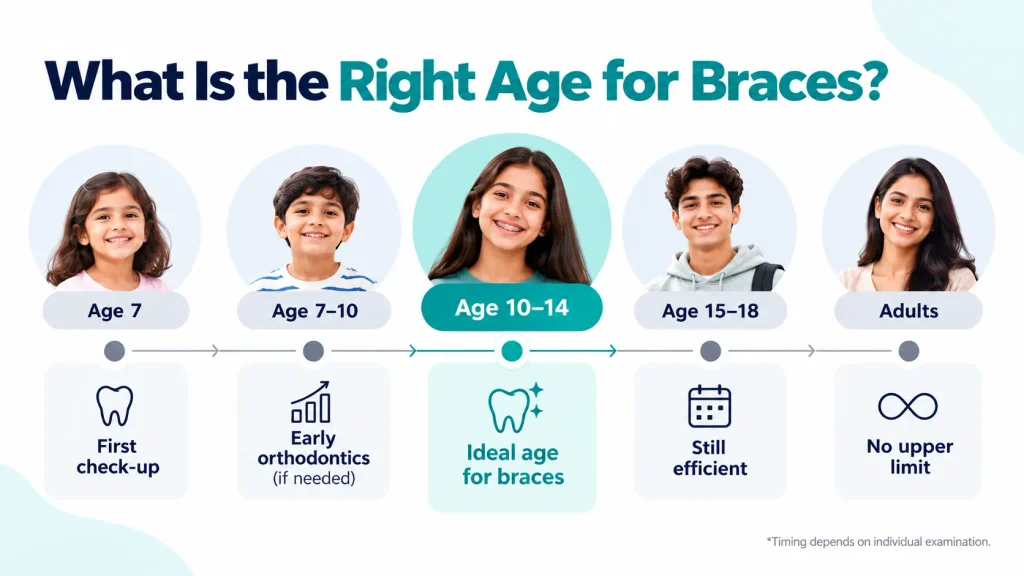
For most children, the best age for braces is between 10 and 14, when most baby teeth have fallen out and the jaws are still growing. However, an orthodontic assessment should happen around age 7, and healthy adults can start braces at any age. The exact timing depends on each person’s dental development.
Age is a useful guide, but orthodontists pay closer attention to dental age and skeletal age than to birthdays. Two 11-year-olds can be at very different stages — one may still have several baby molars, while the other already has every permanent tooth except the wisdom teeth.
| Age | What’s happening in the mouth | Typical orthodontic approach |
| 6–7 | First permanent molars and front teeth erupting | First orthodontic check-up; record a baseline; monitor |
| 7–10 | Mixed dentition — baby and permanent teeth together | Early (Phase 1) treatment only if a specific problem needs it |
| 10–14 | Most permanent teeth in place; pubertal growth spurt | Comprehensive braces; growth-guided jaw correction where needed |
| 15–18 | Growth slowing or complete | Braces or clear aligners; tooth movement still efficient |
| Adults | Growth complete | Braces or aligners; some jaw-size problems need combined surgery |
Why Age 7 Is the Right Time for a First Orthodontic Check-Up
The American Association of Orthodontists recommends that children have their first orthodontic check-up no later than age 7. By then, the first permanent molars and incisors have usually erupted, so an orthodontist can spot bite problems, crowding and jaw growth issues early — often before they become harder to correct.
What the Orthodontist Checks at This Visit
- How the upper and lower teeth meet, front-to-back and side-to-side
- Whether there is enough space for the permanent teeth still to come
- The growth pattern of the jaws and the symmetry of the face
- Habits such as thumb sucking, tongue thrusting or mouth breathing
- Baby teeth lost too early, or permanent teeth arriving very late
A Check-Up at 7 Doesn’t Mean Braces at 7
This is the part most parents find reassuring. In the majority of cases, the orthodontist records a baseline and simply reviews your child every 6–12 months. Treatment starts only when there is a clear benefit to acting now.
For example, a parent from Garia might bring in a 7-year-old whose new front teeth look crooked and slightly spaced. Very often this is a normal stage — permanent incisors are wider than the baby teeth they replace, and the jaws continue to grow to make room. Knowing what is normal spares families both unnecessary worry and unnecessary treatment.
Early Orthodontics: When Treatment Before Age 10 Makes Sense
Early orthodontics, also called Phase 1 or interceptive treatment, usually takes place between ages 7 and 10. It is recommended only for specific problems that are easier to correct while the jaws are still growing — such as crossbites, underbites, severe crowding or protruding front teeth. Most children do not need it.
Problems That Often Benefit From Early Treatment
- Crossbite — some upper teeth bite inside the lower teeth, sometimes forcing the jaw to shift to one side. A palatal expander widens the upper jaw most effectively before the midline suture of the palate matures.
- Underbite — the lower teeth or jaw sit ahead of the upper. Certain appliances that encourage forward growth of the upper jaw work best in younger children.
- Protruding upper front teeth — prominent incisors are more likely to chip or fracture during falls and play. Reducing the protrusion early lowers that risk.
- Severe crowding — creating or preserving space can guide permanent teeth into better positions and, in some cases, reduce the need for extractions later.
- Persistent habits — thumb sucking or tongue thrusting beyond about age 5 can create an open bite, where the front teeth don’t meet.
- Early loss of baby teeth — a space maintainer can hold room for the permanent tooth so neighbouring teeth don’t drift into the gap.
Benefits and Limitations of Early Treatment
| Benefits | Limitations |
| Uses natural jaw growth to correct skeletal problems | A second phase of braces is often still needed later |
| Can lower the risk of injury to protruding teeth | Adds a period of treatment and appointments |
| May make later treatment shorter and simpler | Not useful for problems that will self-correct |
| Addresses habits before they shape the bite | Requires good cooperation from a young child |
Phase 1 usually lasts 6–18 months and uses simple appliances such as expanders, partial braces or habit-correcting devices. It makes the later phase easier — but it rarely replaces it entirely. A good orthodontist will tell you plainly when early treatment isn’t worth it.
Ages 10–14: The Ideal Age for Braces for Most Children
Between 10 and 14, most children have lost their baby teeth and the pubertal growth spurt is underway. This combination makes it the ideal age for braces for most patients: permanent teeth can be fully aligned, and jaw growth can be guided at the same time, which often makes treatment more efficient.
Why Growth Timing Matters
Girls usually reach their peak growth spurt earlier than boys — often around 10–12 — while boys commonly peak around 12–14. Orthodontists use this window for problems such as a small lower jaw, where a functional appliance can encourage favourable growth.
Because these ranges vary widely between individuals, the orthodontist may assess skeletal maturity on a lateral cephalometric X-ray rather than relying on age alone. Starting a growth-dependent correction too late can mean losing the chance to use growth at all.
What a Typical Treatment Journey Looks Like
- Assessment and records — examination, X-rays, photographs and dental impressions or scans.
- Treatment plan discussion — options, expected duration and what is needed from the child at home.
- Fitting the braces — brackets are bonded to the teeth in a painless appointment; mild soreness for a few days afterwards is normal.
- Adjustment visits — usually every 4–8 weeks to progress tooth movement.
- Removal and retention — comprehensive braces commonly take around 18–24 months, followed by retainers to keep teeth stable.
A 12-year-old from Jadavpur who is anxious about wearing braces at school is a very common situation. Tooth-coloured ceramic brackets, or clear aligners in suitable cases, can ease that worry. The right choice, though, depends on the bite problem being corrected — not only on appearance.
Our guide to braces for children covers the options in detail.
Is It Too Late? Braces for Older Teens and Adults
No — there is no upper age limit for braces as long as the teeth, gums and supporting bone are healthy. Adults can achieve excellent results with braces or clear aligners. Treatment may take slightly longer, and jaw-size problems that growth could once have corrected may need a combined orthodontic and surgical approach.
Older Teens (15–18)
Teeth still move efficiently in the late teens, and this group often does very well with treatment. Jaw growth is largely complete in most girls by this stage, while some boys continue growing a little longer. That means growth modification is more limited, but straightening teeth and refining the bite remain entirely achievable.
What’s Different for Adults
- Gum health comes first. Active gum disease must be treated and stable before teeth are moved.
- Movement may be a little slower because adult bone is denser and fully formed.
- Existing dental work matters. Crowns, bridges and missing teeth are planned around — and dental implants cannot be moved by braces.
- Jaw-size problems may need orthognathic (jaw) surgery, or a compromise plan that improves the bite without changing the jaws.
- Discreet options such as ceramic braces and clear aligners suit many working adults.
Consider a working professional from Tollygunge who missed out on braces as a teenager. Crowded lower teeth have become harder to clean, and the front teeth have slowly shifted over the years. For adults like this, orthodontic treatment is often as much about long-term dental health as about appearance.
Orthodontic Age Guide: Comparing Treatment at Each Stage
Each stage of life offers different advantages. Children aged 7–10 benefit from growth-guided correction of specific problems, children aged 10–14 usually get the most efficient comprehensive treatment, and adults can still achieve healthy, well-aligned teeth — though with fewer options for changing jaw size without surgery.
| Stage | Main advantage | Main limitation | Typical duration* |
| Early (7–10) | Can guide jaw growth; corrects crossbites and habits | Second phase often needed | 6–18 months (Phase 1) |
| Ideal (10–14) | Permanent teeth plus active growth = efficient treatment | Needs consistent brushing and diet care | 18–24 months |
| Late teens (15–18) | Teeth still move efficiently; good aligner candidates | Limited growth left to use | 18–24 months |
| Adults | High motivation; discreet options | Slower movement; gum health and jaw size may limit options | 18–30 months |
*Approximate ranges. Actual duration depends on the problem, the appliance and how consistently instructions are followed.
When to Start Braces: Signs It’s Time for an Assessment
Book an orthodontic assessment if you notice crowded or overlapping teeth, teeth that stick out, a bite where the teeth don’t meet properly, jaw shifting, very early or very late loss of baby teeth, or habits like thumb sucking beyond age 5. These signs don’t always mean braces are needed, but they deserve a professional opinion.
In children, watch for:
- Front teeth that stick out noticeably or that the lips can’t close over
- Upper teeth biting behind the lower teeth
- Front teeth that don’t meet when the back teeth are closed
- Difficulty biting or chewing, or frequent cheek biting
- Mouth breathing or snoring that persists
In teens and adults, watch for:
- Teeth that have gradually shifted or become more crowded
- Areas that are hard to clean, with recurring gum bleeding
- Uneven tooth wear or chipping
- Jaw discomfort — this needs evaluation, though braces are not always the answer
Myths vs Facts About the Best Age for Braces
The most common myths about the best age for braces are that treatment must wait until every baby tooth is gone, that adults are too old, and that early treatment removes the need for braces later. In reality, timing depends on the individual problem, and healthy patients can benefit at almost any age.
| Myth | Fact |
| Braces must wait until every baby tooth has fallen out. | Most comprehensive braces do wait, but some problems are best treated earlier. A check-up by 7 tells you which group your child falls into. |
| Adults are too old for braces. | There is no upper age limit when gums and bone are healthy. |
| Early treatment means no braces later. | Phase 1 often makes later treatment simpler, but a second phase is commonly still needed. |
| Crooked front teeth at age 7 always need braces. | Many early irregularities settle as the jaws grow and more permanent teeth erupt. |
| Clear aligners are only for adults. | Aligners can suit teenagers too, provided the case is suitable and they’re worn as instructed. |
| Braces are purely cosmetic. | A healthier bite makes teeth easier to clean, reduces abnormal wear and lowers injury risk to protruding teeth. |
How City Smiles Dental Care Decides When to Start Braces
At City Smiles Dental Care, timing is based on a full clinical examination, not age alone. We assess the teeth, bite, jaw growth and overall oral health, take X-rays where needed, and explain whether treatment should start now, later or not at all — so families across South Kolkata can make an informed decision.
Our assessment typically includes:
- Listening first — what you or your child have noticed, and what worries you most.
- Clinical examination — teeth, bite, jaw movement, gums and habits.
- X-rays where clinically indicated — an OPG to check unerupted teeth and roots, and a lateral cephalometric X-ray to assess jaw relationships and growth stage.
- Records — photographs and dental impressions or scans when treatment is being planned.
- A personalised plan — including the honest option of “watch and review” when starting now offers no real benefit.
City Smiles Dental Care serves families from Baghajatin, Garia, Jadavpur, Tollygunge, Santoshpur, Dhakuria and nearby South Kolkata neighbourhoods. Because orthodontic care involves regular visits over many months, a clinic close to home or school makes a real difference to keeping treatment on track. Every recommendation depends on what we find at examination — we never promise a specific result in advance.
Frequently Asked Questions
What is the best age for braces?
For most children, the best age for braces is between 10 and 14, once most permanent teeth have erupted and while the jaws are still growing. An orthodontic check-up is recommended by age 7, and adults with healthy gums can start braces at any age.
Can a 7-year-old get braces?
Full braces are rarely needed at 7. However, some children benefit from early (Phase 1) treatment using expanders, partial braces or habit appliances to correct crossbites, underbites, protruding teeth or severe crowding while the jaws are still growing.
Is 16 or 17 too late for braces?
No. Teeth still move efficiently in the late teens, and results are often excellent. The main difference is that jaw growth is largely complete, so problems relating to jaw size have fewer non-surgical options than they would at 11 or 12.
Can adults over 40 get braces?
Yes. There is no upper age limit for braces, provided the gums and supporting bone are healthy. Gum disease must be treated first, treatment may take slightly longer, and clear aligners or ceramic braces are popular discreet options for adults.
How do I know if my child needs early orthodontic treatment?
Look for crossbites, an underbite, front teeth that stick out, severe crowding, persistent thumb sucking beyond age 5, or baby teeth lost very early. An orthodontic examination with X-rays confirms whether early treatment would genuinely help or whether monitoring is enough.
Does early orthodontic treatment reduce the need for braces later?
It can make later treatment shorter and simpler, and occasionally avoids it. In many cases, though, a second phase of braces is still needed once all the permanent teeth have erupted. Early treatment is chosen for its specific benefits, not as a substitute.
How long does braces treatment take?
Comprehensive braces usually take around 18–24 months, though some cases finish sooner and complex or adult cases may take longer. Early Phase 1 treatment typically lasts 6–18 months. Retainers are needed afterwards to stop teeth drifting back.
Are clear aligners suitable for teenagers?
They can be, for suitable cases. Aligners must be worn about 20–22 hours a day, so success depends on the teenager’s commitment. Some complex bite problems and growth-related corrections are better managed with fixed braces or other appliances.
Will my child need teeth removed for braces?
Not always. Extractions are sometimes recommended when crowding is severe and there is not enough space for all the teeth. Early treatment can reduce this need in some cases. The decision is made only after examination, X-rays and careful treatment planning.
Finding the Right Time for Your Family’s Smiles
There is no single number that defines the best age for braces for everyone. For most children, treatment works best between 10 and 14, after a first check-up around age 7 identifies whether anything needs earlier attention. Early orthodontics is valuable for specific problems, but most children only need monitoring until their permanent teeth arrive.
For teens and adults, it is rarely too late. With healthy gums and a careful plan, straighter teeth and a healthier bite are achievable at almost any age. The key is an honest, examination-based assessment rather than guesswork.
Book an Orthodontic Assessment at City Smiles Dental Care
Not sure whether it’s the right time for braces — for your child or for yourself? A single assessment can tell you whether to start now, wait and review, or not worry at all.
- Book online: Schedule your orthodontic assessment at a time that suits you.
- Call us: 062890 04840 to speak with our team.
- Visit us: Find directions, opening hours and patient reviews on our Google Business Profile.
Families from Garia, Baghajatin, Jadavpur, Tollygunge, Santoshpur and Dhakuria can reach City Smiles Dental Care easily. We’ll examine, explain and plan — and you decide what happens next.
Medical disclaimer: This article is for general information and does not replace a professional dental examination. Treatment suitability, timing and duration vary between individuals.