


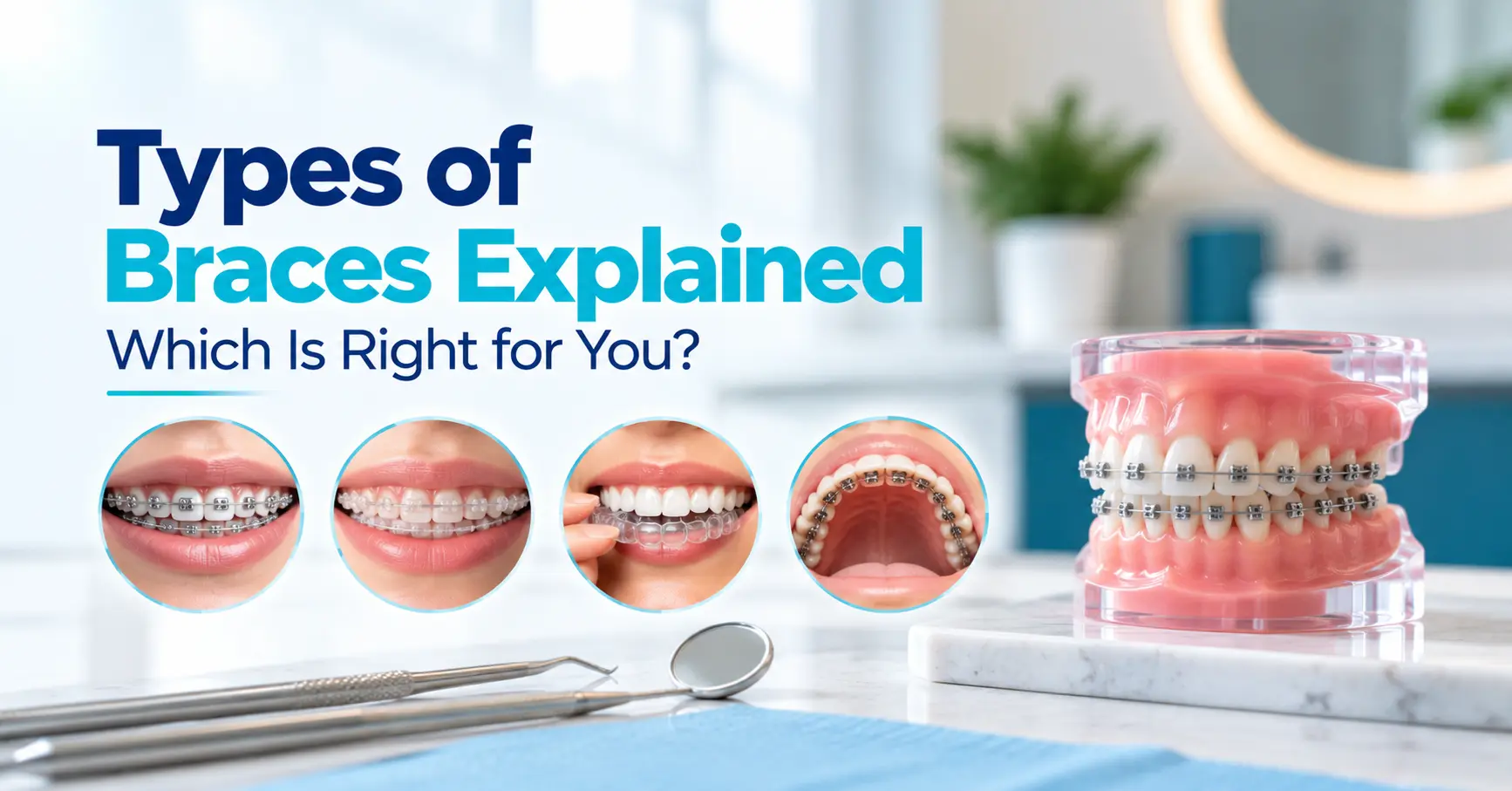
Choosing between the different types of braces is often the first real decision after a dentist says you’d benefit from orthodontic treatment. Today there are four main options — metal braces, ceramic braces, lingual braces and invisible braces (clear aligners) — and each one balances visibility, comfort, cost and daily effort differently.
This guide explains how each type works, who it suits and where its limits lie, in plain language. It’s built around the questions patients at City Smiles Dental Care in South Kolkata ask us most, so you can walk into a consultation already knowing what to ask.
Quick answer: Metal braces are the most affordable and handle the widest range of cases. Ceramic braces work the same way with tooth-coloured brackets. Lingual braces sit hidden behind the teeth, and clear aligners are removable trays. The right type depends on your bite, lifestyle and budget — confirmed by a clinical examination.
What Are the Main Types of Braces?
There are four main types of braces: metal braces, ceramic braces, lingual braces and invisible braces (clear aligners). The first three are fixed brackets joined by a wire, while clear aligners are removable plastic trays. All four move teeth by applying gentle, controlled pressure over several months.
That pressure triggers the same biological process in every case. The ligament around each tooth is compressed on one side and stretched on the other, prompting the surrounding bone to remodel so the tooth can move into its new position.
What differs between the types is the delivery system. That affects how visible treatment is, how it feels, how you clean your teeth and what it costs.
Metal Braces: The Proven All-Rounder
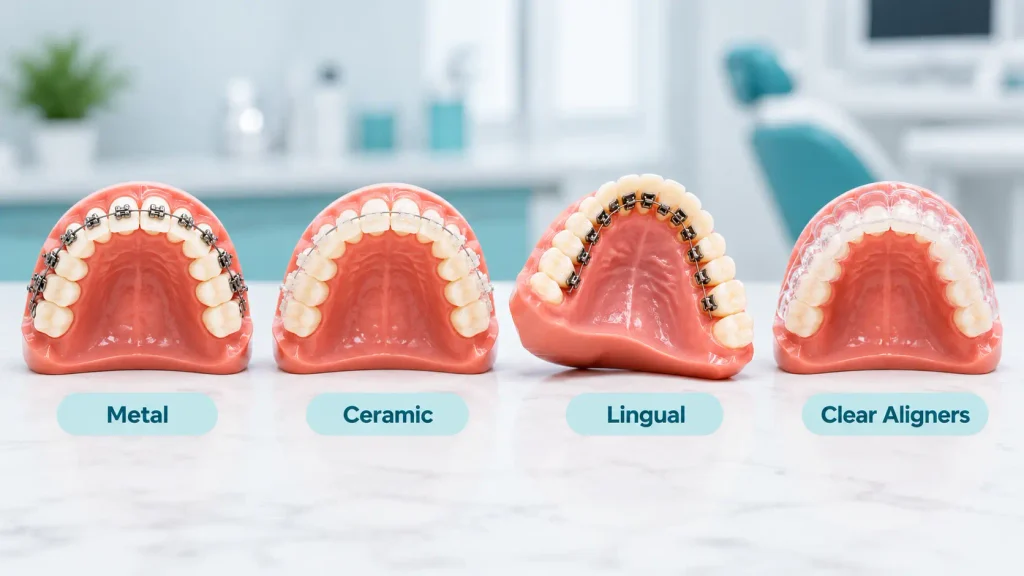
Metal braces use small stainless-steel brackets bonded to the front of each tooth, connected by a thin archwire held in place with elastic ties. Your dentist adjusts the wire at regular visits to guide teeth into position. They are the most widely used, most affordable and most versatile type of fixed orthodontic treatment.
Modern metal brackets are far smaller and smoother than the bulky braces many parents remember. Archwires are often made of heat-activated nickel-titanium, which applies lighter, steadier force than older steel wires.
Where Metal Braces Work Best
- Complex bite problems such as deep bites, crossbites and severe crowding
- Cases that need precise tooth rotation or root movement
- Children and teenagers who may not reliably wear removable trays
- Patients who want the most cost-effective route to straighter teeth
Limitations to Know
- Most visible option. The brackets show clearly when you smile.
- Initial irritation. Brackets can rub the cheeks and lips for the first week or two; orthodontic wax helps.
- Food rules. Hard chikki, popcorn kernels and sticky toffees can break brackets or bend wires.
- Extra cleaning time. An interdental brush or water flosser makes cleaning around brackets much easier.
If you have a known nickel allergy, mention it at your consultation, as alternative materials are available.
Ceramic Braces: Fixed Braces That Blend In
Ceramic braces work exactly like metal braces but use clear or tooth-coloured brackets made of ceramic material. They are far less noticeable at a normal conversational distance, which makes them popular with older teens and working adults. They usually cost more than metal braces and need slightly more care.
Ceramic braces suit people who want the reliability of fixed braces without a “metal smile” in office meetings or college presentations. A common situation is a young professional who needs moderate crowding corrected but doesn’t trust themselves to wear aligners for 22 hours a day.
What to Keep in Mind
- Staining of ties, not brackets. The ceramic brackets resist staining, but clear elastic ties can discolour with turmeric-rich curries, tea, coffee and paan. Ties are replaced at each adjustment.
- Hardness. Ceramic is harder than tooth enamel, so your dentist may avoid placing ceramic brackets where lower teeth bite against them.
- Size and strength. Ceramic brackets are slightly larger and more brittle than metal ones.
- Removal. Taking ceramic brackets off needs extra care — a routine step for an experienced clinician.
For a detailed head-to-head, read our guide to ceramic vs metal braces.
Lingual Braces: Hidden Behind Your Teeth
Lingual braces are fixed metal braces bonded to the back (tongue side) of the teeth, so they can’t be seen from the front. They are usually custom-made for each patient. They can treat many of the same problems as conventional braces, but they cost significantly more, take time to get used to and are offered by fewer clinics.
Lingual braces suit people for whom visibility is a dealbreaker, such as someone in a client-facing role, and whose case is better handled with fixed brackets than with aligners. Because brackets are often custom-designed from a digital scan or impression, the planning phase takes longer.
The Trade-Offs
- Adaptation period. Tongue soreness and a mild lisp are common for the first few weeks.
- Harder cleaning. You can’t easily see the brackets, so brushing takes more care.
- Case suitability. Very short teeth or certain deep bites can limit where brackets can be placed.
- Longer appointments. Adjustments are more technically demanding.
- Highest cost of the four main types.
Invisible Braces (Clear Aligners): Removable and Discreet
Invisible braces usually refers to clear aligners — a series of custom-made, transparent plastic trays that gradually shift teeth. You move to a new set every one to two weeks and wear them 20–22 hours a day. Because they are removable, you can eat normally and brush easily, but results depend on consistent wear.
Most aligner treatments use small tooth-coloured bumps called attachments, bonded to selected teeth so the trays can grip and steer them. Some cases also need interproximal reduction (IPR) — very slight polishing between teeth to create space.
Aligners work best for mild to moderate crowding, spacing and certain bite problems. More complex cases may still need fixed braces, or a combination of both. Our guides to clear aligners vs metal braces and clear aligners cost in Kolkata go deeper.
Why “Invisible Braces” Can Mean Different Things
Patients use “invisible braces” to mean different things. Some mean clear aligners, some mean ceramic braces and some mean lingual braces.
When you book a consultation, tell your dentist what matters most: not being seen wearing them, being able to take them out, or both. That single answer narrows down which “invisible” option fits you.
Types of Braces Compared Side by Side
Metal braces are the most affordable and handle the widest range of cases. Ceramic braces offer similar results with better aesthetics at a higher cost. Lingual braces are fully hidden but the most expensive, and clear aligners are removable and discreet but depend on daily discipline, as the table below shows.
| Feature | Metal Braces | Ceramic Braces | Lingual Braces | Clear Aligners |
| Visibility | Clearly visible | Low (tooth-coloured) | Hidden from the front | Nearly invisible |
| Removable? | No | No | No | Yes |
| Case range | Simple to complex | Simple to complex (some bite limits) | Many cases; case-dependent | Mild to moderate; some complex |
| Relative cost | ₹ (lowest) | ₹₹ | ₹₹₹₹ (highest) | ₹₹–₹₹₹ (varies by case) |
| Comfort | Cheek irritation at first | Similar to metal, smoother brackets | Tongue irritation, temporary lisp | Pressure at each tray change |
| Eating | Avoid hard and sticky foods | Avoid hard and sticky foods | Avoid hard and sticky foods | No restrictions — remove to eat |
| Cleaning effort | Moderate | Moderate | Highest | Easiest |
| Daily discipline needed | Low | Low | Low | High (20–22 hrs/day) |
Treatment time is broadly similar across types — often around 12 to 24 months — and depends far more on how complex your case is than on which braces you choose. Exact fees vary with case complexity and the system used, so a cost can only be confirmed after examination.
A Note on Self-Ligating Braces
Self-ligating braces are a bracket design rather than a separate category. They use a built-in clip instead of elastic ties to hold the wire, and come in both metal and ceramic versions.
They mean fewer ties to stain and can shorten adjustment visits. However, research does not consistently show that they make overall treatment faster.
Which Type of Braces Is Right for You?
The right type of braces depends on four things: how complex your bite problem is, how much visibility matters to you, your budget, and how disciplined you can be with daily wear and hygiene. A dentist confirms which options suit your case after a clinical examination, X-rays and, where needed, digital scans.
For Children and Young Teens
Metal braces are often the practical choice. They are durable, don’t rely on a child remembering to wear trays, and handle growth-related bite problems well.
A first orthodontic check around age 7 is widely recommended, because early problems are easier to spot and sometimes simpler to guide. Parents in Garia and Baghajatin often bring children in when they notice crowding as adult teeth come through. Our guide to braces for children covers this stage in detail.
For College Students and Young Professionals
Ceramic braces or clear aligners are popular when appearance matters every day. Aligners suit people who are organised and can commit to near-constant wear. Ceramic braces suit people who would rather not think about their treatment at all.
For Complex Bite Problems
Severe crowding, a significant overbite or underbite, and teeth that need major rotation are often handled more predictably with fixed braces — metal or ceramic. Some skeletal jaw problems in adults need combined orthodontic and surgical planning, which your dentist will explain if it applies to you.
For Adults Who Want Treatment to Stay Private
Lingual braces and clear aligners are the most discreet options. There is no upper age limit for orthodontic treatment, provided your gums and supporting bone are healthy — which is why a gum check is part of every braces assessment.
What to Expect: The Braces Treatment Journey
Treatment with any type of braces follows a similar path: consultation and records, a personalised treatment plan, fitting the braces or first aligners, regular review visits, and finally removal followed by retainers. Retainers matter as much as the braces themselves, because teeth naturally tend to drift back without them.
- Consultation and examination. Your dentist checks your teeth, gums, bite and jaw, and asks what you want to change.
- Records. X-rays, photographs and impressions or digital scans capture your starting point.
- Treatment plan. You’ll hear which types of braces suit your case, the expected duration, the cost and what’s expected of you.
- Fitting. Bonding fixed braces usually takes one to two hours; aligners are fitted along with any attachments.
- Review visits. Fixed braces are typically adjusted every four to eight weeks; aligner check-ins vary by plan.
- Removal and retention. Retainers are worn as advised — often full-time at first, then mainly at night for the long term.
It’s normal to feel nervous before fitting day. Most patients describe the first few days as pressure and tenderness rather than sharp pain. Soft foods and any pain relief your dentist recommends usually help.
Myths vs Facts About Braces
Many people delay orthodontic treatment because of outdated or half-true beliefs about braces. Some of these myths make treatment sound more painful, more limited or more cosmetic than it really is. Here are the misconceptions we hear most often, with the facts behind them.
| Myth | Fact |
| Braces are only for children. | Adults of any age can have braces if their gums and bone are healthy. |
| Invisible braces work for every case. | Aligners suit many cases, but complex bites may need fixed braces. |
| Metal braces are outdated. | They remain the most versatile option, and modern brackets are much smaller. |
| Braces damage your teeth. | The real risk is poor hygiene around brackets, which can cause white spots or decay. Good cleaning prevents this. |
| Ceramic braces don’t work as well as metal. | They use the same mechanics; the brackets are just more brittle. |
| Once braces come off, teeth stay straight forever. | Without retainers, teeth can gradually shift back. |
Getting Braces in South Kolkata: How City Smiles Dental Care Helps
At City Smiles Dental Care in South Kolkata, every braces consultation starts with a full examination of your teeth, gums and bite. The dentist then explains which types of braces suit your case, the realistic timeline and costs, and what each option asks of you — so you decide with clear information, not pressure.
- Personalised treatment planning rather than one-size-fits-all packages
- Honest guidance on limitations, including when aligners alone may not reach your goal
- Clear comparisons of the options suitable for your teeth, side by side
- Convenient access for families from Baghajatin, Garia, Jadavpur, Tollygunge, Santoshpur and Dhakuria
If you’re still deciding where to go, our article on finding the best orthodontist in Kolkata explains what to look for in a clinic.
Frequently Asked Questions About Types of Braces
Which type of braces is best?
No single type is best for everyone. Metal braces are the most versatile and affordable, ceramic braces are more discreet, lingual braces are hidden behind the teeth, and clear aligners are removable. The best choice is the one that suits your bite, lifestyle and budget, confirmed by a dentist after examination.
Which type of braces is the least visible?
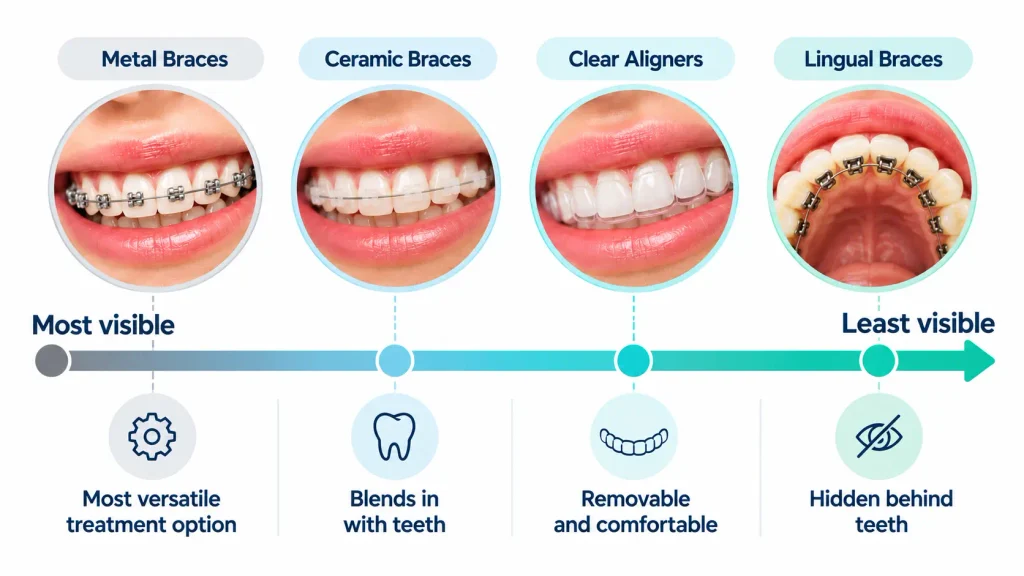
Lingual braces are completely hidden from the front because they sit behind the teeth. Clear aligners are nearly invisible and can be removed. Ceramic braces are low-visibility because their brackets match your tooth colour, though they are still noticeable up close.
Which type of braces is the cheapest?
Metal braces are generally the most affordable type of braces. Lingual braces usually cost the most, while ceramic braces and clear aligners fall in between. The final cost depends on how complex your case is and how long treatment takes.
Which braces work the fastest?
No type of braces is universally faster. Treatment time depends mainly on how complex your case is and, for aligners, how consistently you wear them. Many cases take around 12 to 24 months, while mild cases can be shorter and complex ones longer.
Do braces hurt?
Braces cause pressure and tenderness rather than sharp pain. Most people feel sore for a few days after fitting and after each adjustment or new aligner set. Soft foods, orthodontic wax and any pain relief your dentist recommends usually make this manageable.
Am I too old for braces?
No. There is no upper age limit for braces, and many adults in their 30s, 40s and beyond have orthodontic treatment. What matters is that your gums and supporting bone are healthy, which your dentist checks before recommending treatment.
Do I need a retainer after braces?
Yes. Every type of braces — metal, ceramic, lingual or clear aligners — needs a retainer afterwards. Teeth naturally tend to drift back toward their old positions, and a retainer holds them in place while the surrounding bone and gums stabilise.
Conclusion: Finding the Right Type of Braces for Your Smile
Each of the main types of braces can produce an excellent result in the right case. Metal braces offer versatility and value, ceramic braces add discretion, lingual braces keep treatment completely hidden, and invisible braces give you the freedom to remove them.
The deciding factor isn’t which option is best in general, but which is best for your teeth, your routine and your budget. That answer comes from a proper clinical examination, not a brochure — and a good clinic will tell you honestly when an option isn’t right for you.
Book Your Braces Consultation in South Kolkata
If you’re comparing braces options for yourself or your child, the simplest next step is a consultation at City Smiles Dental Care. We’ll examine your teeth, explain the types of braces that genuinely suit your case, and give you a clear plan with timelines and costs before you commit to anything.
- 📅 Book your appointment online — choose a time that suits you.
- 📍 Find City Smiles Dental Care on Google for directions, opening hours and patient reviews.
- 📞 Call the clinic: 062890 04840
Patients visit us from across South Kolkata, including Baghajatin, Garia, Jadavpur, Tollygunge, Santoshpur and Dhakuria. Your straighter smile starts with one conversation.
This article is for general information and does not replace a personal dental examination. Treatment suitability, duration and cost vary for every patient.