


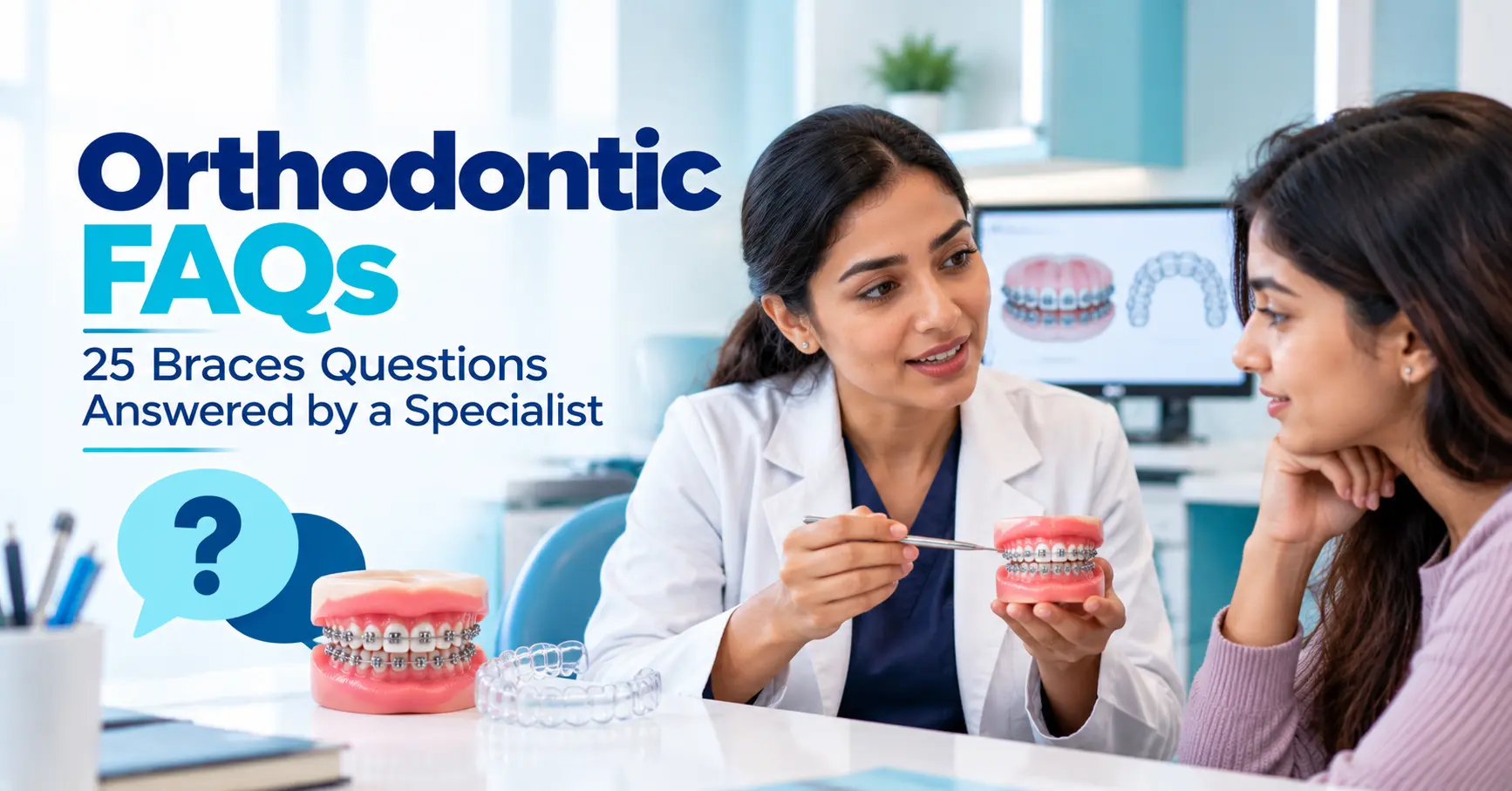
Most people arrive at their first orthodontic appointment with a list of questions — and a few worries they haven’t said out loud. Will it hurt? Am I too old? What will people think at work? These orthodontic FAQs answer the 25 questions we hear most often at City Smiles Dental Care in South Kolkata, from parents of seven-year-olds to adults in their forties.
Think of this as your orthodontic patient guide: what to expect before, during and after treatment. The answers are general guidance. Your own treatment plan always depends on a clinical examination, X-rays and a conversation about your goals.
Quick Summary
- Children should have an orthodontic check by about age 7. Adults can be treated at any age with healthy gums.
- Most braces treatment lasts 12–24 months.
- Soreness lasts a few days after fitting and adjustments, then settles.
- Retainers after braces are essential for keeping results.
Getting Started: Braces Questions Before Treatment
Before starting braces, most patients want to know whether they actually need treatment, the right age to begin, and what the first visit involves. In short: an orthodontic check by age 7 is recommended, adults can be treated at any age with healthy gums, and the first consultation is an assessment, not a commitment.
1. What does an orthodontist do differently from a general dentist?
An orthodontist is a dentist with additional specialist training in aligning teeth and guiding jaw growth. In India, that means a postgraduate MDS in Orthodontics and Dentofacial Orthopaedics. General dentists focus on fillings, cleanings, root canals and gum care.
Both work together during treatment. The orthodontist plans and controls tooth movement, while your general dentist keeps your teeth and gums healthy along the way.
2. How do I know if I need braces?
You may benefit from an orthodontic assessment if you notice any of these:
- Crowded, overlapping or rotated teeth
- Gaps between teeth
- Upper front teeth that stick out well beyond the lower teeth
- Lower teeth that sit in front of the upper teeth when you bite
- Front teeth that don’t meet when you close your mouth (an open bite)
- Jaw clicking, uneven tooth wear, or trouble biting into some foods
Some problems, such as a crossbite, are hard to spot at home. A professional check matters even when teeth “look fine” in the mirror.
3. What is the best age to start braces?
Children should have their first orthodontic check by around age 7, when the first permanent molars and front teeth have come in. Most children who need full braces start between 10 and 14, once most permanent teeth have erupted.
An early check helps catch jaw-growth problems that are easier to guide while a child is still growing. Not every seven-year-old needs treatment — often the advice is simply to monitor. Parents can read more in our guide to braces for children.
4. Am I too old for braces?
No. Teeth can be moved at any age as long as the gums and supporting bone are healthy. Many adults begin treatment in their 30s, 40s and beyond, often for confidence, comfort or before other dental work.
Adult treatment may take slightly longer because mature bone remodels more slowly. Some jaw problems that can be guided in a growing child may also need a different approach in an adult.
5. What happens at the first orthodontic consultation?
The first visit is an assessment. It usually includes:
- A discussion of what bothers you about your teeth or bite
- An examination of your teeth, gums, bite and jaw joints
- Photographs of your face and teeth
- X-rays — usually a full-mouth OPG and often a side-view cephalogram
- Impressions or a digital scan of your teeth
The orthodontist then explains the problem, your options, the expected duration and the cost. You don’t have to start treatment on the same day.
6. Will I need teeth removed for braces?
Sometimes, but not always. When crowding is severe or front teeth protrude significantly, removing two or four premolars can create the space needed for a stable, balanced result.
Many cases are treated without extractions using arch expansion, slight enamel reshaping between teeth (interproximal reduction), or by aligning teeth into existing space. The decision depends on your crowding, facial profile and bite — it is never a fixed rule.
Choosing Treatment: Types of Braces and Costs
The main options are metal braces, ceramic (tooth-coloured) braces, self-ligating braces, lingual braces placed behind the teeth, and clear aligners. All can straighten teeth effectively when matched to the right case. The best choice depends on your bite problem, how discreet you want treatment to be, your discipline with removable appliances, and budget.
7. What types of braces are available?
| Type | Visibility | Best suited for | Things to know |
| Metal braces | Visible | Almost all cases, including complex ones | Most economical and durable option |
| Ceramic braces | Tooth-coloured, less noticeable | Teens and adults wanting discretion | Slightly bulkier brackets; elastic ties can stain with tea, coffee and turmeric-rich curries |
| Self-ligating braces | Metal or clear | Most cases | Built-in clips replace elastic ties; evidence does not show they always shorten treatment |
| Lingual braces | Hidden behind the teeth | Adults who want invisible fixed braces | Initial tongue irritation and speech changes; higher cost; requires specific training |
| Clear aligners | Nearly invisible, removable | Mild to moderate crowding and spacing; selected complex cases | Must be worn 20–22 hours a day to work |
For a closer look at two of the most common choices, see our comparison of ceramic vs metal braces.
8. Are clear aligners as effective as braces?
For mild to moderate crowding and spacing, clear aligners can achieve results comparable to braces when worn as instructed. For complex rotations, large bite corrections or significant vertical tooth movements, fixed braces are often more predictable.
The biggest factor is you. Aligners only work while they are in your mouth — ideally 20–22 hours a day. Our guide to clear aligners vs metal braces covers this in more detail.
9. Which braces are least visible?
Lingual braces are completely hidden from the front, and clear aligners are nearly invisible at normal speaking distance. Ceramic braces come next, as they blend with natural tooth colour.
For working professionals and college students who present, teach or appear on camera, visibility often decides the choice. Even so, your bite problem should guide the decision first — the least visible option isn’t always the most suitable one.
10. How much do braces cost in Kolkata?
Braces cost in Kolkata depends on the type of appliance, how complex your case is, and how long treatment lasts. The table below shows typical general market ranges in Kolkata, not City Smiles Dental Care’s fee schedule.
| Treatment type | Typical range in Kolkata (approx.) |
| Metal braces | ₹25,000 – ₹60,000 |
| Ceramic braces | ₹40,000 – ₹90,000 |
| Self-ligating braces | ₹50,000 – ₹1,20,000 |
| Lingual braces | ₹1,50,000 – ₹3,50,000 |
| Clear aligners | ₹80,000 – ₹3,50,000+ |
When comparing quotes, ask what is included — adjustment visits, X-rays, retainers and repairs are sometimes billed separately. An exact figure is only possible after an examination. For aligner pricing specifically, read our breakdown of clear aligners cost in Kolkata.
Living With Braces: Comfort, Food and Daily Care
Braces cause mild soreness for a few days after fitting and after each adjustment, which settles with soft foods and, if needed, over-the-counter pain relief. Daily life continues normally. You’ll need to avoid hard and sticky foods, clean carefully around brackets after meals, and attend check-ups every four to eight weeks.
11. Do braces hurt?
Fitting braces is not painful and doesn’t need injections. Teeth usually feel tender for 3–5 days after fitting and after each adjustment, as they start to move. Patients often describe it as a dull ache or a “loose” feeling when chewing — this is normal.
In the first week, brackets may rub the inside of the cheeks. Orthodontic wax over the bracket helps, and a simple pain reliever can be taken as advised by your dentist. Most patients barely notice their braces by the second week.
12. How long will I need to wear braces?
Most orthodontic treatment takes 12–24 months. Minor corrections may finish in 6–12 months, while complex cases or those involving jaw growth can take up to 3 years.
What affects your timeline:
- How severe the crowding or bite problem is
- Your age and bone density
- Whether extractions are part of the plan
- Wearing elastics or aligners exactly as instructed
- Keeping appointments and avoiding broken brackets
13. How often will I need to visit the orthodontist?
With fixed braces, adjustment visits are usually every 4–8 weeks. Aligner patients often visit every 6–10 weeks to check progress and collect new trays. Most visits take 15–30 minutes.
Missing appointments doesn’t pause treatment — it usually slows it down. If you travel often for work, tell your orthodontist so visits can be planned around it.
14. What foods should I avoid with braces?
Avoid hard, sticky and chewy foods, as they can break brackets, bend wires and extend your treatment. Most everyday Bengali meals remain perfectly fine.
| Avoid | Eat with care (cut into small pieces) | Generally safe |
| Chanachur and whole peanuts | Apples and guavas | Rice, dal and khichuri |
| Hard toffees and chikki | Corn (cut off the cob) | Boneless macher jhol |
| Patali and nolen gur blocks | Fish with small bones | Eggs, curd and mishti doi |
| Popcorn and ice cubes | Mutton on the bone (remove the meat first) | Soft rotis and parathas |
| Sugarcane and chewing gum | Kathi rolls (tear into bites) | Bananas, papaya and mangoes |
Sweets like rosogolla and sandesh are soft enough for brackets, but sugar sitting around braces raises cavity risk. Rinse or brush soon after eating them.
15. How do I clean my teeth with braces?
Brackets trap food and plaque, so cleaning needs a little more time — about two to three minutes after each meal. A simple routine:
- Brush after every meal with a soft or orthodontic (V-cut) brush and fluoride toothpaste, angling the bristles above and below each bracket.
- Use interdental brushes to clean under the wire and between brackets.
- Floss daily with a floss threader or orthodontic floss. A water flosser is a useful extra, not a replacement.
- Use a fluoride mouthwash if your dentist recommends one.
- Book professional cleanings every six months, or as advised.
Plaque left around brackets can cause white spots on the enamel and swollen gums. Good cleaning is the single biggest thing you control during treatment.
16. Will braces affect my speech?
Conventional braces on the front of the teeth rarely change speech. Lingual braces and clear aligners can cause a slight lisp for one to two weeks while your tongue adjusts.
Reading aloud for a few minutes each day helps the tongue adapt faster. Teachers, presenters and singers usually find the change settles before it affects their work.
17. Can I play sports or a musical instrument with braces?
Yes. Wear an orthodontic mouthguard for contact sports such as football, or when batting or fielding close in cricket. A regular boil-and-bite guard may not fit properly over brackets.
Wind instruments like the flute need a short adjustment period. Orthodontic wax over the front brackets can make playing more comfortable.
18. What should I do if a wire pokes or a bracket comes loose?
Most braces problems are not emergencies, but they should be fixed within a few days. Here’s how to handle common issues:
| Problem | What to do at home | When to contact the clinic |
| Wire poking the cheek | Gently push it flat with a cotton bud, or cover the end with wax | Within a few days |
| Loose bracket still on the wire | Leave it in place and cover with wax if it rubs | Call to arrange a repair |
| Bracket fallen off | Keep it safe and bring it to your visit | Call to arrange a repair |
| Lost elastic tie | Not urgent | Mention it at your next visit |
| Mouth ulcer from rubbing | Warm salt-water rinses and wax over the bracket | If it hasn’t healed in 10–14 days |
Don’t try to cut wires yourself. Seek care promptly for facial injury, swelling, severe pain, or if you think you’ve swallowed or inhaled a part.
Special Situations: Orthodontic Help for Complex Cases
Braces are possible for many people with existing dental work, past gum problems or significant bite issues, but some conditions must be managed first. Active gum disease needs control before teeth are moved, implants cannot be moved, and severe adult jaw problems may need combined orthodontic and surgical care. Each case needs individual assessment.
19. Can I get braces if I have gum disease, crowns or missing teeth?
Often, yes — with the right preparation:
- Gum disease: It must be treated and stable before braces. Moving teeth through inflamed gums can speed up bone loss.
- Crowns and bridges: Brackets can bond to crowns using special techniques. Fixed bridges link teeth together, which limits movement.
- Dental implants: Implants don’t move. If you need both, orthodontics is usually done first, often to create the right space for the implant.
- Missing teeth: Braces can close gaps or open up space for a future replacement.
- Root canal-treated teeth: These can be moved like any other tooth.
20. Can I get braces during pregnancy?
Yes, braces can be fitted or continued during pregnancy. Pregnancy hormones make gums more prone to swelling and bleeding, so careful cleaning becomes even more important.
Routine orthodontic X-rays are usually postponed, so tell your orthodontist if you are or might be pregnant. Some women prefer to start after delivery, when frequent visits are easier. Our article on dental X-rays during pregnancy explains the precautions involved.
21. Can braces fix an overbite, underbite or crossbite?
Yes, braces correct many bite problems. In growing children, expanders and functional appliances can guide jaw development, which often makes later treatment simpler.
In adults, mild to moderate jaw differences can often be corrected or camouflaged with braces and elastics. Severe skeletal problems may need orthognathic (jaw) surgery combined with braces for a stable, functional result.
After Braces: Retainers and Long-Term Results
When braces come off, the retainer phase begins. Teeth naturally tend to drift back toward their old positions, especially in the first year, so retainers are essential. Most orthodontists now recommend wearing retainers at night long term. Your final result depends as much on retainer wear as on the braces themselves.
22. What happens on the day braces come off?
Removing braces (debonding) takes about 30–60 minutes. The brackets are gently released with a special instrument — you’ll feel pressure, not pain. Any leftover adhesive is then polished away.
Your orthodontist takes impressions or a scan for retainers, and may bond a fixed retainer the same day. Teeth often feel unusually smooth, and the gums settle over the following weeks.
23. Why do I need a retainer, and for how long?
Retainers hold teeth in place while the bone and gum fibres around them adapt to their new positions. Rotated teeth are especially prone to slipping back.
There are three common types:
- Clear removable retainers — thin, transparent and discreet
- Hawley retainers — a wire across the front with an acrylic plate
- Fixed (bonded) retainers — a thin wire glued behind the front teeth
Many patients wear removable retainers full-time for an initial period, then at night. Most orthodontists advise night-time wear indefinitely for lasting results.
24. Will my teeth move back after braces?
They can, if retainers aren’t worn as advised. Teeth also shift slightly throughout life with age — this happens even in people who never had braces.
Consistent retainer wear is the most reliable protection. If your retainer starts feeling tight, wear it more often and contact your orthodontist promptly.
25. Can braces damage my teeth?
Braces don’t harm healthy teeth when hygiene is good and treatment is properly supervised. The main risks are:
- White spot lesions — early enamel weakening caused by plaque around brackets
- Gum inflammation — from food and plaque trapped near the gumline
- Root resorption — slight shortening of tooth roots, usually minor and without lasting effect, though occasionally more significant
Regular monitoring and careful cleaning keep these risks low. Be cautious with mail-order aligners started without an in-person examination, as underlying gum or bite problems can be missed.
Orthodontic Myths vs Facts
Many braces questions come from myths passed between friends and family. The most common one is that braces are only for teenagers. In reality, adults with healthy gums can be treated at any age, and most orthodontic treatment improves function as well as appearance.
| Myth | Fact |
| Braces are only for teenagers | Adults with healthy gums and bone can be treated at any age |
| Braces are purely cosmetic | Correcting the bite improves chewing, makes cleaning easier and reduces uneven wear |
| Tighter wires mean faster results | Teeth move at a biological pace; excessive force can harm roots |
| Clear aligners work for every case | They suit many cases, but some movements are more predictable with braces |
| Treatment ends when braces come off | Retainer wear is what keeps the result stable |
| Braces cause cavities | Plaque causes cavities — braces simply make cleaning harder |
Getting Orthodontic Help in South Kolkata
If you’re in South Kolkata and wondering whether braces or aligners are right for you, an in-person orthodontic assessment is the next step. At City Smiles Dental Care, we examine your teeth, bite and X-rays before recommending any option, so your plan is built around your case — not a standard package.
We regularly see patients from Garia, Baghajatin, Jadavpur, Tollygunge, Santoshpur and Dhakuria, including families who bring children for an early check and adults returning to treatment after years of hesitation.
To make your first visit more useful, bring:
- Any previous dental X-rays or orthodontic records
- A list of medicines you take
- Your questions — no question is too small
- For children, a parent or guardian
You can find directions and read patient reviews on our Google Business Profile.
Orthodontic FAQs: The Bottom Line
These orthodontic FAQs cover the questions patients ask us most — but every smile is different. Braces and aligners can transform both function and confidence at almost any age, provided treatment is planned carefully and followed by consistent retainer wear.
The most important step is a proper examination. It turns general braces answers into a clear plan for your own teeth, timeline and budget.
Ready to Talk to Us About Braces?
Whether it’s your child’s first orthodontic check or a treatment you’ve been putting off for years, the team at City Smiles Dental Care is here to give you honest, personalised advice.
- 📅 Book your orthodontic consultation online
- 📞 Call the clinic: 062890 04840
- 📍 Visit us in South Kolkata — get directions and read reviews on Google
Serving patients across Garia, Baghajatin, Jadavpur, Tollygunge, Santoshpur, Dhakuria and nearby South Kolkata neighbourhoods.