


When a dentist tells you that you have tooth damage, the next question is almost always the same: Do I need a filling or a root canal? These two treatments are among the most common dental procedures in the world, but they serve very different purposes. Understanding the difference helps you make informed decisions about your oral health — and removes much of the anxiety that comes with a dental diagnosis.
This guide explains exactly what separates a root canal from a filling, how your dentist decides which one you need, and what you can expect from each procedure.
Quick Answer: Root Canal vs Filling at a Glance
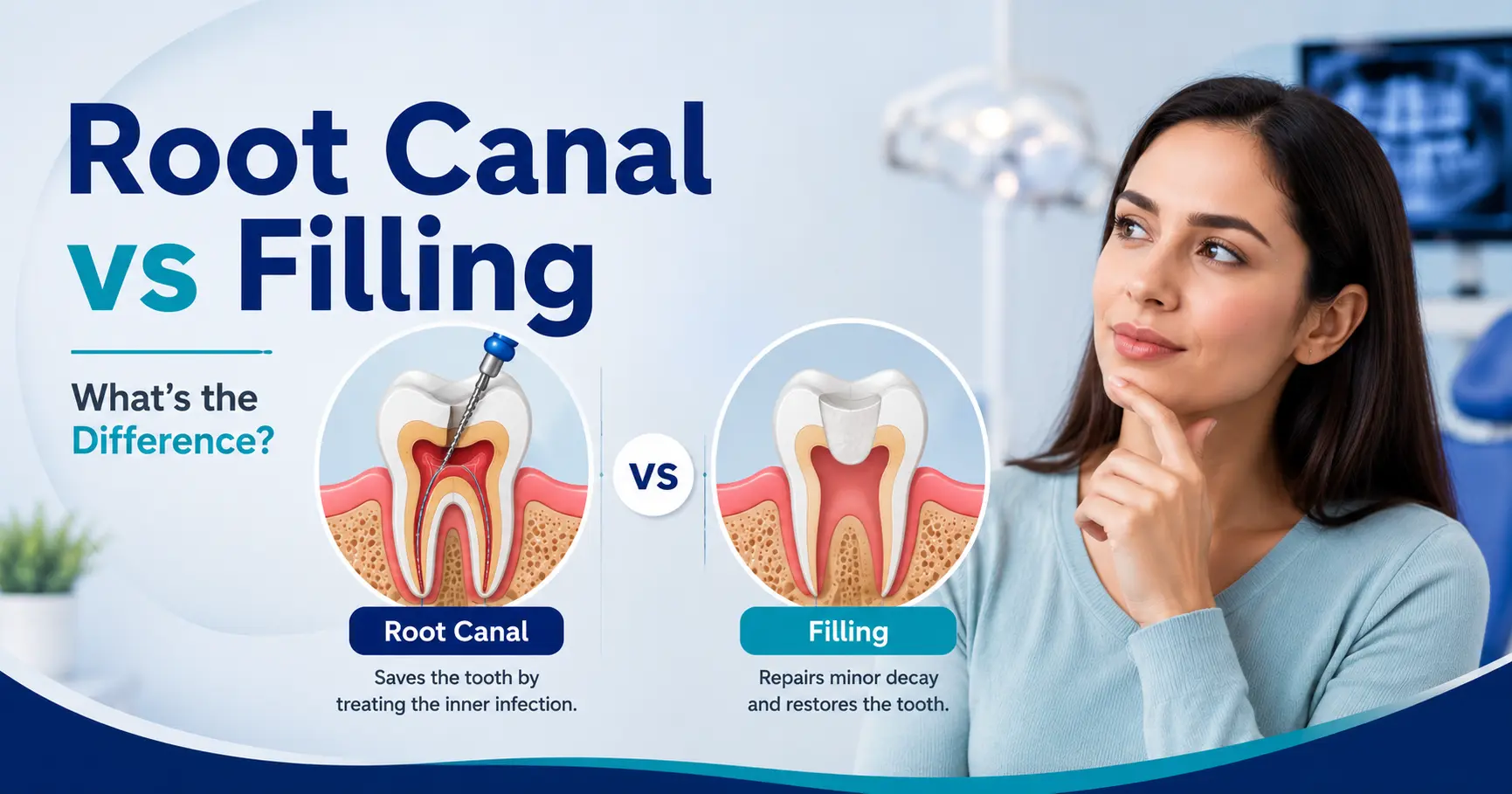
A tooth filling repairs damage confined to the outer layers of the tooth — typically a cavity caused by decay. A root canal is needed when decay, infection, or trauma has penetrated deep into the tooth’s pulp — the soft inner tissue containing nerves and blood vessels. The extent of tooth damage is what determines which treatment is appropriate.
What Is a Tooth Filling?
A tooth filling is a restorative dental procedure that repairs a cavity or minor tooth damage. When decay removes a portion of your enamel or dentine, a filling material is placed to restore the tooth’s shape, function, and strength.
Fillings are the most frequently performed dental restoration in general dentistry. They are completed in a single appointment, require local anaesthesia, and typically cause minimal post-procedure discomfort.
When Is a Filling Recommended?
Your dentist will recommend a filling when:
- Decay is limited to the enamel (outer layer) or dentine (middle layer)
- The pulp remains healthy and unaffected
- There is no sign of abscess, severe pain, or prolonged sensitivity to temperature
- The cavity is caught early through routine X-rays or clinical examination
This is precisely why regular dental check-ups matter — cavities identified early almost always need just a filling.
Types of Fillings Used in Dentistry
| Filling Type | Material | Appearance | Best For |
| Composite Resin | Tooth-coloured plastic/glass | Matches natural tooth | Front and back teeth; aesthetics priority |
| Glass Ionomer | Tooth-coloured, fluoride-releasing | Semi-translucent | Near gum line; children’s teeth |
| Amalgam (Silver) | Metal alloy | Silver/grey | Back molars (less commonly used now) |
At City Smiles Dental Care, composite resin fillings are the most commonly used option — they are bonded to the tooth structure, aesthetically natural, and free from metal.
What Is a Root Canal Treatment?
A root canal treatment (RCT) is a procedure that removes infected, inflamed, or damaged pulp tissue from inside the tooth. Once the pulp is cleaned and shaped, the canals are sealed to prevent reinfection, and the tooth is restored — usually with a dental crown.
Root canals are often misunderstood as painful procedures. In reality, a root canal relieves the severe pain caused by pulp infection — it does not cause it. With proper anaesthesia, the procedure itself is comparable in discomfort to having a tooth filled.
When Is a Root Canal Necessary?
A root canal becomes necessary when:
- Decay has penetrated through the enamel and dentine into the pulp
- There is a dental abscess (a pocket of infection at the root)
- The tooth has suffered trauma — a crack or fracture that exposed the pulp
- The patient experiences prolonged, spontaneous pain, severe sensitivity to heat, or pain when biting
- A tooth that previously had a filling has developed secondary decay reaching the pulp
Ignoring these signs does not cause the problem to resolve on its own. Untreated pulp infection spreads — and the eventual outcome is either extraction or emergency treatment.
What Happens During a Root Canal?
- Examination and X-ray — The dentist confirms pulp involvement through digital X-rays and clinical assessment
- Local anaesthesia — The tooth and surrounding area are numbed completely
- Access opening — A small opening is made through the crown of the tooth
- Pulp removal — Infected or inflamed pulp tissue is carefully removed using fine instruments
- Canal shaping and cleaning — The canals are shaped and disinfected
- Sealing — Canals are filled with a biocompatible material (gutta-percha) and sealed
- Restoration — A dental crown is placed to restore strength and function
Most root canals are completed in one to two appointments depending on the severity of infection.
Root Canal vs Filling: A Side-by-Side Comparison
| Factor | Tooth Filling | Root Canal Treatment |
| Purpose | Repair cavities / minor decay | Remove infected or inflamed pulp |
| Depth of damage | Enamel and dentine only | Pulp (nerve and blood vessels) |
| Procedure length | 30–60 minutes | 60–120 minutes (1–2 visits) |
| Anaesthesia | Local anaesthesia | Local anaesthesia |
| Pain during procedure | Minimal | Minimal (comparable to a filling) |
| Post-procedure sensitivity | Mild, resolves within days | Mild soreness, resolves within a week |
| Restoration needed | Filling itself restores the tooth | Crown typically required after RCT |
| Longevity | 5–15 years (material-dependent) | 10–15+ years with proper care |
| Cost | Lower | Higher (procedure + crown) |
| Urgency | Moderate | High — delay worsens infection |
Cavity vs Pulp Infection: How the Dentist Decides
This is the central question: how does your dentist determine whether you have a simple cavity or a pulp infection?
The decision is based on clinical examination and diagnostic tests — not symptom severity alone. Pain is not always the deciding factor; some deeply infected teeth cause minimal pain, while some shallow cavities can cause significant sensitivity.
Diagnostic tools your dentist uses:
- Digital X-rays — Reveal the depth of decay and any infection at the root tip
- Thermal sensitivity testing — A sharp, lingering response to cold or heat suggests pulp involvement
- Percussion test — Pain when tapping the tooth indicates periapical infection
- Visual examination — Cracks, large existing restorations, or signs of abscess
If decay is confined to the enamel and dentine, a filling is appropriate. If decay has reached the pulp or there is confirmed infection, a root canal is necessary to save the tooth.
Can a Filling Become a Root Canal?
Yes — and this is more common than most patients realise. Several situations can cause a tooth that once received a filling to eventually require root canal treatment:
- Secondary decay — New decay develops under or around an existing filling, eventually reaching the pulp
- Cracked tooth — A crack in a filled tooth exposes the pulp to bacteria
- Deep original decay — A cavity that was very close to the pulp at the time of filling may cause progressive pulp inflammation over months or years
- Repeated dental work — Multiple fillings in the same tooth gradually reduce its structural integrity and irritate the pulp
This progression is not a failure of the original filling — it is simply the natural history of deep decay in some teeth. Early detection through regular dental check-ups at a clinic like City Smiles Dental Care in South Kolkata helps catch these situations before they escalate.
Myths vs Facts: What Patients Get Wrong
| Myth | Fact |
| Root canals are extremely painful | Modern anaesthesia makes root canals as comfortable as a filling. The pain is from the infection, not the procedure. |
| If you have no pain, you don’t need a root canal | Chronic pulp death can be painless. Infection visible on X-ray requires treatment regardless of symptoms. |
| It’s better to extract the tooth than have a root canal | Keeping a natural tooth is almost always the better long-term option. Extraction creates its own complications. |
| A filling can treat any cavity | No. If decay reaches the pulp, a filling alone is insufficient and will fail. |
| Root canals cause illness | This claim has no scientific basis. Root canal treatment is safe and well-evidenced. |
| After a root canal, the tooth is fully restored | A root canal removes the infection, but a crown is usually required to protect and restore the tooth fully. |
What to Expect at City Smiles Dental Care
At City Smiles Dental Care in South Kolkata, no treatment recommendation is made without a proper clinical examination. Whether you arrive with tooth pain, sensitivity, or simply for a routine check-up, the dentist will:
- Take a full dental history
- Perform a clinical examination
- Recommend X-rays where required
- Explain exactly what is happening inside the tooth
- Discuss all treatment options, including the expected timeline, steps, and costs
Patients from Garia, Baghajatin, Jadavpur, Tollygunge, Santoshpur, and Dhakuria regularly visit City Smiles for both routine fillings and more complex restorative treatments including root canal therapy.
You will never be recommended a root canal when a filling is sufficient — and you will never be offered only a filling when a root canal is what your tooth actually needs.
FAQs — Root Canal vs Filling
Q1. How do I know if I need a root canal or a filling? Only a dentist can confirm this after clinical examination and X-rays. General indicators: if decay is caught early and causes mild sensitivity, a filling is likely sufficient. If you have severe or spontaneous pain, prolonged sensitivity to heat, or swelling near the tooth, pulp involvement is more likely and a root canal may be necessary.
Q2. Is a root canal more painful than a filling? No. Both procedures are performed under local anaesthesia. The pain patients associate with root canals is caused by the infection — not the procedure itself. Once the area is numbed, patients typically feel pressure and movement but not sharp pain.
Q3. Can a dentist do a filling instead of a root canal to save money? No responsible dentist would do this. If pulp infection is present, placing a filling over it traps the infection inside the tooth, worsens the situation, and accelerates bone loss. A filling cannot treat infected pulp tissue.
Q4. How long does a tooth filling last? Composite resin fillings typically last 7–10 years with good oral hygiene. Longevity depends on the size of the cavity, the material used, and how well the tooth is maintained. Regular dental check-ups help detect failing fillings before they cause further damage.
Q5. How long does a root canal last? A root canal-treated tooth restored with a crown can last 10–15 years or longer. Success depends on the quality of the root canal procedure, the restoration placed afterward, and the patient’s oral hygiene habits.
Q6. Do I always need a crown after a root canal? In most cases, yes — particularly for back teeth (molars and premolars) that bear chewing forces. Front teeth that have not lost significant structure may sometimes be restored with a filling, but a crown is strongly recommended for most root canal-treated teeth.
Q7. What happens if I delay treatment — filling or root canal? Delayed filling: decay progresses deeper, eventually reaching the pulp, converting a simple filling case into a root canal case. Delayed root canal: infection spreads to surrounding bone and tissue, potentially leading to abscess, severe pain, or tooth loss requiring extraction.
Q8. Can a root canal-treated tooth get a cavity? Yes. A root canal removes the nerve but does not make the tooth immune to external decay. The crown of the tooth can still develop new cavities if oral hygiene is poor. Regular brushing, flossing, and dental check-ups remain essential.
Q9. Is composite resin better than amalgam for fillings? Composite resin bonds to tooth structure, requires less removal of healthy tooth material, and is aesthetically natural. Amalgam fillings are extremely durable but contain mercury compounds and are increasingly being replaced by tooth-coloured alternatives in modern dental practice.
Q10. How do I book an appointment at City Smiles Dental Care? You can book an appointment online at citysmilesdentalcare.com/appointment or find the clinic on Google Maps. The clinic serves patients across South Kolkata, including Garia, Baghajatin, Jadavpur, and Tollygunge.
Conclusion
The choice between a root canal and a filling is not a matter of patient preference — it is a clinical decision based on how far tooth damage has progressed. A tooth filling is appropriate when decay is confined to the outer tooth layers. A root canal becomes necessary when infection or inflammation has reached the pulp.
Understanding the root canal vs filling distinction removes the fear and confusion that often delays necessary treatment. That delay is far more harmful than either procedure itself. Whether your tooth needs a simple composite filling or a full root canal treatment, the outcome of early, accurate treatment is always better than waiting.
Ready to Find Out What Your Tooth Needs?
If you have a toothache, sensitivity, or a cavity you have been putting off, do not wait for it to worsen. The team at City Smiles Dental Care in South Kolkata will examine your tooth properly, explain exactly what is happening, and recommend only the treatment you genuinely need — nothing more.
Book Your Appointment Online →
Or find us on Google: City Smiles Dental Care — Google Business Profile
We welcome patients from Garia, Baghajatin, Jadavpur, Tollygunge, Santoshpur, Dhakuria, and all neighbouring areas of South Kolkata.